Used Hyundai Tucson (Mk3, 2015-2020) review and buyer's guide
A full used buyer’s guide on the Hyundai Tucson covering the Tucson Mk3 that was on sale between 2015 and 2020

Verdict
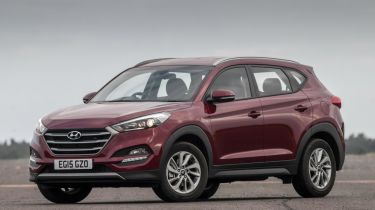
It’s easy to see why the Hyundai Tucson Mk3 was one of the brand's best-selling cars in the UK and across Europe. It looks smart and is well equipped, comes with a decent range of engines and transmissions, and is widely available second-hand. We’d avoid the underpowered entry-level 1.6 petrol, but the diesels and turbocharged petrol engine are more accomplished. If you’re buying to tow, seek out a four-wheel-drive model and find something with plenty of toys; high-spec Tucsons are common. Just check everything works; while reliability isn’t a huge issue, it can be more of a problem on the Hyundai than you might expect.
When Hyundai arrived in the UK in 1982 with the Pony, it was easy to make jokes about how lame the product was. But for those on a budget wanting no-nonsense transport, it was just the job.
The company’s first SUV (the 2001 Santa Fe) was just as uninspiring, but again, the car gained a following with buyers who put value ahead of image.
That was still true to an extent with the original Tucson. However, by the time the third-generation car appeared in 2015, customers could have it all: top value, sharp looks, decent engines, the latest hi-tech kit and a good drive, too.
History
The Mk3 Tucson replaced the ix35 in September 2015. Buyers could choose naturally aspirated or turbocharged 1.6-litre petrol engines, along with 1.7 or 2.0-litre diesel powerplants.
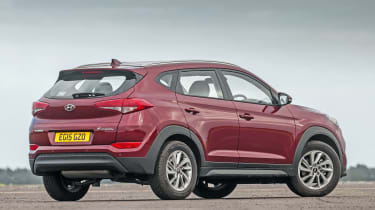
While the 1.7 came in only 115bhp manual front-wheel-drive form, the 2.0 was offered with 135bhp or 175bhp and in front or four-wheel drive with manual or automatic transmissions.
Used - available now

2023 Hyundai
Tucson
17,696 milesAutomaticPetrol1.6L
Cash £22,256
2023 Hyundai
Tucson
56,228 milesManualPetrol1.6L
Cash £14,511
2023 Hyundai
Tucson
51,893 milesAutomaticPetrol1.6L
Cash £19,116
2023 Hyundai
Tucson
30,971 milesManualPetrol1.6L
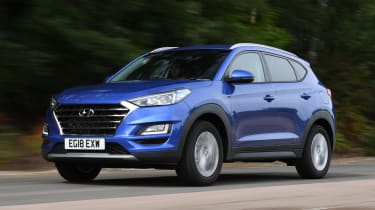
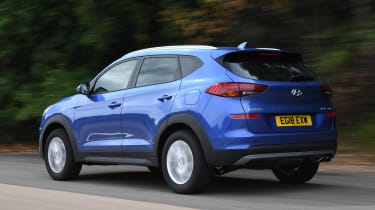
Cash £18,132From March 2016, the 1.7 CRDi got a dual-clutch auto option, while a facelift earlier this year means updated Tucsons are now in dealers. These have a new dash, a revised nose and tail, fresh alloy wheel designs, improved infotainment and extra driver assistance systems. A 1.6 CRDi engine replaces the 1.7 CRDi and a mild hybrid also joins the range.
Which one should I buy?
All Tucsons are well equipped. Even the entry-level S has 16-inch alloys, air-con, electric windows front and rear, DAB and a multifunction steering wheel.
Move up to the SE and you get 17-inch wheels, climate control, electrically adjusted, heated and folding door mirrors, as well as heated front seats, cruise control and rear parking sensors.
SE Nav spec brings an eight-inch touchscreen display with navigation. The Premium also features heated rear seats, AEB, 19-inch wheels (17 inches on the 1.7 CRDi BlueDrive manual), electric front seat adjustment, front parking sensors and leather seat facings. The Premium SE adds LED headlights, a panoramic roof, self-parking and a powered tailgate.
Alternatives to the Hyundai Tucson Mk3
The Tucson’s closest rival is the Kia Sportage, which is identical under the skin; the cars use the same platform and running gear. The Kia gets an even longer warranty than Hyundai’s five-year deal; at seven years, it’s an industry benchmark.
Another tough adversary is the Nissan Qashqai, which is practical but not necessarily as reliable as you’d expect. More impressive is the Peugeot 3008, which looks smart inside and out, and offers good value on the used market. The same goes for the Ford Kuga.
The Renault Kadjar is another stylish alternative, and it’s mechanically related to the Qashqai. Don’t overlook the Honda CR-V, either, or the Mazda CX-5.
What to look for
Clutches
Manual diesel Tucsons can suffer from clutch judder; a redesigned clutch is available.
Hill descent
All cars have Hill Descent Control, providing extra security in very slippery conditions.
Towing
Trailer Stability Assist is standard on all models, meaning the Tucson is an accomplished tow car.
Spare
Entry-level Tucsons feature a mobility kit; SE cars up (with the exception of 1.6 GDi BlueDrive models) get a full-size spare.
Interior
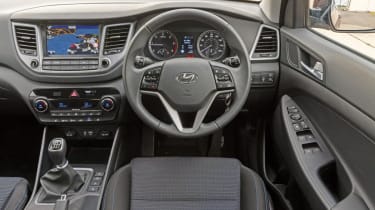
The Tucson’s well-made, well-equipped and spacious cabin is a great place to spend time – especially in high-spec cars with heated seats and leather trim. The infotainment system is intuitive and there’s plenty of legroom in the rear. In addition, the boot is reasonably spacious; it’ll stow 513 litres or 1,503 litres when the seats are folded.
Running costs
A service is needed every two years or 20,000 miles on most Tucsons, but the 1.6 T-GDi has a 12-month/10,000-mile cap.
Services include fresh brake fluid every other year and new coolant every 60,000 miles. All the engines are chain-driven, with no cambelts to replace.
Recalls
The Mk3 Tucson has been recalled only once, in July 2016. This affected 14,775 cars built up to 15 March 2016. The problem centred on the bonnet safety catch which could fail, allowing the panel to fly up at speed. It didn’t help that the warning light to flag up the fault also wasn’t working properly, so this had to be fixed, too.
Driver Power owner satisfaction
The Tucson finished a strong 23rd in the 2018 Driver Power satisfaction survey. Owners told us they love its practicality, safety features and infotainment systems, along with the comfortable cabin. The lowest score was 51st for running costs, with the engine and gearbox also coming in for criticism.
Hyundai Tucson (2015-2020) review: What we said
Extracts from our 2020 review of the Hyundai Tuscon Mk3...
The Hyundai Tucson revived an old name, but everything about this Korean-built family crossover is fully up-to-date. It faces some very stiff opposition in the shape of cars such as the Peugeot 3008, Kia Sportage and SEAT Ateca, but the Hyundai Tucson competes well on most levels.
It looks good thanks to a design that has been inspired by the larger Santa Fe, but inside it is a little bland and uninviting, especially when compared to the modern-looking Peugeot.
The Tucson is pretty spacious and beats some of its competitors when it comes to practicality and boot space. It comes with a generous amount of standard kit, too. Go for one of the diesel options and you’ll have yourself a well priced, well specced and spacious family transport.
The Hyundai Tucson isn’t short of rivals in a highly competitive class, but if you're looking for a family car with good passenger room and boot space, it's definitely worthy of consideration. As the mid-size model in the Hyundai SUV range, the Tucson slots between the smaller Kona and seven seat Santa Fe. The current third-generation model arrived in 2015 and the range was treated to an update in 2018.
In this fiercely competitive class, the Tucson goes up against the Peugeot 3008, Skoda Karoq and SEAT Ateca – all of which we rate highly. But there are far more rivals than this to consider. The Kia Sportage is mechanically similar to the Tucson, while the Nissan Qashqai and Renault Kadjar – which are also closely related – are two other cars worth considering. The Mazda CX-5, Toyota RAV4, Honda CR-V, Volkswagen Tiguan, Vauxhall Grandland X and Ford Kuga are all vying for attention too.
The Tucson offers good space inside, both for passengers and luggage, while most specifications are generously equipped. Power comes from a wide range of petrol and diesel engines, while two and four-wheel drive is offered.
That Tucson engine range comprises a 1.6-litre petrol and turbocharged 1.6-litre petrol, while diesel power is handled by two different 1.6-litre units and, further up the trim level table, a 2.0-litre, all of which come with mild hybrid assistance. Power outputs across the engine line-up range from 114bhp to 182bhp, and all models bar the 2.0-litre diesel hybrid are front-wheel drive.
You get a six-speed manual gearbox with the 1.6 GDi petrol and 1.6 T-GDi, while the latter has the option of a seven-speed DCT auto. The least powerful diesel also gets a six-speed manual, while the more powerful 1.6 CRDi is available with a manual or auto. The 2.0-litre mild hybrid is only available with an automatic gearbox.
Not all engines come with every trim level, but there is a broad enough spread to cater for most needs. The entry point to the range is S Connect, which is only offered with the 1.6 GDi petrol engine. Despite its bottom-rung status. S Connect features 16-inch alloys, a seven-inch touchscreen with Android Auto and Apple CarPlay, Bluetooth, DAB Radio and USB connections, auto lights and dual-zone climate control.
Hyundai doesn't offer much in the way of options, so instead you need to move up a trim grade to get more kit. SE Nav adds (as the name suggests) route guidance on an eight-inch touchscreen, plus 17-inch wheels and auto wipers, while Premium cars have luxuries such as a premium stereo, wireless phone charging and an electric parking brake. Premium SE is fully equipped with a heated steering wheel, 360-degree parking cameras, LED headlights and 19-inch wheels. It's also the only model to get adaptive cruise control.
2019 saw the addition of the sporty N Line trim. This model sits roughly between SE Nav and Premium in terms of kit, and adds a new bumper design inspired by the i30 N hot hatchback, plus 19-inch wheels finished in black, a matching roof, door mirrors and a larger rear spoiler. Inside, the black leather and Alcantara trim is lifted with red highlights. It’s available with the 48-volt mild-hybrid 1.6-litre diesel and the 1.6-litre turbocharged petrol; both get tweaked braking and steering calibration, while the latter gains a firmer suspension setup to sharpen up the handling. Pricing is similar to that of the SE Nav trim.
Engines, performance and drive
The Tucson was redesigned from the ground up, rather than being a development of the ix35 which it replaced, while updates to the range in 2018 and 2019 introduced new and more efficient engines to the range, including the 48-volt mild-hybrid versions. In terms of ride comfort, the Tucson is a step up from its predecessor and offers supple suspension that can easily deal with potholes and nasty road imperfections.
It’s quiet, too – even in the most powerful 2.0-litre diesel 4WD model, engine noise rarely enters the cabin and it’s a hushed place to be when cruising on the motorway. Despite the soft suspension, body roll is fairly well contained – there’s no unpleasant leaning through fast corners.
With the exception of the eight-speed unit in the top-end 2.0-litre diesel, the remaining automatic gearboxes are all dual-clutch transmissions. The eight-speed auto is smooth and relaxing, but the dual-clutch unit isn’t the best of the breed: it’s easily confused and can be quite laggy – especially when moving off. Unless you really need an automatic, we’d save £1,250 and get the six-speed manual instead.
For most people, the Tucson will be more than adequate to drive, but for those who like their SUVs to be especially sporty behind the wheel the Tucson falls short – the SEAT Ateca and Mazda CX-5, for example, are far more pleasurable and exciting to drive. However, go for the sportier petrol N Line, and thanks to its firmer suspension and revised steering and braking systems, it manages to stay fairly well controlled on a twisty road. Best of all, it doesn’t really come at the expense of ride comfort.
In fast bends, the Tucson’s steering doesn’t give you much feedback on what the front wheels are doing – but not much in this class does. It is accurate, though, and on SE models or higher the Flex Steer system increases steering weight at speed.
Engines
Diesel engines are generally best in a car of this type, although petrol power is gaining ground. The 1.6 CRDi diesel gained mild hybrid assistance with the 2019 update, and it's even more fuel efficient than the older 1.7 CRDi. It’s not the most powerful engine in the range with 114bhp or 134bhp to choose from, but it’s up to the job and delivers adequate performance for a family of five.
The mild hybrid system recoups energy under braking that’s stored in a 0.44kWh battery. It can then deploy this power under acceleration, taking as much as 16bhp of load off the combustion unit to save fuel. The set-up is also used to run many of the car’s ancillary electrical systems, which reduces the load a conventional alternator would usually place on the engine, which in turn helps to improve overall efficiency.
The punchy 182bhp 2.0-litre CRDi diesel uses a similar 48-volt electrical system which, as in the 1.6, helps to save fuel by cutting the engine more frequently than a conventional stop-start system. This boosts acceleration, too, and a 9.5-second 0-62mph time is pretty quick for an SUV like this. Maximum speed for models with this engine is 125mph.
If petrol engines are the choice for you, Hyundai has two 1.6-litre options, including a non-turbo that needs plenty of revs to make any progress, the result of which is poor fuel economy and a less relaxed drive. The 1.6 T-GDi, meanwhile, has 175bhp to deliver sprightly performance, and is a much more viable option. It has 265Nm of torque, so while mid-range punch isn't quite up to diesel standards, it's still reasonable, and has a rapid 0-62mph time of 8.9 seconds for the DCT-equipped model. Like the 2.0-litre CRDi, top speed for this engine is 125mph.
MPG, CO2 and running costs
Prices for the Tucson range start at around £22,000 and rise to around £35,000, but at least they don't break the £40,000 mark, so all models cost £140 a year in road tax. And you won't deviate very far from the list prices by adding options, because the only option offered is metallic paint at around £650.
The Tucson engine range is designed to offer competitive running costs, and the 2018 update saw the older 1.7 CRDi diesel replaced by a smaller 1.6 CRDi that offers the same performance but with improved efficiency. However, it's not possible to compare these engines like-for-like, because the new engines have been tested to WLTP legislation, which offers poorer economy results in test conditions, but produces results that are more likely to be achievable in the real world.
The introduction of the mild hybrid systems has improved efficiency in the 1.6 diesel models. The 134bhp engine achieves 48.7mpg (manual) and 52.3mpg (auto) on the WLTP test cycle, with CO2 emissions of 151g/km and 141g/km, respectively.
At the top of the range, the 2.0 CRDi has claimed economy of 42.8mpg, although the way the mild-hybrid system works means it doesn't do much to boost the engine's WLTP test economy. Emissions are rated at 172g/km.
All diesel Hyundai Tucsons use AdBlue to help reduce emissions, and there's a 14-litre AdBlue tank that will need topping up on occasion as and when the Tucson's trip computer lets you know it needs doing.
Petrol models have fuel economy ranging from 34.9mpg to 37.2mpg, and surprisingly the engine that's the most efficient is the more powerful 175bhp 1.6 T-GDi with the seven-speed DCT auto. This means it also has the best emissions, at 173g/km.
Interior, design and technology
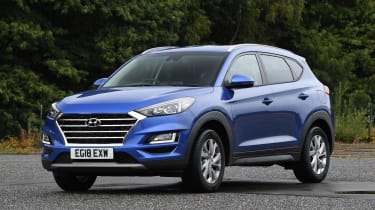
Hyundai styled the Tucson to look like the last-generation Santa Fe, so compared to the all-new version of that model (and the radical looking Kona) the mid-range Hyundai SUV looks a little conservative. This is particularly evident at the front, where the Tucson has a chrome bar grille that links up to headlights that sweep back onto the front wings.
Squared off wheel arches and a Z-shaped shoulder crease down the car’s flanks are designed to give the impression the Tucson is moving while it’s stationary. The rounded rear end is smart, while the rear light clusters have a similar look to some of Hyundai’s other models, such as the i20 supermini. The overall look is a far cry from the bulbous ix35 the Tucson replaced.
The N Line features its own sporty styling upgrades. The front gets i30 N Line-inspired ‘shark tooth’ elements flanking each edge of the front bumper. A honeycomb grille comes with a smoked metallic surround instead of the usual chrome, and there are a set of LED daytime running lights in a boomerang shape. The changes are rounded off with contrasting black finishes for the door mirrors, roof, rear spoiler (larger than on other Tucsons) and 19-inch wheels.
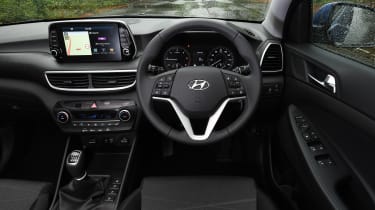
Easy to read dials, the extensive use of squidgy soft-touch plastics and a first-rate infotainment system are particular highlights, but despite these gains in quality, the interior has an air of blandness – the Nissan Qashqai and Renault Kadjar have dashboards that are more interesting to look at.
Sat-nav, stereo and infotainment
The cabin isn't very visually appealing, but the layout and design are functional. The dash is simple, but you can see where everything is so you don’t have to go poking around trying to work out how to adjust the air con or find your favourite radio station.
The touchscreen infotainment system is very bright and easy to navigate thanks to simple, ogical menus. However, it’s not quite as sharp as some rival systems graphically, and the screen, which isn’t able to recognise pinch and swiping motions on the mapping screen, can be slow to respond to touches.
Equipment levels are strong though: all Tucsons come with DAB radio, Bluetooth and air conditioning, while SE Nav models benefit from rear parking sensors, heated front seats and climate control. All cars get a touchscreen with Apple CarPlay and Android Auto as standard, while navigation is fitted to SE Nav models and above.
Practicality, comfort and boot space
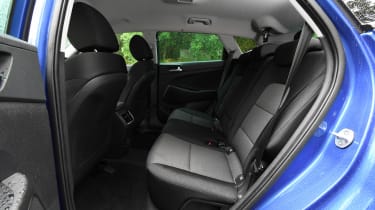
Four six-footers won’t have any trouble getting comfortable in the Tucson, thanks to a roomy cabin that’s near the top of the class space-wise. Room in the boot is competitive as well; with the back seats in place, there’s 513 litres on offer.
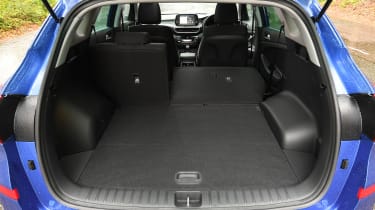
This swells to 1,503 litres with the seats folded, which is comfortably larger than the Kadjar’s 472 and 1,478 litres. However, it’s just a shame that the rear seat backs don’t lie flat when folded, robbing the Tucson of a few extra litres of space.
Even with the Tucson’s sloping roof, there’s plenty of headroom, and all the doors open wide allowing easy access. But that sloping roof and thick rear roof pillars do have impact on rear visibility – parking sensors are a must.
Size
The Tucson is both longer and wider than its closest rival, the Nissan Qashqai, a car which isn’t exactly short on space inside.
The larger body naturally makes for more space inside than some of the Tucson's most competitive rivals, so you certainly won't feel claustrophobic when you're behind the wheel.
Leg room, head room and passenger space
Whether you're transporting three children or three adults, there’ll be no complaints about a lack of space in the Tucson. Even behind a long-legged driver, there’s still enough space for another adult, while the shallow transmission tunnel means there’s also a good amount of legroom for those in the rear, too. However, the centre rear seat isn’t the best in the class: it’s quite narrow and firm, meaning that the Tucson isn’t the most comfortable family crossover with three passengers in the back.
Boot
The 513-litre boot in the Tucson is 83 litres larger than the Qashqai’s capacity, while with the rear seats folded flat space increases to 1,503 litres. However, these capacities are for the petrol models. Go for a diesel, and the need to fit an AdBlue tank means boot space decreases to 484 litres and 1,474 litres respectively.
If you go for the Tucson 4x4, load capacity is affected again to accommodate the additional drive and the 48-volt hybrid system beneath the rear seats. Boot space decreases to 459 litres with all five seats in place and 1,449 litres with the rear seats folded. All cars have a space-saver spare wheel under the boot floor except for the 2.0 CRDi Mild Hybrid, which has a tyre repair kit.
Did you know you can sell your car with Auto Express? Get the highest bid from our network of over 5,500 dealers and we'll do the rest. Click here to try Auto Express Sell My Car now...