New Hyundai Ioniq 3 prototype review: small EV is gunning for the Renault 5
First impressions of the Hyundai Ioniq 3 reveal a sweet handling and practical compact EV that hits the UK market in September, from £25,000

Verdict
Hyundai’s Ioniq 3 will be a compelling electric supermini when UK sales begin in September. Its handling is its strongest suit, with sharp turn-in and deliciously responsive steering, although performance is a bit underwhelming. With 441 litres of cargo capacity plus competitive rear seat space, the Ioniq 3 ticks rational boxes too. We can’t wait to drive it more.
The Hyundai Ioniq 3’s sloping nose swings right, then left, carving precisely through the cones at around 40mph. With no slop and a sweet weighting, the steering controls the front end like a puppet master making a marionette dance. This very first prototype drive reveals responses way sharper than your average supermini’s.
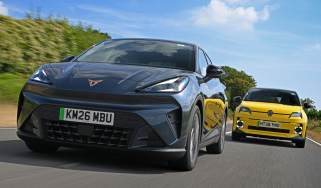
Yet that’s exactly what the Ioniq 3 is: a £25,000 electric hatchback, set to compete for your affections against the retromodernist Renault 5, sporty Cupra Raval or classical Volkswagen ID.Polo. People looking for the best electric car finally have a host of compact contenders grouped around the Ioniq 3’s 4.17m-long size.
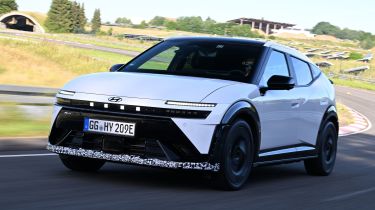
Auto Express is in Germany at the Pferdsfeld former air force base, to become one of the first three people outside Hyundai to test a prototype Ioniq 3. This one wears the sportier N-Line trim, whose muscular bodykit includes a ventilated front bumper, protruding rear wing and a low-set diffuser, race car details making performance promises this Ioniq 3 can’t match. The alloy wheels, shod in Hankook rubber, grow from the base car’s 18-inches to 19s.
Hyundai Ioniq 3: battery, power and range specs
The Hyundai comes with two batteries, 42.2kWh in the standard range model, or the long range’s 61kWh. Curiously, the smaller battery gets a bigger output motor – sending 145bhp to the front wheels – while the heavier car makes 133bhp.
Used - available now

2024 Volvo
XC40
15,181 milesAutomaticPetrol1.5L
Cash £23,680
2026 Audi
Q2
23,561 milesAutomaticPetrol1.5L
Cash £19,840
2024 BMW
3 Series
91,947 milesAutomaticPetrol2.0L
Cash £18,500
2023 Polestar
2
54,595 milesAutomaticElectric
Cash £18,680What you lose in power, you gain in range: the 42.2kWh stack promises to travel up to 214 miles on the WLTP test cycle, while the 61kWh breaks the psychologically important 300-mile barrier with eight miles to spare. That’s 25 miles more than the leggiest ID.Polo.
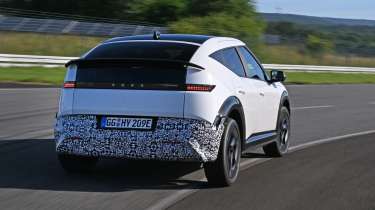
Hyundai says the Ioniq 3 is set up to efficiently and nimbly carve through the urban jungle, which is why scores of cones lay out a mostly 20-40mph handling circuit, with a mocked-up roundabout and stop/go section of simulated traffic lights.
We hit the start button between the small, silky-feeling steering wheel and the 14.6-inch central touchscreen, running Hyundai’s new ‘Pleos Connect’ operating system. It’s reminiscent of a Tesla’s, with the speedo top left, a ‘car’ section to display regenerative braking or driver assistance info and the remaining two-thirds dedicated to displaying the navigation map or infotainment. Key information – like speed – is replicated in a high-set digital display above the wheel.
Does the Hyundai Ioniq 3 feel fast?
Pull the column-mounted stalk downwards to select drive, press the accelerator and the Ioniq 3 hustles forward to a charming e-motor whine. Snappy pick-up off the line is an electric car staple, and with 250Nm of instant torque spinning the front wheels the Hyundai feels well equipped to swim in and out of shoals of urban traffic.
There’s one section that’s mercifully cone free, and we pin the throttle to gradually climb from 50 to 70mph: mid-range acceleration feels far from relentless. The 61kWh N-Line’s zero to 62mph run takes a measured 9.6 seconds, admittedly a couple of tenths faster than the almost-identically powered ID.Polo Life model.
The problem for Hyundai is that VW – and Cupra with the Raval – offer two higher performance options, with the flagship 223bhp GTI mashing 0-62mph in 6.9 seconds. Bosses say the new i20 N hybrid hot hatch is a bigger priority than an Ioniq 3 N, but we reckon Hyundai shouldn’t wait too long to pep up its baby EV. Especially when the N-Line looks so racy.
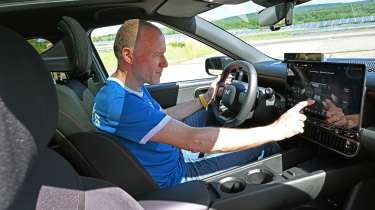
The driver’s seat feels a touch high – often an EV bugbear due to underfloor batteries perching your hips higher – and in faster corners, the Ioniq 3 rolls in a controlled and progressive way. Trying to gauge the ride quality on two laps of a billiard table-smooth circuit is a fool’s errand, but Hyundai seems to have prioritised comfort over a lashed-down body.
Does the Ioniq 3 have customisable regenerative braking?
Hyundai was an early advocate of configurable regenerative braking, and true to form the Ioniq 3 has four settings – from coasting to sharp deceleration – operated by the wheel-mounted paddles.
In level zero, press the brake pedal and the top end feels a bit baggy before the friction brakes bite hard. We’re encouraged to put the 3 into i-pedal mode, where lifting off the accelerator slows the car, harvesting energy for the battery and minimising wear and tear on the pads.
Level 3 i-pedal mode feels spot on for this fast-flowing course, with a momentary lift shifting weight to the nose to jink through the cones. And approaching the faux-traffic lights, it’s fun attempting to lift at the ideal braking point to watch the car bring itself to a halt for the ‘junction’, all to the sound of a ghostly regenerative whistle.
The ‘lights’ make way for a faster section, braking into a sharp, higher speed corner: the Ioniq turns in crisply. Then it’s through the roundabout, with the steering feeling meaty despite our inputs being quick and effortless.
At the end of our few laps, the trip computer reads 9.6km (6.0 miles), with average efficiency of 2.82 miles per kWh. That’s not bad, considering our unsympathetic, stop-start driving – and the remorselessly hot weather baking the former NATO base.
Did you know you can sell your car through Auto Express? We’ll help you get a great price and find a great deal on a new car, too.
| Model: | Hyundai Ioniq 3 N-Line Long Range |
| Price: | £29,000 (est) |
| Powertrain: | 61kWh battery, 1 x electric motor |
| Transmission: | Single-speed automatic, front-wheel drive |
| Power/torque: | 133bhp/250Nm |
| 0-62mph: | 9.6 seconds |
| Top speed: | 106mph |
| Range: | 308 miles |
| Max charging: | 110kW (10-80% in 30 minutes) |
| Size (L/W/H): | 4,170/1,800/1,505mm |
| On sale: | September |