Five new Hyundais on the way: Kona, Bayon, Tucson, i20 and Ioniq 3 to reinvent brand’s range
New Tucson, i20 and Bayon – and Ioniq 3 EV – coming in an 18-month product onslaught

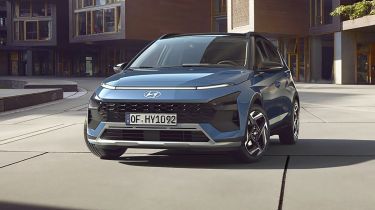
Hyundai is unleashing a “product offensive” that will renew its heartland cars, introduce an electric hatchback and facelift the Kona, as it floors the throttle following a “solid” European performance in 2025.
“We’ll be launching five major all-new models in the next 18 months,” Hyundai Europe CEO Xavier Martinet told Auto Express at the brand’s annual results conference in Frankfurt. “[We’re] talking about Ioniq 3, [new] i20, new Bayon, new Kona, new Tucson. These really are volume cars [that] will help us cover pretty well the European market in terms of bodystyle [and] powertrain. It’s an opportunity to grow.”
Hyundai Europe delivered a stable performance in 2025, with registrations just over the 600,000 mark, up one per cent. Crucially, fast-growing sales of hybrid and electric cars contributed 43 per cent of that volume, helping Hyundai with its “CO2 emissions management” to avoid regulatory fines, as well as delivering decent “sales and profits,” Martinet told us. “It’s a very solid foundation for [evolving] ourselves in the next few months and years.”
Evolution? It sounds more like a core model revolution – and here are the details.
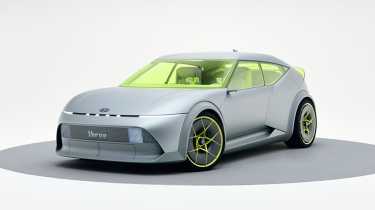
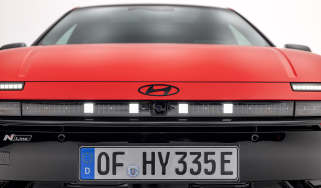
Summer 2026: Hyundai Ioniq 3
Martinet confirmed that the production version of the Concept Three – naturally called Ioniq 3 – will be unveiled at Milan Design Week in April 2026. The compact electric hatchback, set to rival the Volkswagen ID.3 and the EV4 from sister brand Kia, is being intentionally premiered at a design summit.
That’s because design is a key differentiator to drive an “emotional connection” with customers, says Martinet, helping elevate the Korean brand in a sea of Chinese EV imports. It’ll be backed by another key Hyundai pillar –technology – with an 800-volt architecture to unlock fast charging.
The Ioniq 3 is the first of three launches in the compact car ‘B-segment’, even though its 4.3m length places it closer to the C-segment Volkswagen Golf than the Polo. The 3 will offer superior cabin space thanks to a stretched wheelbase housing the batteries. And this interior package, along with the zero emissions drivetrain, create a very different proposition to the two other B cars, which replace the Bayon compact SUV and i20 hatchback.
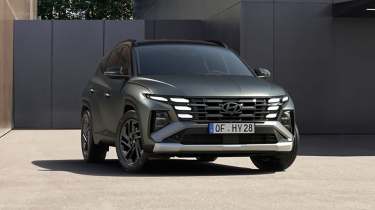
Autumn 2026: all-new Hyundai Tucson
The outgoing Tucson – Hyundai’s critical mid-size SUV – took the brand’s design to the next level in 2020, with a show-stopping face that blended the lights and grille and kickstarted a much-imitated design trend. But the logic behind the body’s criss-crossing lines confounded some rival designers – will the new SUV look similarly revolutionary, we asked Martinet?
“When others are talking about your cars, usually it’s a good sign,” retorted the boss. “When they don’t talk about your cars, they don’t know you exist.”
The new car has permission to stand out: Martinet says that chief designer SangYup Lee has a chess board in his office, with the different pieces reflecting the differing roles and capabilities of cars in the Hyundai portfolio.
“[The designers are] really trying to create this emotional connection, with every car fitting the purposes of the target audience, but still with this Hyundai sense of belonging.” So which piece on the chess board is the Tucson?
“I think the queen is the right one,” mused the European boss. “We have ICE, we have full-hybrid, we have plug-in hybrid. It's a car that’s sold in almost all markets. It’s a queen but [one that] looks masculine and bold.” And Hyundai has no margin for error with the new car – it accounted for 167,000 registrations or 30 per cent of European sales.
The Tucson is odds on to introduce an all-new hybrid powertrain. Expected to mate a 1.6-litre turbo engine with two motors – one acting as a starter-generator, the other to provide electric driveline power – it deploys front- and optional all-wheel drive, thanks to an additional electric rear axle. The hybrid system will be a mainstay of future Hyundais – including the new small cars.
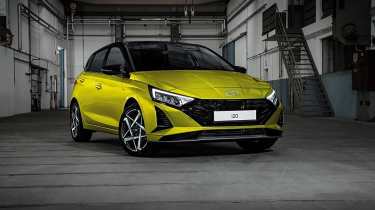
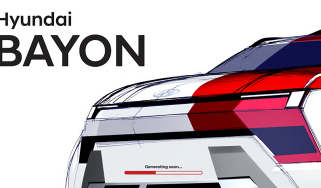
2027: Bayon and i20 continue B-segment takeover
Martinet pulls no punches on Hyundai’s B-segment performance: “we could be doing a better job. That’s why we have three models coming, which will offer ICE, hybrid and BEV powertrains.”
Martinet confirms the replacement for the i20 supermini will arrive in 2027, and will be built in the same Turkish factory as the Ioniq 3. The factory’s multi-powertrain approach is a deliberate hedge to ensure there’s a Hyundai for all customer types.
The i20 will provide a more traditional offer for customers not ready to go electric. It’ll be smaller, lighter and less spacious – and at a “more affordable price” than the Ioniq 3, said Martinet. Not that it will go light on technology: it will add to the 2-million connected Hyundais on European roads, and deploy the new hybrid powertrain. Baseline petrol/electric power is expected to start around the 100PS/99bhp mark – ideal for a B-segment supermini.
Today’s i20 shares its platform and engines with the Bayon SUV, and Hyundai is almost certain to continue with this strategy for the next generation. Martinet says Hyundai plans its cars around an 80:20 rule, trying to maximise platform commonality but leave sufficient headroom to tailor each car and add surprise and delight features for each customer group.
The fifth car in the new model push is the Kona compact SUV. The second generation only went into full production in 2023, so the revised version is unlikely before 2027.
UK becomes Hyundai’s top European market in 2025
More than 93,000 British people bought new Hyundais last year, with the UK edging out Germany to become the brand’s biggest European market for the first time. It was close run, with 234 registrations separating the two countries as Germany delivered 92,890 cars.
“We made great progress in the UK,” concluded Martinet. Some 58 per cent of UK Hyundais were electrified, a higher level than in Germany. Interestingly Hyundai UK’s electrified market share is 10 per cent above the market average, meaning there’s no threat of fines for failing to meet quotas for electric cars stipulated by the ZEV mandate.
Get the latest and best car news and reviews, first! Follow Auto Express on Google today