New Hyundai Ioniq 3: electric hatch spied again ahead of April reveal
Design cues from wild Concept Three will be retained for this production car
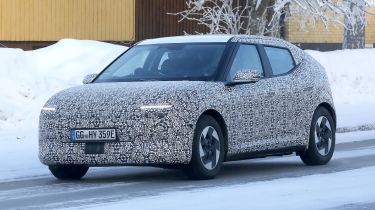
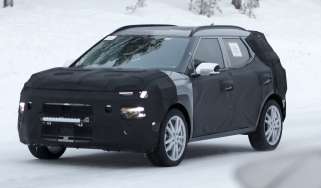
Hyundai is stepping into a new segment with the upcoming Ioniq 3 - which we’ve spied here ahead of its unveiling in April.
A rakish electric hatchback that’s set to take on the Kia EV3, Volkswagen ID.3 and Cupra Born, the Ioniq 3 sits between the Hyundai Inster city car and Kona Electric SUV in the brand’s EV line-up - though it’s the smallest Hyundai in the Ioniq range. The Ioniq 3 is likely to go on sale before the end of the year, and we expect it will be priced from around £28,000.
If you can't wait for the Ioniq 3 to arrive, why not check out our latest prices on the larger Ioniq 5? You can buy a new Hyundai Ioniq 5 for less than £35,000, or a used Ioniq 5 for just over £15,000 through the Auto Express Buy a Car service.
We thought that the Concept Three, which was revealed at the 2025 Munich Motor Show, gave us a good indication of the Ioniq 3’s design - and that’s backed up by these revealing spy shots taken during winter testing. Thanks to the minimal camouflage, it’s clear the overall proportions and some of the concept’s design cues will be carried over to the final car.
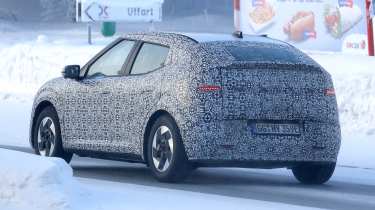
The low, rounded bonnet will be fronted by a set of pixelated LED headlights - a familiar feature on Hyundai’s Ioniq EVs. The windscreen is swept back, which not only helps provide a sleek profile, but will surely aid the Ioniq 3’s drag coefficient. The roofline slopes down towards the rear, while the window line rises to meet it, giving the Ioniq 3 a squat, purposeful stance. At the rear we can see more LED lights, not much overhang behind the rear wheels, and the Concept Three’s distinctive ducktail spoiler - albeit slightly toned down from the larger, see-through version used on the concept.
Hyundai has strongly hinted that a sporty Ioniq 3 N version is in the works and we expect it will be a closer reflection of the Concept Three, especially if the wide-bodied Ioniq 5 and Ioniq 6 N models are anything to go by. The new Kia EV3 GT’s dual-motor set-up will almost certainly underpin an Ioniq 3 N, with 288bhp and a sub six-second 0-62mph time.
How much range will the Hyundai Ioniq 3 offer?
Given that it uses a slightly simplified version of Hyundai’s E-GMP platform, we already have a good idea what to expect from the Ioniq 3. That’s because the Kia EV3 uses the same architecture, meaning the Ioniq 3 won’t have the complex and costly 800-volt electrical system that gives the Ioniq 5 its ultra-rapid charging capabilities, but should help make the smaller model more affordable.
If the Ioniq 3 uses the same 58.3kWh and 81.4kWh batteries as the EV3, entry-level models should deliver around 300 miles of range, while the higher-spec versions might be capable of close to 400 miles on a single charge. Expect the performance-focused Ioniq 3 N to sacrifice a bit of range in favour of power.
What did the Concept Three show us?
“We wanted Concept Three to have a very sporting stance with a clear silhouette defined by aero hatch profile and typical EV-specific proportions with the low front,” Eduardo Ramirez, Hyundai Design Europe chief designer, told Auto Express.
Although Hyundai gives each of its EVs their own character rather than following the same design language through from small to large cars, the pixel lighting theme that connects all three of those models is widely used on the Concept Three. The large pixel squares on the front, which look like a grille at first glance, are capable of showing the movement of the car’s animated companion, Mr Pix.
Meanwhile, the rear lighting is an evolution of the pixel-based displays on existing production cars, deploying parametric pixels that give the lightbar a 3D effect rather than the retro 2D lighting on the likes of the Ioniq 5.
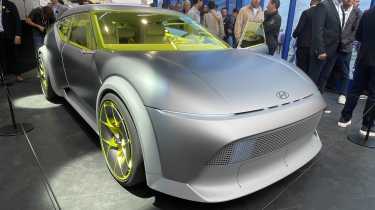
That front animation is one element that won’t make it through to production, although Simon Loasby, the head of the Hyundai Design Centre, said it’s not beyond possibility for production. “We can do it, but it’s about adding cost into the vehicle and would it move the car on in the eyes of the customer,” he told Auto Express. “But there is a fun factor to doing it. We get too serious sometimes, and it gives impact and is memorable.”
The front end also features active air flaps to cool the battery, and a narrow band of LED lights. The rear is adorned by what looks like a pair of central exhaust pipes that, on closer inspection, are actually speakers designed to "deliver an emotive experience through sound,” according to Ramirez.
“This is the first compact car under the Ioniq brand and it’s been a lot of fun developing it,” added Loasby. Playful elements across the car include frequent appearances of the Mr Pix character, and the wording ‘May the downforce be with you’ stamped onto the huge rear diffuser.
The diffuser is another element that will be stripped away when the production version, which has been designed in tandem with its more extravagant concept sibling, is revealed next spring.
“Obviously they had some liberty in designing the concept car, but the dimensions are very, very close to what you’ll have with the final vehicle,” Hyundai’s European boss Xavier Martinet told Auto Express. “The exterior is quite close, and the interior will be more traditional, although don’t expect it to be boring.”
At 4,288mm long, the Concept Three was larger than an ID.3, and just 52mm shorter than Hyundai's own i30 petrol hatchback. Meanwhile, the concept’s cabin is, according to its designers, supposed to represent a living room, with each item in the car reflecting an individual piece of furniture.
Get even more from Auto Express, follow our channels...