New Ferrari Luce interior revealed: Italian brand’s first EV goes wild and retro inside
The first Ferrari pure EV is set to be called Luce and will revolutionise its interiors thanks to input from Apple legend

Ferrari has revealed new details on its controversial, first fully electric model, including its official name and a brand new interior and technology suite. Called the Ferrari Luce (Italian for light), the model will take the brand into new territory in a raft of different ways when it’s unveiled in May.
Ferrari has already revealed details of the new model’s all-electric powertrain, and now, marking the next stage of the Luce’s stretched out reveal, the Italian firm is showing off its interior and new user interfaces. Created in collaboration with some of the world’s most prominent industrial designers, it offers something completely different to anything we’ve seen from the brand previously.
Interior design and technology by Apple (sort of)
It won’t surprise you to learn that as Ferrari embraces full electrification, it’s also entering a whole new era of interior design, plus introducing plenty of new technology. It’s an area where the brand has been criticised in the past, thanks to the overly complex and fiddly systems seen in today’s models.
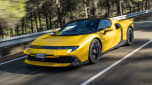
To do this, Ferrari partnered with LoveFrom, a design consortium co-founded by two of the world’s most respected industrial designers. One of these is Sir Jony Ive, godfather of iconic Apple products such as the original iPod and iPhone, who together with powerhouse designer Marc Newson collaborated with Ferrari across all of the car’s interior elements.
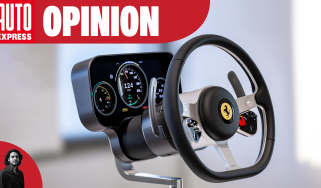
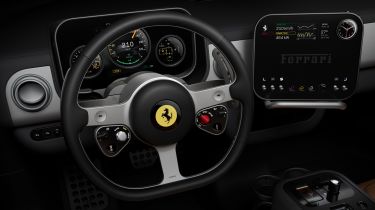
Ironically, this didn’t start with digital interfaces, but more traditional product design in the form of the steering wheel. Reflecting a desire to draw a tighter connection to the brand’s heritage, the Luce’s new steering wheel takes inspiration from the iconic Nardi wheels of the fifties and sixties. Made from machined aluminium with an exposed structure, it has two simple analogue button groups on each upper spoke, creating a simplified aesthetic. This is in stark contrast to the brand’s existing steering wheels, which are covered in different controls scattered across the front and back.
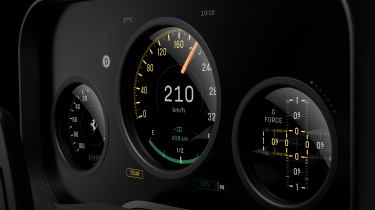
Behind the new wheel is a binnacle that’s attached directly to the steering column. It features a complex arrangement of OLED screens that create a three-dimensional effect from the driver’s perspective. It does this by layering two displays, with the forward one featuring cut-outs that reveal the second screen behind. By moving with the wheel, it ensures the perspective remains optimised perfectly for the driver no matter their driving position.
The interfaces themselves are also designed to emulate classic rotary dials, with Ferrari claiming they have a watch-like clarity, while referencing classic instruments from the fifties and sixties – just like the steering wheel.
The main centre display is mounted onto the dashboard via a ball-and-socket, allowing the screen to rotate towards either driver or passenger. Underneath sits a palm-rest, which makes using the main touchscreen interface easier while on the move. However, this is more than just a screen, as it also incorporates a mechanical ‘multigraph’, or, in other words, a fancy clock with individually controlled hands that sit over the top of the main touchscreen to create the look and feel of a mechanical clockface.
There are a few physical toggle switches that control on-screen functions, which will bring a nice tactility to the interface, and the digital interface itself is also brand new and more contemporary. It’s not just the physical design that’s taken a few cues from Apple, but the software too.
The key and drive-selector have also been given a futuristic update, as both are now made of a glass-crystal that uses sci-fi tech in its manufacturing. The key also has a clever ‘e-ink’ display that changes whether the key is inserted into its dock on the centre console. And to reassure those with bad memories of digital BMW keys and the endless need to charge them, we’re told this type of display only draws energy during colour changes. Ironically, BMW is also in development of this e-ink tech, which we should see later this decade.
The interior design that all this new tech sits in is just as innovative, but in a nostalgic way. The simple, straightforward dashboard and brutally clean aesthetic is a world away from Ferrari’s current interiors, and looks to signal a shift towards a completely different look and feel that could well be channelled to the car’s exterior design, too. We’ll have to wait until May to see the whole picture.
If you can't wait for the Ferrari Luce to arrive, you can get your hands on a used Ferrari through our Buy a Car service. A used Ferrari 488 GTB is available from less than £130,000, while a used Ferrari California T can be yours for less than £70,000.
How much power will the Ferrari Luce have?

Like the Rimac Nevera hypercar or BMW’s tyre-roasting VDX concept, the Ferrari Luce will feature four independent electric motors – two on each axle. These will work together to deliver just over 1,000bhp, which is about the same as the new Ferrari 849 Testarossa.
However, the new Testarossa’s plug-in hybrid petrol V8 can’t come close to the EV’s combined 11,500Nm of torque when Launch mode is activated. 0-62mph will take 2.5 seconds while the top speed, if you’re interested, is set to be 193mph.
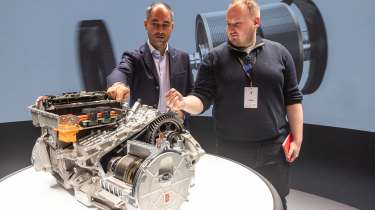
The compact design of the e-motor is derived from Ferrari’s Formula One technology. It utilises a water cooling system and thermal conductivity resin to distribute the heat generated.
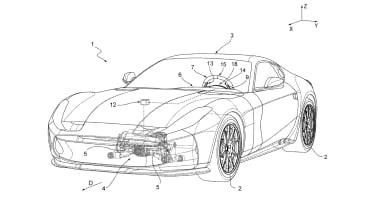
Within the front e-axle unit is an all-new disconnect device which can completely decouple the motors from the car’s front wheels to boost efficiency when extra traction isn’t required, like when cruising on the motorway. This new system can engage or disengage the two motors in just 500 milliseconds, and Ferrari says its 70% lighter than previous versions.
For taking on corners, the Luce’s four motors will provide torque vectoring, meaning the car will control the speed of each motor for greater agility. This should also make the 2.3-tonne EV feel lighter than it is.
There will be three modes for the powertrain – Range, Tour and Performance – that drivers can switch between using an eManettino panel on the steering wheel. These modes will alter how the power output and traction control are managed, as well as whether the car becomes rear-wheel drive or all-wheel drive.
Why is the Ferrari Luce going to have shift paddles?
Certain brands like Hyundai and Genesis have already explored the idea of a virtual gearbox in EVs, to deliver a more engaging driving experience. Ferrari has gone down a similar route with what it calls its ‘Torque Shift Engagement’ strategy for the Luce.
By pulling on the right-hand paddle on the steering wheel, the driver can activate five progressively higher levels of torque and power delivery to produce a similar sensation of acceleration to that in a petrol Ferrari. The left-hand paddle is used in a similar way to replicate the feel of engine braking when slowing down for corners.
What will the Ferrari Luce sound like?
When screaming V12 and howling V8 engines are a part of what makes the brand's cars so evocative, you might assume Ferrari would try to emulate their soul-stirring soundtracks in a naturally silent EV. A bit like the popping and crackling hot hatch exhaust noises you get in the Hyundai Ioniq 5 N.
But no. Ferrari instead wanted to give the electric motors a voice of their own, and harness some of the sound they emit by placing an accelerometer within the casing for the rear e-axle. This sensor detects the vibrations from the motors, which are then amplified and pumped into the cabin. Presumably through the car’s speakers.
The analogy Ferrari uses is that this sensor is like the pickups on an electric guitar, which turns what an artist is playing into the noise that we hear from an amplifier.
Ferrari was adamant when it began work on the Luce that it didn’t want to try and replicate the sound of its internal combustion engines, nor did it want to create something entirely digital. Though sadly we’ve not had a chance to hear the Luce’s unique and slightly mysterious soundtrack for ourselves. Also, in normal driving conditions there won’t be any additional noise generated, to make the cabin more relaxing.
What do we know about the Ferrari Luce’s chassis?
The chassis of the Luce is made from recycled aluminium, which Ferrari says contributes to an overall saving of 6.7 tonnes of CO2 for every one built.
One advantage of EVs is a low centre of gravity, because the big, heavy battery is located underneath the floor. For the Luce, all the battery modules sit within in between the front and rear axles, and the majority are located as low as possible within the chassis, resulting in a centre of gravity 80mm lower compared to an equivalent petrol car.
Ferrari says this enabled the evolution of its active suspension system that was first used in the Purosagne SUV, and then by the F80 hypercar.
More specifically, Ferrari lengthened the pitch of the recirculating ball screw within the damper by 20 per cent so it can better absorb the forces from impacts like potholes. That screw is connected to a 48-volt electric motor, like in the F80, which generates torque to turn the screw for precise body control and handling.
At the rear, the Luce will feature Ferrari’s first separate subframe, designed to help reduce noise, vibration and harshness but without compromising on driving dynamics or adding too much weight. The solution was a one-piece hollow casting made from recycled aluminium, connected to the chassis with ‘elastomeric’ bushing. The back wheels can also turn up to 2.15 degrees to offer greater stability or agility as required.
Even though the Luce’s regenerative braking system will generate up to 0.68G of stopping force (the Rimac Nevera’s can ‘only’ deliver 0.4G worth), Ferrari has still fitted a newly developed carbon-ceramic braking system from Brembo. It consists of enormous 390mm discs with six-piston calipers on the front axle, and 372mm discs and four-piston calipers on the rear.
Ferrari took inspiration from its mid-rear-engined 'berlinetta' sports cars for the Luce’s driving position. It will place the driver close to the front wheels to offer “the purest dynamic feedback” but the engineers have also worked to maximise comfort, and make the car easier to get into and out of, like the brand’s front-engined GT cars.
How much range will the Ferrari Luce have?
The Luce features a gigantic 122kWh battery that Ferrari claims is the most energy dense unit ever used by an electric car, and running underneath the entire powerpack is a massive cooling plate.
The battery consists of 15 individual modules that the engineers have arranged to maximise the available space without having to lengthen the wheelbase. For instance, two modules have been stacked on top of others and positioned underneath the rear seats.
Inside each module are tall pouch battery cells, instead of cylindrical cells like BMW now uses. These allowed Ferrari to achieve the unit's high energy density. Another advantage is that they are lighter, which was a key consideration for the brand when developing the Luce’s hardware.
Ferrari says the new EV will deliver more than 330 miles of range, which is probably the least impressive thing we’ve heard about this car. By comparison, the new BMW iX3 with a smaller 108.7kWh battery pack can cover up to 493 miles on a single charge.
The Luce features twice as many motors as the BMW, however, and is a far more performance-focused car so it will be driven in a very different way to most other EVs. Plus with a maximum charging speed of up to 350kW, we reckon drivers will be able to almost fully recharge the battery in half an hour or less.
What will the Ferrari Luce look like?
That’s one of many unanswered questions we still have about the Ferrari Luce. But one thing is for sure, it’s not a supercar. Apparently battery technology isn’t good enough yet to meet Ferrari’s standards and demands for this type of high performance vehicle.
Instead, the Luce will be a four-door, four-seat car that “can be used by the family, by friends,” according to head of product development Gianmaria Fulgenzi, “so that many people can enjoy the experience and the emotion of a Ferrari all together.”
Needless to say, it won’t be an MPV; and will most likely take the form of some type of SUV, in a similar vein to the V12-powered Ferrari Purosangue.
Ferrari’s analysis showed that, compared to its existing pure-petrol and plug-in hybrid models, an electric powertrain would offer the biggest improvements in areas like performance and driving experience for its more versatile models. Specifically the Purosangue, and the old GTC4 Lusso shooting brake that it effectively replaced.
Prototypes of the Luce have been spotted testing several times already, all wearing similar camouflage and sporting some body panels taken from a Maserati Levante. The test cars have provided some clues about the design, such as the flared front wings that feature a more streamlined profile than the Purosangue’s. The front bumper showcases an open and aggressive style, and presumably ensures sufficient air flow to cool the battery and motors.
Ferrari has also worked with a design agency called LoveFrom on the interior of the Luce. The firm was founded by Sir Jony Ive, former chief design officer at Apple, and industrial designer Marc Newson. According to CEO Benedetto Vigna, together the two companies have created something “really unique.” We’ll have to wait until next spring to find out exactly what that is though.
Why is Ferrari launching its first EV now?
Ferrari is clear on this: it wasn’t going to launch its first electric car until the technology available could deliver the driving experience and performance that customers expect of any machine born in Maranello.
Though it still says something that rival Lamborghini has delayed the launch of its first EV until 2028, which will be five years after it previewed the car with the Lanzador concept. Similarly, Aston Martin has also pushed back the introduction of its first electric car, and now only says it will arrive before the end of decade.
When asked why this was the right time to launch the Luce, Vigna responded: “we want to show that we are able to harness any technology in a unique way, for the sake of driving thrills for our clients. And also we want to access another pool of clients that want and will buy a Ferrari, if and only if it’s electric.”
Did you know you can sell your car through Auto Express? We’ll help you get a great price and find a great deal on a new car, too.