Gov cash for Vehicle-to-grid EV tech could save families £100s on electricity bills
The government is pumping £4.8m into ‘Vehicle-to-Everything tech’, allowing EV owners to use stored battery energy most efficiently

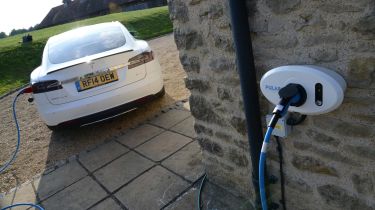
The government is backing four schemes focusing on developments in bi-directional charging tech that could one day see EV owners selling energy stored in their car batteries back to power companies at times of peak demand.
New charger technologies will theoretically also allow EV owners to charge their cars off-peak, and use the energy stored in their car batteries to run domestic appliances such as fridges and washing machines at more expensive peak rate times. This is the vision as the government announces a £4.8 million investment in four separate projects to develop and implement so-called ‘Vehicle-to-Everything’ or ‘V2X’ tech.
“The prospect of families being able to store energy on their doorstep in electric vehicles and use it to power their homes is incredibly exciting,” said Minister for Affordability and Skills Amanda Solloway. “This is exactly the sort of ingenuity and creativity that makes the UK one of the world’s most innovative nations. By backing this technology, we could save families hundreds of pounds a year, while also supporting jobs, investment and growth.”
The four V2X projects that have been awarded cash include two companies making or trialling bi-directional chargers, another creating bi-directional charging hubs featuring solar panels and batteries housed in repurposed shipping containers, and one working with Royal Mail on trialling a fleet of 20 V2X delivery vans in London. The focus is on commercial applications first, but the technology is likely to make its way into consumer applications in due course.
According to the government, the 2-way charging tech builds on existing smart charging technologies which already allow vehicles to be charged overnight when electricity prices are lowest.
“Households could power their home appliances as a result of the development of bidirectional charging, which enables electricity stored in a vehicle’s battery to flow back into the grid or back into the home and workplaces, which can then be used to power other devices,” it says, pointing out that domestic users could use V2X tech to sell electricity back to the grid when prices are higher, while businesses could benefit by storing electricity in their EV fleets and using it to power other operations or activities.
Want the latest car news in your inbox? Sign up to the free Auto Express email newsletter...