DS No7 review
The No7 is essentially a Vauxhall Grandland in a posh frock

Our opinion on the DS No7
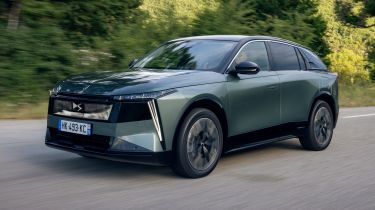
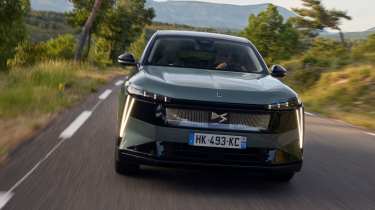
We applaud DS for its very different take on luxury motoring, and in some ways, it works well. The DS No7 looks distinctive, if quite busy, and the interior is a refreshing change from the usual German-made options in the premium car sector. The ride is suitably smooth, too, and refinement is where it should be.
The problem comes from the box of bits the DS No7 is made from. There’s no getting away from the fact the No7 has much in common with the Vauxhall Grandland and Citroen e-C5 Aircross, yet is considerably more expensive. It definitely works better in E-Tense electric form, but however configured, the No7 is a tough sell against options from the likes of Audi and BMW.
About the DS No7
The reinvention of the DS Automobiles range continues with the No7. The new naming format, replacing the simple numbers of before, is expressed as ‘Number 7’, a bit like Chanel No.5. DS is aiming to finally make some headway in the premium car market but the same monumental challenge of beating the Germans remains.
With DS being part of the huge Stellantis empire of car brands, the No7 ends up being built from many ingredients found in models that don’t have the same premium car ambitions. Cars like the Vauxhall Grandland and Citroen e-C5 Aircross, each of which can be purchased for many thousands less.
Used - available now

2018 Peugeot
3008
69,250 milesAutomaticPetrol1.2L
Cash £9,795
2018 Ford
C-Max
118,000 milesManualPetrol1.6L
Cash £1,995
2020 Jaguar
F-Pace
83,850 milesAutomaticDiesel2.0L
Cash £12,295
2020 BMW
1 Series
79,950 milesAutomaticPetrol1.5L
Cash £13,495In a lot of ways, though, the DS No7 represents a decent leap forward compared to its DS7 predecessor, the brand’s biggest-selling car. It’s 7cm longer with a 5cm longer wheelbase, giving more interior space, and it should feel airier, with larger rear windows and a bigger panoramic roof. There’s also now a fully-electric DS No7 E-Tense.
Performance & driving experience
Pros |
|
Cons |
|
We tried a car in Etoile specification on 20-inch alloys and fitted with DS’s clever Active Scan suspension, which uses a forward-facing camera to pre-empt bumps in the road by prepping the dampers to cope with the impending hit.
The good news is that the technology works beautifully in the No7, and the supple ride quality is arguably the strongest dynamic point of the DS. It’s aided and abetted by sumptuous refinement, the SUV’s aerodynamic body (0.26Cd) cutting through the airflow quietly and efficiently. As an easy-going form of elegant transportation, the No7 squarely hits the mark.
However, the DS EV is not quite so impressive in the corners, mainly because the steering is something and nothing. It’s weighted well and accurate, but there’s not really any meaningful feel; any resistance off dead-centre feels decidedly artificial.
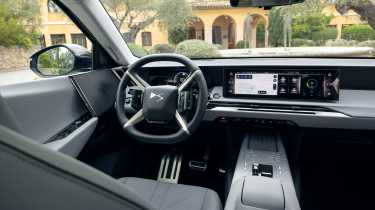
We also can’t talk about the steering without mentioning the bizarre steering wheel. The No7 gets an X-shaped arrangement which reminds us of Charles Xavier’s wheelchair. You never know quite where to rest your hands on it. We can’t help but wonder if it’ll be quietly dropped by the time of the facelift.
Performance, 0-60mph acceleration and top speed
The sole combustion option is called the DS No7 Hybrid, although that’s a bit of a misnomer, because the 1.2-litre unit is more of a mild-hybrid with only very limited electrical assistance. The inappropriate labelling is the least of its worries, though.
Frankly, in this size and supposed exalted class of car, its 143bhp is simply not enough to convey a persuasively premium air. It also doesn’t help that acceleration is lethargic in the extreme, its slovenliness only partly hinted at by a 10.4-second 0-62mph time. It feels slower.
Its six-speed dual-clutch makes matters worse thanks to the eternity it seems to take to shift down with an application of full throttle. At lower speeds, meanwhile, it can be quite clunky in its operation.
The biggest problem of the setup is the racket it makes should you want to reach 62mph in that quoted 10.4 seconds. The sound of a three-cylinder engine getting a good thrashing simply doesn’t work with the DS No7’s premium aims.
The electric E-Tense with its smooth, effortless nature makes much more sense in the DS No7. It helps that even the slowest version is significantly faster than the sluggish, noisy Hybrid.
There are three main flavours here. The first has a smaller 73.7kWh battery, a single front-mounted motor and up to 256bhp on a time-limited overboost phase (226bhp otherwise). There’s also 343Nm of torque, and a far more respectable 0-62mph time of 7.7 seconds. At the other end of the spectrum is the only dual-motor AWD No7, offering 370bhp, a bigger battery and 0-62mph in 5.4 seconds.
However, the one we think makes the most sense, and the one offered up by DS for the test drive, is the Long Range. Its 97.2 kWh battery is shared with the AWD, but it retains the front-drive arrangement of the entry-level electric car. This gives it a claimed maximum range of 460 miles.
The No7 Long Range also summons up to 276bhp in overboost (it runs 242bhp otherwise) and backs that up with 343Nm of torque, which allows for a 0-62mph time of 7.8 seconds.
| Model | Power | 0-62mph | Top speed |
| DS No7 Hybrid | 143bhp | 10.4 seconds | 125mph |
| DS No7 E-Tense FWD | 226bhp | 7.7 seconds | 118mph |
| DS No7 E-Tense AWD | 370bhp | 5.4 seconds | 118mph |
“We’re not sure what DS was thinking in quite literally reinventing the (steering) wheel - the X-shaped arrangement is really awkward to use” - Alastair Crooks, senior news reporter.
MPG & running costs
Pros |
|
Cons |
|
What the DS No7 Hybrid’s 1.2-litre engine lacks in refinement and performance, it somewhat makes up for in frugality. It’s officially rated at 52.3mpg, and in both the No7 and the many other cars this engine is fitted to, we’ve found that the real-world economy return is very close to this number.
In less good news, only the entry-level Pallas version of the Hybrid escapes the government’s luxury car tax supplement, and it’s possible to push it over the £40,000 threshold with some optional extras.
The threshold for EVs is set at £50,000, but the much higher price of the E-Tense models means that, again, it’s only the Pallas trim that comes in under that figure, and there’s even less wiggle room for options before it too is hit with the extra charge.
| Model | MPG | CO2 | Insurance group |
| DS No7 Hybrid | 53.2mpg | 121g/km | TBC |
Electric range, battery life and charge time
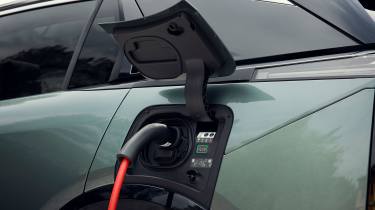
The headline figure here is 460 miles of range from the Long Range, which is impressive, if not quite as attention-grabbing as the ~500-mile innings of cars including the BMW iX3 and Volvo EX60 in certain guises.
The AWD uses the same 97.2kWh battery pack, with its extra motor having a sizeable impact on the range, which drops to 422 miles. The Long Range is still plenty brisk, and given that the No7 isn’t the most fun thing to drive, we reckon it’s a better bet than the faster AWD model.
The entry-level model’s 337 miles range is reasonably impressive, too. As for what you’ll achieve with any of these models in real-world driving conditions, it’s hard to say, but as a general rule, official WLTP ranges are tricky to replicate.
Where the No7 looks a lot less competitive is in its rapid charging capacity of just 160kW for the larger battery model. For comparison, it’s 400kW for the iX3 and 370kW for the Volvo EX60.
| Model | Battery size | Range | Insurance group |
| DS No7 E-Tense FWD | 73.7kWh | 337 miles | TBC |
| DS No7 E-Tense AWD | 97.2kWh | 422 miles | TBC |
| DS No7 E-Tense Long Range | 97.2kWh | 460 miles | TBC |
Interior, design & technology
Pros |
|
Cons |
|
DS has done a good job of making the No7 look and feel quite different from its much less expensive stablemates, as well as more obvious alternatives like the BMW iX3.
The front part of the cabin gives the feeling of wrapping around the driver and passenger, with a structure that appears to flow into the door panels. There’s then interesting touches like massive laser-etched aluminium (or wood) panels for some of the speakers, plus all the more usual stuff including high-end leather trim. It’s a roomy, practical interior, too, but as we’ll shortly explain, the infotainment setup lets it down.
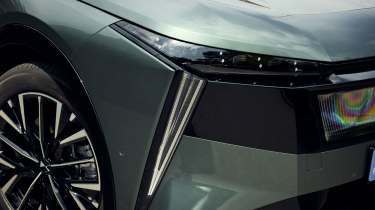
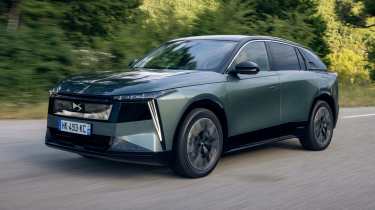
The exterior will certainly help the car stand out, particularly with that conspicuous illuminated front grille. The whole car looks pretty busy, though.
Six exterior colours are available, four of which are monotonal, keeping things classy, if not exactly vibrant. You can choose between Alabaster White, Palladium Grey, Crystal Pearl, Perla Nera Black, Topaz Blue and Silky Green.
Infotainment, sat-nav and stereo
While there are DS-specific fonts and graphics used for the infotainment system, it’s very reminiscent of the setup found in the Vauxhall Grandland. That isn’t really a good thing.
First off, there’s the layout to consider. 16 inches sounds like a decent size, but it’s heavily letterboxed, and temperature shortcuts for the climate control are displayed at either end, leaving you without much usable real estate.
It responds quickly to touch inputs, but certain functions require the system to stop and have a think before much of anything happens. And while the navigation is usable enough, it’s a bit laggy, often a moment or two behind the car’s actual position.
We reckon you’re better off using a mobile phone navigation app like Google Maps or Waze, which won’t be too much of a hassle thanks to the inclusion of wireless Apple CarPlay and Android Auto as standard.
A 14-speaker Focal sound system is available as part of an option pack on the No7 Etoile, and as standard on the La Premiere version. It’s an impressive setup, but it does require a bit of fiddling to get the best from it.
“The No7 feels suitably plush on first inspection, but a lot of DS’s design efforts are sullied by a less-than-brilliant infotainment system” - Richard Ingram, deputy editor.
Boot space & practicality
Pros |
|
Cons |
|
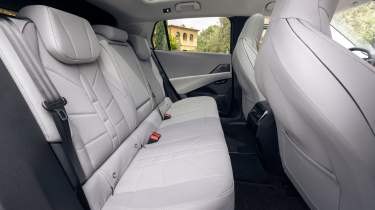
The No7’s positioning between compact and mid-size SUVs largely plays out when it comes to practicality. That said, its boot space is better than what’s found in some larger rivals. It’s good for passenger space, too, with a good amount of head and legroom for those in the rear.
There’s a headroom penalty associated with the optional panoramic roof, though. Also, the E-Tense models have a higher floor than the Hybrid versions due to the location of the battery pack, which will make them feel slightly more cramped for anyone in the back.
Although the Peugeot 5008, which sits on the same platform as the No7, is a seven-seater, the DS only has seating for five.
Dimensions and size
At 4,650mm in length, the DS No7 sits somewhere between compact SUVs like the Audi Q3 (120mm shorter) and mid-size options including the Mercedes GLC (66mm longer). In terms of width, the No7 is closer to a mid-size SUV, while the wheelbase, much like the length, sits roughly between the two categories.
| Dimensions comparison | |||
| Model | DS No7 | BMW iX3 | Audi Q3 |
| Length | 4,650mm | 4,782mm | 4,531mm |
| Width | 1,905mm | 1,895mm | 1,859mm |
| Height | 1,657mm | 1,635mm | 1,588mm |
| Wheelbase | 2,784mm | 2,897mm | 2,681mm |
| Boot space | 560-1,570 litres | 520 - 1,750 litres | 488-1,386 litres |
Boot space
A 560-litre boot that expands to 1,570 litres with the seats down sounds decent enough when a BMW iX3 manages a more modest 520 litres despite being a longer car. There’s a caveat to this, though, because the No7 AWD takes a big hit due to the packaging of its rear motor, offering 500 litres. There’s a further, smaller penalty for cars with the Focal sound system, because its subwoofer also saps boot space.
It’s good to see a 40/20/40 split in the folding rear bench rather than a less flexible 60/40 arrangement. The seatbacks don’t sit anywhere near flat when they are stowed, though.
The boot opening itself is a good size and shape. There’s also a variable height floor, should you wish to sacrifice some cargo volume for a flatter, easier-to-load boot.
Towing
The E-Tense AWD is a clear winner in terms of towing capacity – it can haul braked loads of up to 1,430kg. The E-Tense FWD isn’t too far behind at 1,270kg, while the Long Range manages 1,200kg. The Hybrid’s braked towing capacity is an underwhelming 650kg.
Reliability & safety
Pros |
|
Cons |
|
Euro NCAP hasn’t specifically tested the No7, instead carrying over the No8’s score due to the car being so structurally similar. That result was four stars, which would sound better were it not for the fact that five-star scores are so common these days, particularly among the No7’s intended rivals.
The safety assistance rating of 65 per cent won’t have helped the No7’s cause, although a 76 per cent adult occupant result isn’t great either. The child occupant rating of 85 per cent is more like it. On that front, there are two Isofix mounting points on the outer rear seats.
As standard, all versions come with lane assistance, a driver attention monitor and autonomous emergency braking. An optional Tech Pack (standard on Etoile and La Premiere) adds a more sophisticated assisted driving setup with predictive speed adjustment, lane-keeping assist and 'semi-automatic' lane changing.
Because DS sales are quite limited in the UK, there’s not enough data for the brand or its cars to appear in our Driver Power rankings. We can, at least, look at other brands from the Stellantis stable to give us some indication of reliability, and on that front, it’s mostly good news.
The various brands belonging to the car-making giant have been climbing up the rankings in recent years, most notably with Vauxhall, Peugeot and Jeep occupying places seven to nine. Fiat had a respectable 18th-place finish, four places up from the previous year, but it was less good news for Citroen just two places from the bottom.
As ever, we can point out that the E-Tense models have fewer moving parts than the Hybrid versions, which means fewer bits and pieces to potentially go wrong.
| Euro NCAP safety ratings | |
| Euro NCAP safety rating | 4 stars (2025) |
| Adult occupant protection | 76% |
| Child occupant protection | 85% |
| Vulnerable road user protection | 80% |
| Safety assist | 65% |
Buying, prices and deals
- Best buy: DS No7 E-Tense Long Range Etoile
There’s a starting price of just over £49,000 for the E-Tense models, rising to £53,000 for the Etoile and nearly £59,000 for a La Premiere.
You’ll need to add a bit more for Long Range and AWD powertrains – combining the latter with La Premiere trim gives a whopping £67,000 price tag before options. For a car that shares so much in common with a Vauxhall Grandland and Citroen C5 Aircross, those are punchy figures.
The No7 Hybrid is significantly cheaper than the E-Tense, starting at just over £38,000 in Pallas trim. It’s over £41,000 for the mid-spec Etoile and £47,000 for La Premiere.
The mid-spec Etoile looks to be the best bet in terms of blending value and standard equipment, while the best powertrain is the E-Tense Long Range.
DS No7 alternatives
It’s tricky to nail down some obvious rivals for the DS No7, owing to its positing somewhere between two market segments in terms of size, and its offering of both petrol and hybrid power. However, those bold prices put the No7 E-Tense firmly in the crosshairs of the BMW iX3, which is a far better-rounded EV.
At the same time, while it’s not as practical, the smaller iX1 could be considered an alternative, and it’s cheaper. An Audi Q4 e-tron, meanwhile, is priced closely to the DS, and is more convincing as a luxury product, despite - like the No7 - sharing parts with less expensive models from other brands.
The No7 Hybrid is relatively well matched to the Audi Q3 in terms of pricing, and is larger, but it’s not as convincing as a luxury car.
The biggest elephant in the room is the Citroen C5 Aircross – the No7’s corporate cousin. Sure, it’s not as fancy inside, but it might just be more comfortable, and the cheapest e-C5 Aircross is a colossal £15,000 less expensive than the entry level No7 E-Tense. The DS can’t possibly justify the premium.
DS No7 pictures
Frequently Asked Questions
The standard DS warranty lasts for three years or 60,000 miles, whichever comes first. The E-Tense's battery is covered by a separate 8-year/100,000-mile plan.
Deals on the No7 and alternatives