Dacia: how to reinvent a car brand
We go behind the scenes to learn more about Dacia’s rebranding

How do you reinvent a brand? You probably start by boiling down what it currently means to people; then you come up with what you’d like it to mean to people. And then, presumably, you work out a way of joining the dots between the two.
But how do any of those processes actually happen? In the case of Dacia, the team had decades of experience with customers – listening to their comments, reading feedback through the dealer network, studying owner-satisfaction surveys such as Auto Express’s own Driver Power. After all, knowing why people buy your cars is important; knowing why they don’t is arguably even more critical.
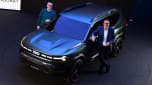
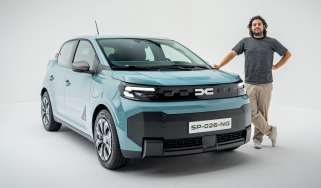
Lionel Jaillet, Dacia’s vice-president for product performance, and David Durand, its design chief, are the guys who then had to lead the push to collate the brand’s vision of its own future into a meaningful, coherent plan that could build on this knowledge. The end results are already there for us all to see – a new logo, fresh branding, a change of slogan (it’s all about ‘good thinking’ now), even a different corporate colour scheme.
Durand is quick to recall comments from Luca de Meo, the overall Renault Group boss, when he joined the company more than two years ago. “He said to us, ‘You are so lucky at Dacia.’,” he recalls. “Keep your uniqueness. But try to make it a little more attractive; make it cool.’ And this is our goal. You choose from Dacia because it’s a good price but also because you love the design, and you want it.”
The foundations of this, and the new look, are three brand pillars: essential, robust and outdoor. The first of those is perhaps the one that resonates strongest with Dacia up to now – nothing but the basics, no gimmicks, no add-ons. Even a transparent buying process with no discounts. But Durand says there’s more to it than that. “Our products are essential, but we often say that the most important thing about a Dacia is not actually driving it, but the point when you arrive at the place where your experience starts,” he says. “The moments are what matter, and the car is an enabler for those things – some of which you possibly couldn’t afford if you’d bought a car other than a Dacia.”
But it’s on ‘outdoor’ and ‘robust’ where Durand, Jaillet and the teams have really tried to extend Dacia’s reach. The choice of corporate colour, a khaki-esque green; the chunky logo that looks stronger than the previous old-fashioned badge – there’s an element of military surplus about the whole thing. Functionality remains king, but it’s fine for this to say something about your lifestyle as well. It’s no wonder that as Durand walks us through one of Dacia’s ‘mood walls’, he points to a Swiss army knife as a good example of the kind of products that inspired his designers.
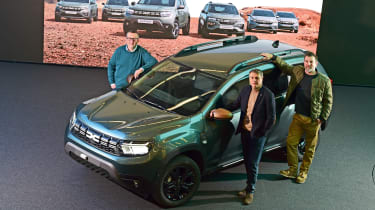
“We were always thinking about building cars that look and are more robust, by being a bit more simple,” he says. “Fewer parts that can be pulled off or which can fall off; it’s quite easy to understand. It looks simple, but also robust. It’s been in our DNA from the beginning.
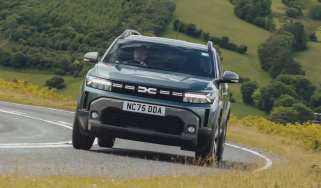
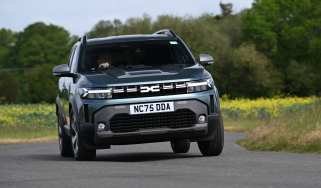
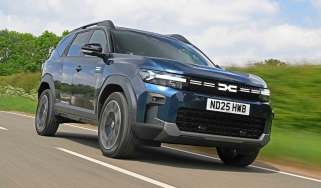
“You can also say the same about ‘outdoor’. We weren’t saying it before, but we realised that it already applies to us – with Duster, which is a real off-roader, but also with Stepways, which have some protection and more ground clearance, quite thick tyres. In a way, it goes back to the foundation of the brand.”
There’s actually a fourth brand message: eco-smart, with eco meaning economical but also ecological. Dacia has struck upon its cars’ essential nature as a way of saving weight, thanks to minimal add-ons. It will also make more use of recycled materials in the future and show them off in bare form, instead of hiding them under paint.
How did they get here, though? We want Durand to boil down how these examples were formulated. “It never really stops,” he explains. “And we have some groups between us, on WhatsApp and so on, where we send each other things that make us think, ‘This is not far from being us,’ or something very interesting. We send each other a lot of things from Instagram.
“So if we take the army knife as an example, I can tell you that the one here was not the first one, but every so often people would find better ones that had tiny elements and characteristics that made us feel they were more in tune with us.”
It’s around this point where we realise that Dacia’s rebranding doesn’t mean a total reinvention; if anything, it’s a sharpening of focus, a realisation of what customers liked most about the cars and the company, and a fresh push further into those areas.
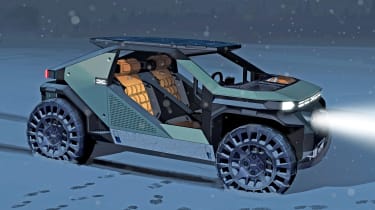
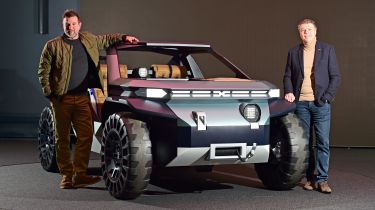
The best example of this, for now at least, is a very unusual thing for Dacia: a concept car. Called Manifesto, the rugged, pared-back creation was one of the stars of last year’s Paris motor show – but even now, more than six months later, the team’s pride in it is matched by a slightly uneasy self-awareness.
“We are car guys,” Jaillet explains as we walk around the vehicle, “so while we were challenging ourselves, and thinking of new things, we needed to go beyond CGI or 3D, to go more physical than digital. Manifesto is maybe a bit extreme, but the proof points are there – the three pillars.”
“Manifesto is not a car that’s going to hit the showroom any time soon,” Durand chips in. “So in fact, we were wondering if our customers would understand it. They’d be asking, ‘What is this Dacia that we’ll never buy one day?’
“We explained it as a laboratory of ideas, something to unleash the designers and encourage them to go extreme. They came up with no windscreen, no doors, something that’s like a motorcycle on four wheels.
“They did this for every part of it,” Durand adds. “At the beginning, for example, it had two headlamps, but we got talking and asked ourselves, ‘Why do we need two? We have super-powerful LEDs.’ So we put one lamp and were essential to the end.”
This final phrase is what seems likely to underpin Dacia’s growth, even as it draws new followers. And it’s something that is clearly ingrained in the firm’s design philosophy. “We’re constantly asking ourselves, ‘Do you really need this? Does the car have to have a line or a crease there?’” Durand says. “I often quote Dieter Rams, who was in charge of many famous Braun products from the sixties. His philosophy was that the best design is when you have the least design possible. And we try to apply that.”
Q&A with Lionel Jaillet
Dacia Vice President of Product Performance
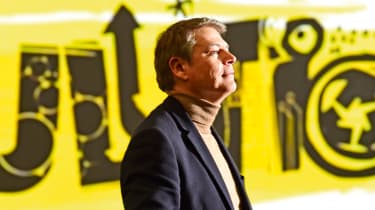
Q: To what extent has Dacia accelerated since Luca de Meo took over at Renault Group?
A:“When Luca came to the company, he already had a good idea of what could happen to Dacia. But he selected 40 people and our mission was to take each element of the plan and do a stress test on it. I was part of this. We had to ask ourselves, ‘Are the projections realistic? What are the boundaries and will there be any issues?’ We were also looking carefully at the brand positioning between Dacia and Renault. The challenge from Luca was to unlock the potential of Dacia while making sure we’re still complementary to Renault.”
Q: Can you define what ‘unlocking the potential’ actually means? Bigger sales volumes? A wider product portfolio? Bigger profit margins?
A: “Well, you can talk about all of those things. We are putting some more emotional values into the brand, and we have deployed the new brand identity. But yes, there is growth in the product line; these targets were agreed before Jogger, even before the Spring [Dacia’s baby EV]. And then there are elements like the Extreme line, which is now coming across the range – this gives us some more scope within the existing line-up. We’ve already seen people looking more and more towards the upper end of our trims and ranges; this allows us to do that.”
Q: What about cars like the Bigster? We know it’s coming, and that will take you into a completely different area of the market where you can really pull in fresh buyers. Was that even being talked about in 2020 when the plan was formulated?
A: “Talked about, yes. But was it fully actioned? No. It was something that we had discussed, and we had done some feasibility studies, but it very quickly became part of the plan. Because it’s something that we can do on the right platform – the same as Jogger, same as Sandero, same as the next Duster – while going into the C-segment. We think it’s an area where Dacia can have a huge impact.”
Q: The reception to the Jogger will have helped, of course?
A: “Yes, it has been well received. But I’d also say that this is probably the first time that I’ve been writing a strategy and delivering a strategy in a perfect manner. Which is to say that we are not late; we are doing what we said we’d do. And we are even giving a little more than what we said we’d do. We are already doing better than some of our own projections.”
Q: Why can’t you bring products like Bigster now? Is it about manufacturing capacity?
A: “Not really. What was a little bit unusual with Bigster was that Luca said, ‘I want to show the concept now,’ very soon after it was finalised, because he wanted to preview the future direction. It felt a little strange for Dacia, to be honest, because the development process is planned from 2020 to 2025. We’re testing it now and we’ve just finished customer clinics with the car. It is on track; it’s just that this glide scope was always meant to land in 2025.”
Click here for our review of the new Dacia Jogger Hybrid...
Discovering Dacia
A special feature exploring Britain's favourite value car brand...
- The future of Dacia: CEO plans value car empire
- How to build a budget car: Dacia's engineering philosophy uncovered
- Dacia Jogger: European road-trip marathon in UK's cheapest 7-seater
- Dacia Jogger Sleep Pack exclusive review: a night in the amazing budget Motorhome
- History of Dacia - and its greatest cars
- Dacia dealers: inside the showrooms of Britain's favourite budget car brand