eFuels boost as Stellantis confirms they work in current engines without modifications
Global car giant Stellantis has teamed up with Aramco to prove that existing car fleets could save 400 million tons of carbon using eFuels

Hardcore environmentalists often reject synthetic low carbon petrol and diesel substitutes as an alternative to battery EVs, because they only reduce tailpipe emissions by 70 per cent. However, a joint venture between Stellantis and the Aramco energy and chemical group suggests so-called eFuels could be safely used in 28 million existing Stellantis vehicles, potentially saving 400 million tons of CO2 between 2025 and 2050.
Low carbon eFuels are made by reacting CO2 captured from industrial processes or from the atmosphere, with green hydrogen electrolysed using solar, wind or other renewable energy sources.

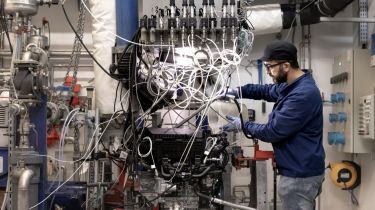
The latest study over several months orchestrated by Stellantis and Aramco is said to prove that eFuel can be safely used in 24 Stellantis engine families introduced since 2014 without the need for any modification. That amounts to millions of vehicles in use today, with the potential, Stellantis says, to drastically cut the lifecycle emissions of existing and still-to-be-built ICE cars that are likely to be on the road for years to come. The company says its testing covered “tailpipe emissions, startability, engine power, reliability endurance, oil dilution, fuel tank, fuel lines and filters, as well as fuel performance in extreme cold and hot temperatures”.
Stellantis has a strategic plan to cut its carbon footprint in half by 2030, and be a ‘net zero’ manufacturer by 2038. It believes synthetic eFuels could play a major part in that journey, if owners were simply able to substitute eFuels for refined petrol or diesel at any filling station.
The numbers appear to make its argument stack up, but Stellantis and its fellow car makers, together with the energy industry, still have a job to do convincing politicians that eFuels are a worthwhile transitional stage in the long march towards net zero.

The potential success of eFuel as a means to lower greenhouse gas emissions, along with the success of fuel cell vehicles, depends heavily on the rapid industrialisation of green hydrogen production around the world.
Aramco is currently working on two pilot projects to achieve just that, including an eFuel plant in Saudi Arabia making synthetic petrol and a plant in Bilbao, Spain making synthetic eFuel diesel and aviation fuel.
“Drop-in eFuels can have a massive and almost immediate impact on reducing the CO2 emissions of the existing vehicle fleet, offering our customers an easy and economically efficient option to reduce their carbon footprint — one as simple as choosing a different fuel pump at the station, with no additional modification to their vehicles,” says Stellantis Chief Engineering and Technology Officer Ned Curic.
Want the latest car news in your inbox? Sign up to the free Auto Express email newsletter...