New Citroen e-C3 Urban Range review: suited to the city in more ways than one
The Citroen E-C3 Urban comes with an even lower price, but also less battery range


Verdict
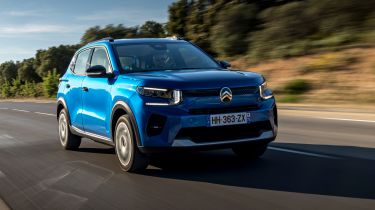
The use case for the Citroen e-C3 Urban Range is more limited than the Standard Range, with range figures suited to town driving and charging essentially only making sense at home or work. The flip side is that it’s a more practical car than you might think and way more comfortable than most rivals. It’s also cheap, but then in plenty of areas the Citroen feels it.
It’s been almost two years since we crowned the Citroen e-C3 as our Car of the Year for 2024. And while it impressed us back then with its pricing, drive and surprising practicality, the market for small electric cars has exploded since with a flurry of capable rivals.
There’s the new Renault Twingo, which – like the Renault 5 – manages to draw plenty of attention with cutesy yet retro-inspired styling. The Dacia Spring has just been updated with an even lower price tag and the Leapmotor T03 is the cheapest EV in the UK, while the Smart #2, Volkswagen ID.1 and a range of Chinese models are due in showrooms soon – all looking to snatch the attention of those looking to pay less than £20,000 for an EV.
Also sneaking below that figure is the Citroen e-C3 Urban Range – a new variant of the brand’s entry-level electric car. As we’ve come to expect from Citroen, pricing for the newcomer is pretty keen at £19,995, but like the more expensive e-C3 Standard Range model, the Urban Range qualifies for Band 2 of the Government’s Electric Car Grant. That £1,500 discount brings the price of the e-C3 Urban Range down to £18,495 in its sole Plus trim level.
Used - available now


At that price, the Citroen e-C3 Urban Range is £2,100 cheaper than the Standard Range Plus, but as the name suggests, there’s a caveat in terms of range. The Urban Range gets a 30kWh battery instead of the Standard Range’s 44kWh, although both use LFP (lithium ion phosphate) chemistry. Citroen says the Urban Range will cover 130 miles on a charge, a fair chunk off the 201 miles claimed in the Standard Range.
The company is keen to point out that the ‘Urban’ part of this car’s name very much relates to the type of motoring it expects customers will do. “It’s perfectly suited to drivers who mainly drive in town or around suburbs – the school run, shopping trips, commuting. We’re realists – this version isn’t aimed at regular long-distance motorway drivers”, we were told.

Before driving the e-C3 Urban Range, we had plenty of reason to be optimistic about the range. That’s because when we tested the e-C3 Standard Range, we achieved 3.5 miles/kWh, which equates to around 153 miles of real-world range. Off the motorways, that figure climbed up to roughly 5.0mi/kWh, boosting the predicted range to around 220 miles.
Our test route in the Urban Range was a pretty even mix of town, motorway and country roads in ideal conditions around Marseille, France. As expected, at low speeds the Urban Range produced impressive efficiency of 4.7 miles per kWh, which would have given us a total range of 141 miles. However, hitting the motorway for the second half our drive saw the efficiency drop to 3.5 miles per kWh, which would have meant a range just over 100 miles.
It’s a slight shame the e-C3 Urban Range is so much more efficient around town, because the little Citroen is more accomplished than many of its rivals on the motorway. While you might be constantly aware of the tiny proportions of, say, a Leapmotor T03 at high speeds, the Citroen feels more settled and comfortable.
The ride of the Urban Range, especially by the standards of the city car segment, is one of its best attributes. This is mainly down to Citroen’s ‘Advanced Comfort’ technology and its clever hydraulic bump stops, which are fitted to many other, more expensive Citroens. With the smaller battery, the Urban Range weighs 1,338kg, 78kg less than the big-battery model. Citroen hasn’t adapted the suspension as a result, but it didn’t need to; the e-C3 hunkers down well, feeling more solid than not only some of its rivals, but larger cars too.
Rather unsurprisingly, the e-C3 Urban Range does its best work in urban environments. The boxy profile and relatively high driving position combine to give excellent visibility all around, which came in handy navigating the incredibly tight streets of Marseille’s more historic parts. There’s also a super-compact 10.6-metre turning circle and the steering, while weighty enough on the motorway, is featherlight at low speeds.
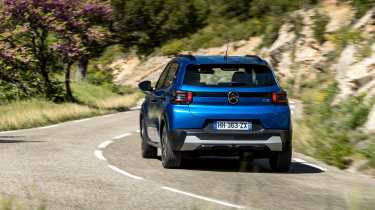
The dinky stature of the e-C3 means that its 17-inch alloy wheels can clatter into large speed bumps and potholes, but over consistently rough roads the Citroen settled fairly well. We did notice a few more undulations sitting in the back seats, though.
Citroen proudly claims that while many of the e-C3’s competitors come with a sub-100bhp electric motor, the French car has the same 113bhp as the Standard Range. Weirdly, there’s no difference in 0-62mph times despite the Urban Range’s lighter kerbweight, and the little Citroen’s performance remains perfectly adequate, feeling zippy enough around town while having enough grunt to make overtakes without much fuss on the motorway. At any speed, however, the electric motor is one of the noisiest we’ve encountered – though no less refined than any of Stellantis’ petrol engines. There’s regenerative braking too, although there’s only one level and it’s exceptionally weak during coasting.
While it rides well and has enough power, the e-C3 Urban Range doesn’t goad you into driving it with any enthusiasm like some petrol-powered city cars such as the Kia Picanto. That light steering is pretty well calibrated for easy-going driving, but the Citroen will feel out of sorts if you’re too eager with your inputs; as you might expect, there’s plenty of body roll, too.
The Urban Range gets the same package of equipment as Plus versions of the petrol and hybrid-powered C3. It misses out on the electric rear windows and bi-directional charging of the £13,240 Dacia Spring Extreme and the Leapmotor T03’s sunroof, but as Citroen says, “the Plus trim has all the necessary equipment for daily use”. There’s a 10-inch touchscreen with Apple CarPlay and Android Auto connectivity, a driver’s display mounted high on the dash, rear parking sensors and two-tone paintwork.
The infotainment is a rather basic affair, but it’s sensibly laid out with shortcuts always visible – the volume control on the far side of the touchscreen is a pain to use, though. There’s no built-in sat-nav, but you won’t mourn its loss, as long as you can connect a smartphone for Google Maps or Apple Maps.

Inside the e-C3, space is tight in the rear, where tall passengers especially won’t enjoy the lack of under-thigh support created by the high floor. However, there is a fantastic amount of kneeroom back there considering the e-C3’s size. The tall roofline means there’s loads of headroom, but it’s all too easy to snag yourself on the tight rear door openings as you get in or out.
There’s no getting away from the fact that it’s a car built to a price, although given that the Urban Range is so cheap, you can possibly forgive the scratchy plastics, flimsy piano-black plastic on the centre console, manual handbrake (possibly a positive for some), wind-up rear windows and lack of any grab handles.
What isn’t as easy to forgive is the lack of rapid charging as standard. Although the e-C3 Urban Range does support rapid charging at speeds of up to 30kW – allowing a 36-minute 20 to 80 per cent recharge – you’ll have to pay £440 to option it. Without this, you're confined to a maximum 7.4kW rate and a two hour 50 minute wait. In comparison, the Dacia Spring can charge at 30kW and the BYD Dolphin Surf can manage 65kW.
There’s an argument that most Urban Range drivers will use their cars in, well, urban scenarios and charging is likely to take place at home via the standard-fit 7.4kW single-phase charger. However, it still feels like a stingy move from Citroen.
| Model: | Citroen e-C3 Urban Range Plus |
| Price: | £18,495 |
| Powertrain: | 1x e-motor, 30kWh battery |
| Power/torque: | 113bhp/125Nm |
| Transmission: | Single-speed automatic, front-wheel drive |
| 0-62mph: | 10.4 seconds |
| Top speed: | 78mph |
| Range: | 130 miles |
| Charging: | 7.4kW (20-80% in 2hr 50 minutes) |
| Size (L/W/H): | 4,015/1,813/1,577mm |
| On sale: | Now |