Leapmotor T03 review
The Leapmotor T03 enters a burgeoning electric city car market, offering decent space, strong refinement and great value for money

Our opinion on the Leapmotor T03
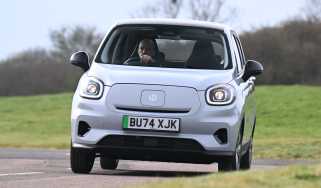
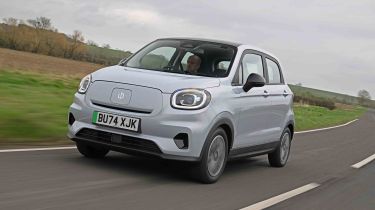
With a wave of new brands coming to market in recent months, it can be hard to stand out from the crowd. But the Leapmotor T03 manages to do so by being a small electric city car that’s packed with kit and all for a competitive price. It’s not without its flaws, but when it’s priced so low and features so much standard equipment, it’s easy to overlook the foibles of its intrusive safety systems and the frustrating infotainment touchscreen. The refined driving experience also goes a long way to making up for its shortcomings elsewhere.
About the Leapmotor T03
While Leapmotor is a relatively new brand to UK customers, it benefits from being a part of the wider Stellantis group, so it has piggybacked on sister brands to fast-track its UK dealer network, with around 80 franchises due to be open before the end of 2025.
The Leapmotor T03 is the smallest car that the company sells – it’s joined by the Leapmotor B10 and Leapmotor C10 electric SUVs in the line-up – and it’s also one of the cheapest cars currently for sale in the UK, with list prices starting from £16,000 before any discounts have been applied.
For the money you get a compact five-door city car with a four-seat interior, plus a long list of equipment. There’s just one model offered, but it comes with the sort of kit that you’d be happy to get in a car costing twice as much. There’s keyless entry, a panoramic glass roof, a reversing camera, a 10-inch touchscreen, a multifunction steering wheel and a host of safety systems.
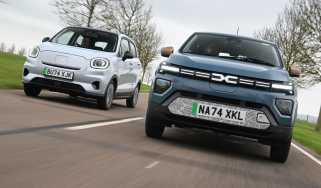
We've put the Leapmotor T03 against the Dacia Spring in our real-world twin test, with the T03 coming out on top due to its greater refinement, long list of standard equipment, and superior interior packaging. However, we weren't fans of its complicated infotainment system and over-zealous safety-assistance warnings. We also included it as part of our six car small EV range test, where the T03 got the closest to its official claimed range.
Leapmotor T03 prices and latest deals
While a £16,000 asking price is already impressive, there are even greater savings to be had courtesy of some competitive discounts that are on offer direct from Leapmotor. You can find out more about these via the Auto Express buy a car service.
Performance & driving experience
Pros |
|
Cons |
|
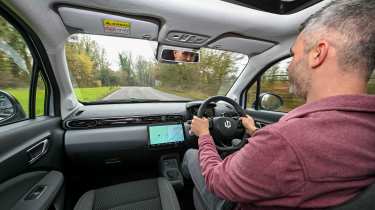
For such a small car, the T03 feels surprisingly grown-up and refined to drive, but the overly intrusive driver-assist systems are infuriating. At least the powertrain structure is easy to get along with since there's just the one option with the T03.
| Model | Power | 0-62mph | Top speed |
| Leapmotor T03 | 94bhp | 12.7 seconds | 81mph |
Performance, 0-60mph acceleration and top speed
A single motor drives the front wheels in the T03, delivering a healthy output of 94bhp and 158Nm, which is pretty impressive for such a small car.
While those numbers comfortably out-punch the Dacia Spring, the Leapmotor does weigh more, too. At 1,175kg, its kerbweight is closer to most typical superminis than city cars, but it’s still significantly lighter than the majority of EVs on the market, which (as we’ll see later) bodes well for its efficiency.
On the road, that motor delivers more than enough punch for a car like this; around-town acceleration is great, and is better than the most powerful Dacia Spring that’s offered. Acceleration does tail off towards motorway speeds, but it’s still perfectly adequate for the occasional longer high-speed trip.
The powertrain itself is a little more finely tuned than the Spring’s, particularly at parking speeds. However, we found the fact that the drive mode settings default to Eco whenever the car is restarted – rather than being left in the mode the driver had last chosen – to be a little irritating.
Town driving, visibility and parking
Once you’ve got over the slightly odd noise emitted by the pedestrian warning tone – the tune ramps up its pitch in noticeable steps, which makes it sound like it’s playing a sci-fi tune as it drives along – the T03 delivers an impressively mature and sophisticated driving experience.
There’s little of the tinny, slightly flimsy feel of the Dacia Spring on the move, with the overall refinement feeling at least on a par with many models from the class above. Vehicles this small tend to feel a little bouncy over bumps, but even here the T03 feels more stable than many other similarly sized alternatives, including the Kia Picanto.
As with the Spring, the Leapmotor is fantastic to manoeuvre in tight spaces; officially, the T03’s turning circle is 7cm larger than its Romanian rival’s, but a figure of 9.7 metres is still great.
What’s less great is the lack of a rear wiper. While that isn't a major problem in dry weather, it could become a bigger issue in a downpour or when you need to clean the window. There is a very good reversing camera and standard rear parking sensors, but we’d like to see a rear wiper included when the T03 is updated.
Country road driving and handling
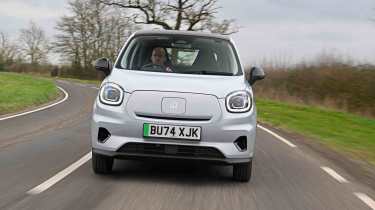
At higher speeds, that steering can feel a little odd, however. While it’s not as remote as the Dacia Spring’s rack overall, it’s quite vague and has a reasonable amount of play around the straight-ahead, with an unnatural urge to self-centre itself.
Apply more lock through a corner, and that weighting still feels a little off, but given that the Leapmotor is almost never going to be pushed hard, this isn’t the end of the world. Neither is the fact that the T03 feels a little dull to drive; most city cars and superminis feel sprightly and fun, but the Leapmotor seems rather flat-footed in comparison. Again, this isn’t a massive issue for a vehicle in this segment, and the fact that it’s stable and predictable is good enough.
Motorway driving and long-distance comfort
That overall sense of refinement and stability continues on faster roads, too. Given the tall, narrow body, the Leapmotor might look as if it would be susceptible to crosswinds, but it’s more planted at speed than the Spring. There’s more soundproofing, too, so the T03 is impressively hushed at speed. For a car that isn’t really designed for motorway runs, it delivers a solid performance.
"Budget cars are often fitted with budget tyres. The Dacia Spring and the entry-level BYD Dolphin both ride on Linglong tyres, which I find hard to accept even on cheap motors. I was pleasantly surprised, then, that when I tested the Leapmotor T03, our test car was fitted with Continental tyres." - Alex Ingram, Chief reviewer.
Range, charging & running costs
Pros |
|
Cons |
|
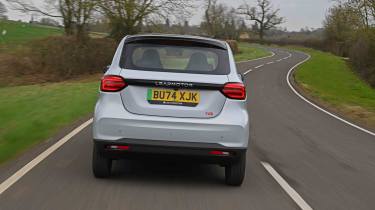
A lightweight car with a small battery translates into impressive real-world efficiency and, therefore, low running costs. However, while it goes quite far given its battery capacity, there are rivals with larger batteries that can go further on a single charge and top up more quickly on a rapid charger.
Electric range, battery life and charge time
The T03’s relatively light weight compared with most EVs means it makes great use of the energy you feed it. During a week of mixed driving – including brief forays onto a motorway – it averaged an impressive 4.6 mi/kWh at temperatures of roughly 12 degrees. We also drove it on a range of different road types as part of our EV range test, and achieved 3.9 mi/kWh.
On both occasions, it proved to be slightly less efficient than the even lighter Dacia Spring, but the Leapmotor’s higher capacity battery pack – 36kWh of usable energy to the Spring’s 26.8kWh – translates into a real-world range of between 140 and 166 miles – the latter is one mile more than the official claim. However, those with a bit more to spend might be interested in the Hyundai Inster, which comes with either a 42- or 49kWh battery and over 200 miles of range to a charge.
What’s more, the Inster can charge quicker on a rapid charger than the T03. The Leapmotor charges at a speed up to 48kW, whereas the 42kWh Inster manages 73 kW, and the 49kWh version 85 kW. Hyundai quotes a typical 10 to 80 per cent state of charge top up at 30 minutes for both versions, whereas Leapmotor only quotes a 30 to 80 per cent top up time of 36 minutes. That’s still better than the entry-level Dacia Spring, which doesn’t have any rapid charge capability, but if you plan on tackling motorway trips and need to charge mid-journey, the Inster is the better bet.
However, you don’t really buy small cars like these for long motorway trips; most T03s will be topped up at home. On a typical 7.4kW home wallbox charger, expect it to take around 6.5 hours to fully recharge a T03.
| Model | Battery size | Range | Insurance group |
| Leapmotor T03 | 37.3kWh | 165 miles | 25 |
Insurance groups
For a car so small and cheap, group 25 insurance will come as a bit of a surprise to some prospective buyers. For reference, the Kia Picanto starts in group 3, while the Hyundai Inster starts in group 21.
Tax
Few cars will cost as little on a company car tax scheme as the T03, with a three per cent benefit-in-kind (BiK) rate presently, but this will rise to four per cent for the ‘26 to ’27 tax year, and five per cent from ‘27 to ‘28.
Since the T03 is so cheap, it’s a shame that it now faces the same annual £195 VED road tax charge as any other petrol or diesel car. At least it falls well shy of the revised £50,000 luxury car tax threshold for EVs, so you won’t incur a surcharge.
One thing to be aware of is that EV owners may be subject to an eVED pay-per-mile fee if that comes into force from April 2028 onwards.
Depreciation
The T03 is predicted to maintain around 40 per cent of its original asking price after three years or 36,000 miles, which is on par with the Dacia Spring and a little behind the Hyundai Inster (41 to 43 per cent).
That’s a little behind the petrol-powered Kia Picanto, though. While the Picanto costs slightly more to buy in the first place, it retains 53 per cent of its value over the same period, losing less money overall. Of course, if you have a cheap rate EV electricity tariff and do enough miles, you might be able to balance this out against costlier petrol prices.
Interior, design & technology
Pros |
|
Cons |
|
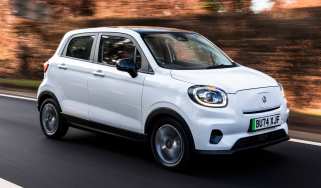
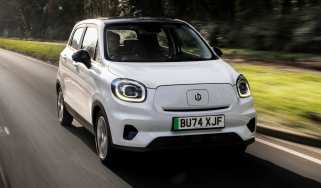
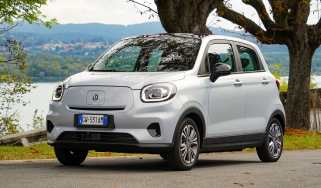
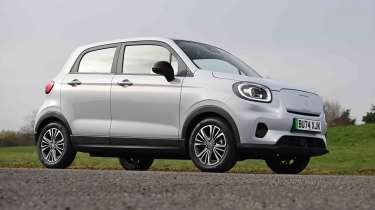
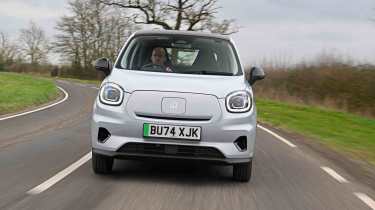
The exterior of the Leapmotor T03 is a pretty simple design. There are rounded features to give it a friendly look, and Leapmotor says the fake grille was shaped to look like a smile. The proportions are tiny, especially when you see the side profile and the wheels sitting at each corner.
The ‘cell-to-chassis‘ platform is bespoke to the T03 and allows it to have traditional ‘city car’ dimensions, although Leapmotor claims interior space is on a par with what you would normally see in a supermini. With no internal combustion-engined version, there’s greater scope to efficiently pack the electric powertrain within the T03’s body.
Interior and dashboard design
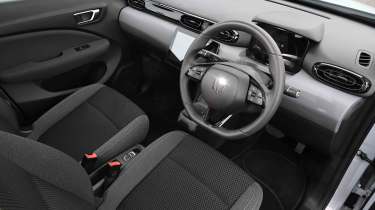
This isn’t a car you come to for an inspiring interior design, because the T03 is fairly plain to look at, even beside budget rivals such as the Dacia Spring. With so many controls located on the touchscreen, which we’ll address later, the cabin remains fairly sparse. The Mercedes-style column-mounted automatic shifter is fairly intuitive, and the steering wheel has a few buttons for trip and audio functions, but it does feel pretty bare.
Materials and build quality
The plastics are hard, which is common with city cars, but there’s nothing that feels overly cheap and nasty inside. It doesn’t look quite as substantial as a Kia Picanto, but it’s perfectly adequate. Fabric sections in the door panels might seem like a simple touch, but they help to lift the feel above some other alternatives at this price.
Infotainment, sat-nav and stereo
For a car so small, Leapmotor has packed the T03 with standard tech. This includes keyless go, electrically adjustable and heated door mirrors, an electronic parking brake, four electric windows, rear parking sensors, adaptive cruise control and even a large panoramic sunroof with an electric blind.
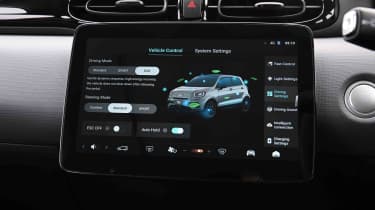
There’s also a digital instrument panel and a 10-inch touchscreen display. The name Leap OS4 suggests this is the fourth iteration of the firm’s in-car software, but we think that the brand needs to go through a couple more heavy updates before the system is in reasonable working order.
There are currently too many irritations. The on-screen menus and keys are far too fiddly, while certain functions, such as the heating controls, are confusing. It feels like Leapmotor has laid things out differently for the sake of it rather than for any ergonomic benefit.
While part of us thinks that we should be grateful that a car so cheap comes with a touchscreen at all, the fact that so many functions are operated through the display means it must be held to a high standard, and it misses the mark.
We rarely approve of confining heating controls to a touchscreen, and here they’re needlessly messy; they’re accessed by a small shortcut key on a bar running along the base of the display, and once the page has been opened, you can choose to either turn on a heater or a cooler, rather than select a simple temperature choice as in almost any other car. Worse still, the headlights are also controlled by the screen. While some might argue that automatic headlights make the need for physical controls less important, automatic units aren’t infallible, and such a fundamental function should be made a priority with physical switches as you’ll find on the Hyundai Inster.
If the system in the Leapmotor deserves credit in one area, however, it’s that the reversing camera is impressively sharp by any standard, let alone on a car this cheap.
The incessant series of bings and bongs from the various safety systems seems unnecessary. This is a familiar complaint about Chinese cars, and is as bad here as in any new model I’ve tested; what should be a help feels more like a hindrance." - Richard Ingram, Deputy editor.
Boot space & practicality
Pros |
|
Cons |
|
At just 3.6 metres long, there are few new cars smaller than the T03. But while it’s tiny, it makes great use of the space it takes up.
Dimensions and size
As we’ve already mentioned, the Leapmotor T03’s short length is not only less than its closest Dacia Spring and Hyundai Inster rivals, but makes the T03 one of the shortest cars around - impressive given it has five doors. However, it is both wider and taller than its competitors, which benefits overall practicality.
| Dimensions comparison | |||
| Model | Leapmotor T03 | Dacia Spring | Hyundai Inster |
| Length | 3,620mm | 3,701mm | 3,825mm |
| Width | 1,652mm | 1,583mm (1,767mm inc mirrors) | 1,610mm (1,875mm inc mirrors) |
| Height | 1,577mm | 1,519mm | 1,575mm |
| Wheelbase | 2,400mm | 2,423mm | 2,580mm |
| Boot space | 210-880 litres | 308-1,004 litres | 280-1,059 litres |
Seats & passenger space
Up front, the T03’s cabin feels light and airy, with a deep dash reaching out towards the short bonnet, and just a small console jutting out of the bottom against an otherwise open floor area.
The steering wheel adjusts for height only (not unusual at this price) and while there’s reasonable adjustment in the seat, we were left wishing for a little more support at the sides and from the base cushion. It’s okay for the most part, but on slightly longer trips it starts to become a little less comfortable.
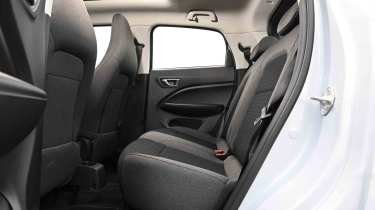
Passenger space in the back is excellent for a car of this size. There’s more space here than you’ll find in other city cars such as a Spring or Picanto, and even some compact SUVs such as the Jeep Avenger. If you regularly carry four adults on short urban trips, few cars fit the bill better.
Boot space
A 210-litre boot capacity is behind its nearest rivals, falling well short of the 308 litres offered by the Spring. While you won’t be squeezing big dogs or bulky items in there, some clever packing should still mean the load bay will offer enough room for a reasonably big supermarket shop.
A pair of adults in the front will be fine for shorter journeys, but you’ll have to be comfortable making close acquaintance with your passenger because there isn’t a huge amount of shoulder room available. This is highlighted by the fact there’s no space made available for a central armrest. - Richard Ingram, Deputy editor
Reliability & safety
Pros |
|
Cons |
|
It’s one thing having safety technology that will pass a controlled lab assessment – and we’ll see how the T03 fares when Euro NCAP tests it – but how the kit works in the real world is another completely.
We’ve complained about the accuracy of speed-limit warning systems in the past – and the T03 isn’t great in this respect, reading the wrong road signs from time to time, too – but it’s the lane-departure warning and lane-keep systems that are the most frustrating.
The latter is far too keen to tug on the wheel to prevent you straying from a lane, while the former bongs at the driver even if they stay to within 30 centimetres or so of the white line. Along narrow country lanes, where there is often little choice but to drive close to the centre of the road, it becomes infuriating.
Disabling all of these systems requires diving into the touchscreen infotainment system – at which point the distraction-warning system bongs in protest because the layout is so fiddly that your gaze is diverted from the road for too long.
A burning question for interested customers will be around the dealer network and after-sales support. The good news is that thanks to its tie-up with Stellantis, Leapmotor will have around 80 franchises by the end of 2025. Owners will also be supported by a standard four-year/60,000-mile warranty – trumping the three years offered in mainland Europe.
Buying and owning
Best buy: Leapmotor T03
There’s just the one model on offer, so all you need to do is pick which colour you’d like out of the standard Mint Green or optional Light White, Canopy Grey, or Glacier Blue, which cost around £650 extra. Starry Silver is presently a stock-only option.
Leapmotor T03 alternatives
There are very few all-electric rivals to the Leapmotor T03 at its price. The most obvious is the Dacia Spring, which has a cheaper variant (by £5) and a more expensive version at around £1,000 more. While the Dacia has a bigger boot and a much more recognisable badge, the Leapmotor has more range and is better equipped.
The Hyundai Inster is of a similar size to the T03, but its additional refinements, larger capacity battery, and faster charging speeds make it significantly more expensive to buy outright. If you plan on regularly undertaking longer trips in your electric city car, that additional expense might be worth it.
A slightly leftfield alternative is the near £18,000 Microlino. It’s a modern interpretation of the classic Isetta bubble car from the sixties, so it’s certainly got plenty of character. The Microlino’s 114-mile range isn’t the best, though, and neither is its performance, because it tops out at 56mph. In reality, it’s more of a city-based car than the Leapmotor.
If it’s basic city transport you need, then the Citroen Ami is a quadricycle that can do no more than 30mph, but you don’t need a car licence to drive one.
Key updates of the Leapmotor T03 review
4 February 2026: Review updated to include our real-world efficiency figures, the revised EV luxury car tax threshold, and a mention of the proposed eVED pay-per-mile scheme.
Pictures of the Leapmotor T03
Deals on the T03 and alternatives
Frequently Asked Questions
For the money, the Leapmotor T03 offers pretty outstanding value for money on the new-car market. It comes with lots of kit, and everyday running costs should be reasonably low, but there are compromises to be had with the frustrating touchscreen system and over-active safety systems.