Volvo ES90 vs DS No8: Swedish minimalism meets Parisian style in EV exec test
Fancy an executive car that isn’t German? Two recently launched contenders are here to tempt you into trying something new

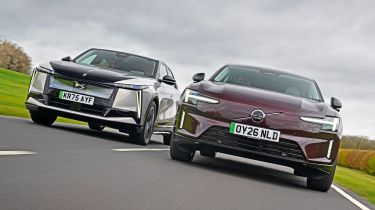
Some people would argue that buying anything other than a German executive limousine is tantamount to burning wads of cash on a bonfire, but here we’re testing a pair of new all-electric machines from Sweden and France that are challenging that traditional thinking.
First up is the Volvo ES90, which replaces the combustion-engined S90 in the Swedish company’s line-up, and uses running gear that’s shared with the seven-seat EX90 SUV. The newcomer is a bit more practical than the S90, thanks to its hatchback rear, while the interior features plenty of tech and premium materials that boost its upmarket appeal.
Our other contender is the DS No8, which is described as an SUV coupé by its maker and replaces the DS 9 at the top of the French luxury firm’s UK line-up. It has price on its side when compared with the Volvo, while its unique design touches mean it really stands out from the mainstream. That hasn’t always been a plus point in the eyes of conservative car buyers, so does the DS No8 have the talent to appeal to a broader market beyond fans of quirky French machinery? Or does the Volvo make more sense here?
Did you know you can sell your car through Auto Express? We’ll help you get a great price and find a great deal on a new car, too.
Volvo ES90
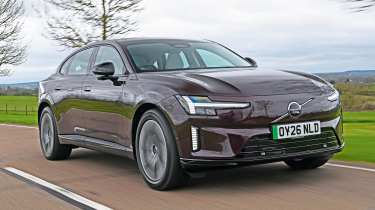
| Model: | Volvo ES90 |
| Price: | £67,560 |
| Powertrain: | 92kWh battery, 1x e-motor, 328bhp |
| 0-62mph: | 6.6 seconds |
| Test efficiency: | 3.3 miles/kWh |
| Official range: | 411 miles |
| Annual VED: | £640 |
The ES90 uses the same platform as the EX90 SUV and Polestar 3, while there are 92kWh and 106kWh battery options. The former is fitted to the Single Motor version, while the latter powers the Twin Motor and Performance editions.
Used - available now

2024 Audi
A3 Sportback
32,749 milesAutomaticPetrol1.5L
Cash £19,197
2023 Hyundai
Tucson
46,092 milesAutomaticPetrol1.6L
Cash £19,870
2023 Kia
Sportage
36,542 milesAutomaticPetrol1.6L
Cash £21,670
2021 Ford
Focus Estate
48,481 milesManualDiesel1.5L
Cash £12,290We’re testing the entry-level Plus, which comes only in Single Motor guise. Ultra trim costs around £10,000 extra, while it’s £81,500 for the Twin Motor and £88,000 for the Performance version.
Tester’s notes
Adjusting the door mirrors in the ES90 is a bit more complicated than simply playing with a toggle switch on the driver’s door. As in a Tesla, you adjust them via the touchscreen.
Select which mirror you want to adjust, and then you use the right-spoke buttons on the steering wheel to move them up, down, left and right. It seems like a bit of a faff, but then how often do people adjust the mirrors once they’re set up in the first place? Handily, Volvo gives you the option to fix them (and the seat position) at that point for each time you get into the car.
Volvo has tapped into the novelty of dual-function controls in a couple of places. The electric window selector on the driver’s door has a Volkswagen-style set-up, where you press a button to choose between front or rear windows for the two switches.
When you adjust the electric driver’s seat, a controller adjusts the base and back, but press the button in the middle, and the same controller also tilts the seat and alters the lumbar support. One feature that’s manually operated is the extendable seat cushion.
DS No8
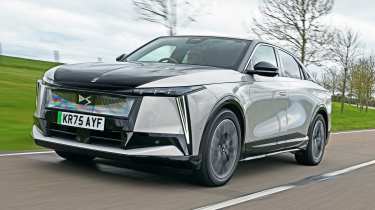
| Model: | DS No8 |
| Price: | £63,290 |
| Powertrain: | 97kWh battery, 2x e-motors, 370bhp |
| 0-62mph: | 5.4 seconds |
| Test efficiency: | 2.9 miles/kWh |
| Official range: | 412 miles |
| Annual VED: | £640 |
Since it’s based on Stellantis’s STLA Medium platform, the DS No8 has even more relatives than the Volvo, including the Peugeot 3008/5008 and Vauxhall Grandland, but the DS is electric only.
There are 74kWh and 97.2kWh battery options, with the latter available with either front or four-wheel drive. Trim levels are Pallas, Etoile and Jules Verne, and prices range from £50,790 to £68,790.
Tester’s notes
The No8 is designed to be DS’s flagship car, but there needs to be greater attention to detail to the fit and finish at this level to make it feel like a properly premium machine.
Take the bootlid as an example. It has ‘DS Automobiles’ emblazoned across it in brushed metal-effect lettering, but the grain of the letters is inconsistent, so some characters look darker or brighter, depending on how the light catches them. The exterior door handles don’t feel particularly solid, either, and the C-pillar releases for the back doors are fiddly, too.
The square metal panels on the doors have a dual function. Firstly, they’re illuminated along the leading edge, and this is where the grab handle to close the door is located. However, this position is a little awkward and means the doors need a bit of a yank to get them closed.
The grille that’s cut into the surface hides the speakers for the Electra 3D Focal sound system that’s a £2,200 option for the mid-range Etoile car. The set-up sounds great, with 14 speakers around the cabin delivering excellent surround-sound audio quality.
Head-to-head
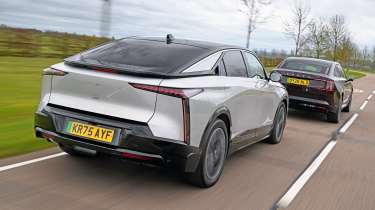
On the road
These are large, heavy executives, so they major in comfort above anything else. The Volvo feels more limousine-like, with a smooth ride at higher speeds that’s only disturbed when the long wheelbase sends bigger bumps back through the cabin.
There’s more fidget to the DS’s ride, but it’s still reasonably comfortable. However, while it’s faster and more powerful than the ES90, the powertrain isn’t very responsive.
Tech highlights
The ES90 shares plenty with the EX90 and Polestar 3, having the same touchscreen infotainment and compact driver’s display. It’s easy to get along with, and the Google-derived operating system is slick and easy to use.
While the DS No8 is packed with quirky features, you don’t have to delve too deep to find plenty of tech that’s shared across the Stellantis line-up: it’s just been given a more upmarket look.
Price and running
Neither car is cheap to buy, but efficiency is reasonable for their size. We saw 3.3 miles per kWh from the Volvo, which translates into a range of 290 miles, but that’s some way short of the 411-mile official figure.
The DS wasn’t as efficient as the Volvo on test, recording 2.9mi/kWh, but its bigger battery means it isn’t far behind for overall range, at 282 miles. Again, however, this trails the official figure of 412 miles.
Practicality
Passenger comfort should be a priority in cars such as this, but neither rival is particularly outstanding for back-seat space.
There’s just enough headroom in both models, thanks to their sloping roofs, but high floors leave the seats in an awkward position with a shortage of under-thigh support. The Volvo has more kneeroom than the DS, but foot space under the front seats in both cars is limited.
Safety
Neither car is left wanting for safety kit, and Volvo especially takes pride in its safety efforts, even down to stamping ‘Since 1959’ on the seatbelt buckles on the ES90.
While the Volvo hasn’t been tested by Euro NCAP just yet, the EX90 SUV has a five-star rating and features all of the same systems. The DS only has a four-star rating because there is no occupant detection or door opening warning.
Ownership
Both cars come with a three-year/60,000-mile warranty and the option to extend at extra cost. Since Volvo is a premium brand, it should deliver a high standard of customer service, and its 13th-place ranking in the 2025 Driver Power survey reflects this.
DS is less of a known quantity because of its links with Citroen, but the company is attempting to offer a concierge level of service to DS No8 buyers.
Verdict
Winner: Volvo ES90
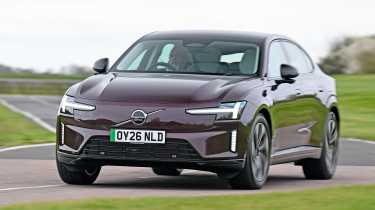
There’s a bit of a price difference between these two cars, with the base version of the ES90 costing more than the highest-spec DS No8, but it really is a case of getting what you pay for. The Volvo is more luxurious, more efficient and has better space in the back, and yet the base model is so well equipped that it seems frivolous to upgrade to another version.
It’s not without its faults, though. Rear space isn’t as generous as it could be, courtesy of the high floor, and while comfort is good, there’s not much fun to be had from behind the wheel.
Runner up: DS No8
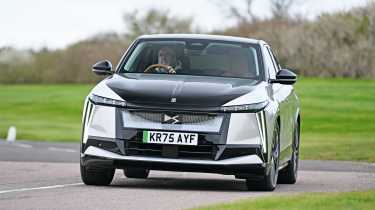
There is a lot to like about the DS No8. The looks will be a matter of taste, but we like that DS has gone out on a limb with the coupé-SUV look after the more restrained DS9, while the cabin’s Art Deco ambience offers a breath of fresh air when compared with more conservative executive rivals.
It’s quiet and refined, and the suspension is largely comfortable, if not as pillow soft as we’d like from a maker that emphasises past luxury. The biggest disappointment is the relative lack of space in the back.
Prices and specs
| Model tested | Volvo ES90 Extended Range Plus | DS No8 Long Range Etoile AWD |
| Price from/price as tested | £67,560/£67,560 | £50,790/£63,290 |
| Powertrain and performance | ||
| Powertrain | 1x electric motor | 2x electric motors |
| Power/torque | 328bhp/480Nm | 370bhp/511Nm |
| Transmission | Single-speed/RWD | Single-speed/4WD |
| 0-62mph/top speed | 6.6 seconds/112mph | 5.4 seconds/118mph |
| Interior noise 30/70mph | 84/93dB | 86/92dB |
| Battery capacity/usable | 92/88kWh | 97.2/97.2 |
| Official range | 411 miles | 412 miles |
| Test efficiency/range | 3.3mi/kWh/290 miles | 2.9mi/kWh/282 miles |
| Charging | 310kW (10-80% in 22 mins) | 160kW (20-80% in 27 mins) |
| Dimensions | ||
| Length/wheelbase/width/height | 5,000/3,102/2,054/1,554mm | 4,820/2,900/1,900/1,580mm |
| Front door opening width/height/sill height | 685/990/470mm | 710/1,010/442mm |
| Rear door opening width/height | 830/950mm | 865/950mm |
| Rear kneeroom/headroom/elbow room | 625-850/875/1,480mm | 565-785/880/1,475mm |
| Boot opening width/height | 995/915mm | 985/1,085mm |
| Boot space (front/seats up/down) | 22/424/1,427 litres | N/A/581/1,514 litres |
| Boot length/width/lip height | 1,010/1,035/790mm | 1,120/985/755mm |
| Kerbweight/payload/towing weight | 2,335/565/1,600kg | 2,289/511/1,400kg |
| Turning circle | 11.8 metres | N/A |
| Costs/ownership | ||
| Residual value (after 3yrs/36,000 miles) | £30,740/45.5% | £33,101/52.3% |
| Depreciation | £36,820 | £17,689 |
| Ins. group/theAA.com quote/VED | 44/£1,498/£640 | 42/£1,498/£640 |
| Annual tax liability std/higher rate | £540/£1,080 | £506/£1,012 |
| Annual fuel cost (10k miles) | £748 | £851 |
| Basic warranty/recovery | 3yrs (60,000 miles)/3yrs | 3yrs (60,000 miles)/3yrs |
| Extended warranty | Up to 4yrs (80,000 miles) | Up to 4yrs (100,000 miles) |
| Driver Power manufacturer position | 13th | N/A |
| NCAP Adult/child/ped./assist/stars | Not yet tested | 76/85/80/65/4_ (2025) |
| Equipment | ||
| Metallic paint/wheel size | £845/20 inches | £900/20 inches |
| Parking sensors/camera | Front & rear/360 degrees | Front & rear/360 degrees |
| Spare wheel/Isofix points | Repair kit/two | £300/two |
| Keyless entry & go/powered tailgate | Yes/yes | Yes/yes |
| Seat upholstery/leather | Artificial/£1,495 | Alcantara/£1,600 |
| Heated seats/steering wheel | Four/yes | Front/yes |
| Screen size/digital dashboard | 14.5 inches/9.0 inches | 16.0 inches/10.25 inches |
| Climate control/panoramic sunroof | Four-zone/yes | Two-zone/£800 |
| USBs/wireless charging | Four/yes | Four/yes |
| Wireless CarPlay/Android Auto | Yes/yes | Yes/yes |
| Blind-spot warning/head-up display | Yes/Yes | Yes/yes |
What we would choose
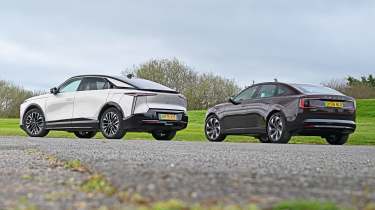
Volvo ES90
You can add kit from Ultra trim to the Plus model, including electrochromatic tinting of the panoramic glass (£995) and air suspension (£1,995). Vented seats are £800, but Nappa leather (£1,495) is only an option on Ultra cars.
DS No8
The black bonnet and roof cost £500, while you can add smaller 19-inch wheels (£150) or larger 21-inch rims (£1,100). Our car’s brown Nappa leather is a £1,600 add-on; the Etoile model has blue Alcantara as standard.
Looking for your next car? You can now search our nationwide dealer network for a choice of great cars on offer right now with new, used and leasing deals to choose from...