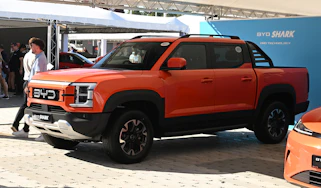
New BYD Shark 2026 review: the Ford Ranger PHEV has a real rival
The new BYD Shark pick-up has arrived in the UK and there's lots to like, but the way it drives is a let down

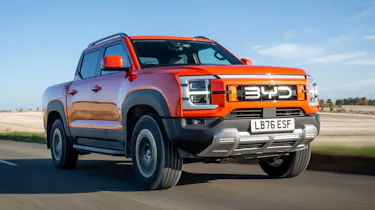

Verdict
The BYD Shark comes with plenty of kit, interior space and quality to really work as a plug-in hybrid family vehicle. The Shark’s blend of quietness and off-road ability is pretty remarkable, but the on-road dynamics, especially in urban areas, do let it down. At the very least, BYD has made sure with the Shark that the fledgling plug-in hybrid pick-up truck market is already a fiercely competitive one.
BYD is quickly looking to cover all the most important segments in the UK market and next on its list is the one for pick-up trucks, which it is looking to conquer with the new BYD Shark.
The pick-up truck sector is a tricky one to succeed in. The Mercedes X-Class, the Nissan Navara it was based on, the Fiat Fullback and the Mitsubishi L200 all fell by the wayside in recent years - although the L200 has made a comeback. If there’s one brand with the ambition and resources to take a slice of the pick-up pie, then it’s BYD.
The Shark has already been on sale in several other markets, including Australia where it’s become the country’s most popular plug-in hybrid. It’s not quite the most popular truck or ‘ute’, over there though - that honor goes to its biggest rival, the Ford Ranger.
Used - available now

2023 Tesla
Model Y
44,333 milesAutomaticElectric
Cash £21,676
2021 Mercedes
A-Class
59,959 milesAutomaticDiesel1.5L
Cash £15,697
2023 Vauxhall
Corsa
21,687 milesManualPetrol1.2L
Cash £11,897
2023 Citroen
C3 Aircross
51,969 milesManualPetrol1.2L
Cash £9,997There is also the ever-present Toyota Hilux (which is now available as a full-EV), the Volkswagen Amarok, plus the budget-focused Isuzu D-Max and GWM Poer 300 - but the BYD Shark is plug-in hybrid only, a powertrain option that only the Ford Ranger can offer.
On paper, the BYD possesses some class-leading stats. The ‘Super Hybrid’ plug-in hybrid system in the Shark has been used on the Seal U and Seal 6 passenger cars, but the pick-up truck gains DMO - BYD’s Dual Mode Off-road system. That refers to a dual-motor set up with one on the front axle developing 231bhp and 310Nm of torque, and another at the rear producing 204bhp and 340Nm. The combined maximum system output is 435bhp and 650Nm of torque, enough for a zero to 62mph time of just 5.7 seconds - a couple of seconds quicker than the Ranger PHEV.
While there is a 150bhp 1.5-litre turbocharged four-cylinder petrol engine, BYD says the hybrid system is designed to offer an ‘EV-first driving experience’. To achieve this, the petrol unit’s main purpose is to generate electricity for the motors directly, or for the Shark’s battery - which is a huge 32.2kWh unit, that’s bigger than the batteries in small fully-electric cars like the Renault Twingo or even the BYD Dolphin Surf.
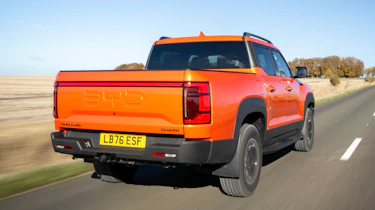
The Shark makes use of a ladder frame chassis like most pick-up trucks, but the battery is incorporated into the centre of the body thanks to ‘Cell-to-Chassis’ technology, which not only helps with packaging and rigidity, but also protects it in rougher conditions.
Having such a large battery (almost three times the size of the Ranger PHEV’s) means the BYD’s electric range is massive. At 55 miles, it’s over double that of the Ford’s and even more than plug-in hybrid SUVs like the Mitsubishi Outlander and Kia Sportage. The charging is also impressive for a PHEV with a 55kW DC charger taking 21 minutes to go from 30 to 80 per cent.
If you’re using the Shark for relatively short journeys every day and have a place to charge it, there’s really no reason to not run this big pick-up on EV power only, saving yourself a bundle, especially at the current state of petrol prices.
Things aren’t as rosy for longer-distance drivers because the Shark only has a 60 litre fuel tank to the maximum range is only 419 miles, plus the combined WLTP mpg is just 80.7mpg - 14mpg less than the Ford.
BYD helpfully gives an efficiency figure for the Shark with a drained battery, which is 29.4mpg. During our drive we drained the battery to its lowest level - the Super Hybrid keeps some battery power in reserve but we saw it go down to 25 per cent with zero electric miles. At this point the Shark was returning 25mpg. Like any plug-in hybrid, the Shark only really makes sense when you’re regularly charging it up.
The usual EV and HEV (hybrid) modes are available on the Shark with the latter coming on by default if prolonged, hard acceleration is needed - though that’ll be rare given the amount of punch the two electric motors possess. When the petrol engine is being worked, it’s noticeably gruff and in certain drive modes the revs can rise and fall wildly and seemingly out of sync with the Shark’s actual speed.
On the whole, though, the plug-in hybrid system is very well matched to the Shark’s abilities - which go far beyond its lengthy EV range.
Our first excursion in the Shark was over an off-road course. There are no locking differentials or low-range transfer cases on the Shark as both axles are powered independently with no propshaft in between the two (the massive battery wouldn’t leave any room anyway). While you might think this would hinder the big BYD’s capability in the rough stuff, it took on steep inclines without any hassle with hill descent control working perfectly well on the downslope.
Our route took us through some nasty looking ruts and muddy ditches, but the distribution of torque between each axle along with 230mm of ground clearance (15mm more than the Ford) ensured we didn’t get stuck. The 700mm wading depth also came in handy crossing a river that you would think twice about in a lot of 4x4s. The only caveat to our off-road experience was that our car was fitted with fairly knobbly all-terrain tyres - on normal road tyres we would’ve probably struggled a bit more.
While there are sand, mud, snow and gravel off-road modes, more important is how the Shark behaves on the road so switching to Normal we set off (with a car on summer tyres). The first thing you notice is how quiet the Shark is. There’s very little road noise troubling the cabin and despite the bluff front end and massive wing mirrors - wind noise is kept at bay, too.
It doesn’t quite convince you that you’ve switched from a truck to a more refined electric SUV however, because the low-speed ride is pretty agricultural. Over speedbumps, potholes or even just slightly rougher roads, the Shark can shudder and vibrate. BYD says the independent double-wishbone suspension at both front and rear, achieves an optimal balance between handling and comfort. While it is incredibly stable off-road as a result, there seems to be too much focus in containing the Shark’s sizeable 2,710kg kerb weight by firming up the damping. A positive is that at really low speeds around car parks and slow moving traffic, the Shark doesn’t feel too cumbersome - unlike some trucks with their overly-soft suspension.
The steering calibration isn’t quite there either. It makes sense for the big, heavy Shark to have suitably heavy steering, but the inconsistent resistance to your inputs isn’t the nicest or most confidence-inspiring feeling.
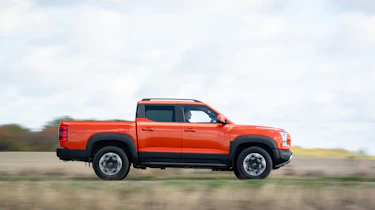
Perhaps surprisingly for a truck, it’s at motorway speeds where the Shark feels at home. It settles down both in terms of its ride and steering, plus the electric side of the powertrain is just as happy cruising along or dispatching a few middle-lane hoggers with bursts of torque.
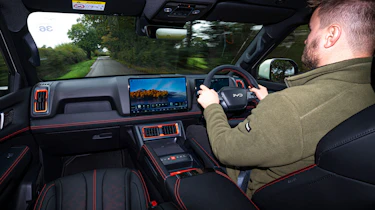
Inside the Shark feels very well put together - we poked around and could only find sturdy trim pieces with no obvious creaks or rattles while driving either. While most of the Shark’s functions are on the massive 15.6-inch touchscreen, there are still buttons for the drive modes, demister and the electronic tailgate and they all have a satisfying click. The infotainment software itself is something we’ve experienced in plenty of BYDs. While its displays and layouts are a bit overwhelming (driver’s display included), the integration of Apple CarPlay is very well thought-out with the shortcut menu also visible beneath.
The space inside the Shark is excellent as well. There’s a massive storage area under the centre armrest and in the back, so often an afterthought on dual-cab pick-up trucks, there’s plenty of space for adults to get comfortable. The 11kW onboard charging cable can be stored behind the rear seat backs as well.
There’s just one trim level, but it’s very well catered for with a 12-speaker sound system, heated and cooled front seats with faux-leather trim, front and rear parking sensors, a 360-degree camera system and a head-up display. There’s also vehicle-to-load charging, which comes from two three-pin plugs in the bed.
It all sounds very promising, but then the Shark is limited by its payload capacity. Standing at 790kg it’s way down on the 1,000kg the Ford Ranger PHEV offers and also means the BYD isn’t eligible for a VAT refund for business users, unlike the Ranger. The towing capacity is 2,500kg as well, 1,000kg less than the Ford.
At £47,290, the BYD Shark is £1,639 cheaper than the Ford with VAT applied to both. For retail buyers looking for a plug-in hybrid truck for personal use, the BYD makes an excellent case for itself, though for business users the Ford is still the prudent choice.
| Model: | BYD Shark DMO |
| Price: | £47,295 |
| Powertrain: | 1.5-litre turbocharged four-cylinder petrol + 2x electric motors |
| Combined power/torque: | 435bhp/650Nm |
| Transmission: | Single-speed auto, AWD |
| 0-62mph: | 5.7 seconds |
| Top speed: | 111mph |
| Economy/CO2: | 80.7mpg/23g/km |
| EV range/max charging: | 55 miles/55kW |
| Size (L/W/H): | 5,457/1,971/1,925mm |
| On sale: | Now |