New Audi RS 5 2026 review: predictably great to drive but surprisingly efficient
It's heavy and plug-in hybrid powered, but the Audi RS 5 is still a fully fledged BMW M3 challenger


Verdict
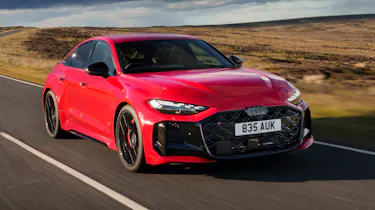
You might not find the latest Audi RS 5 to be quite as visceral or engaging as its key rival from BMW, nor is the cabin design or exterior styling quite as on point as in RS models of the past. But for sheer breadth of ability and quality of engineering, it brings the RS sub-brand into a whole new era. The plug-in hybrid system also offers distinct ownership benefits, and while there are compromises in terms of packaging, for many this will be a worthwhile trade-off.
It might not look it, but the Audi RS 5 is a whole new type of high-performance compact executive saloon for the German brand – one that introduces complex fresh hybrid technologies to make it the right fit for both buyers and regulations in 2026.
This transition for AMG and BMW hasn’t always been smooth, but Audi thinks it’s nailed the formula with the RS 5. Now, having spent some decent time with the car in the UK, we can finally reach a definitive verdict on whether it has succeeded.
Launching in both Avant estate form and the sleek saloon bodystyle we’re driving here, the new RS 5 in effect replaces the former RS 4 Avant and RS 5 Sportback. This is a bigger and more technically advanced car, but it’s also more expensive, at £89,400 for the base saloon, rising all the way to £109,385 for the top-spec Vorsprung Avant. However, a BMW M3 Competition now starts at more than £90,000, so maybe we need to accept that this is the going rate for this type of car.
Used - available now


All RS 5s have the same technical basis, centered around a new plug-in hybrid powertrain. Core to this is a heavily updated version of the existing twin-turbocharged 2.9-litre V6 petrol engine. This was used in previous-generation RS models, plus a range of Porsches, too.
To this, Audi has fitted an electric motor onto the eight-speed automatic gearbox, which lifts power to 630bhp. This is a big increase on the RS 4’s 444bhp, and isn’t just derived from the added electric motor, but deep-rooted mechanical upgrades to the engine itself. Peak torque is rated at 825Nm. Of course, the RS 5 is still all-wheel drive, and to help distribute this performance as effectively as possible, Audi has fitted a clever new type of rear differential that’s able to finely control drive across its rear wheels.

The electric motor draws its energy from a 25.9kWh battery pack, which gives the RS 5 up to 50 miles of combined electric range, and helps pin the combined mpg figure to a rather impressive 68mpg. The benefits of a plug-in hybrid system don’t come without compromises, though. There are two main issues, the first being the tiny 46-litre fuel tank, and just 331 litres of luggage space in this saloon. The Avant fares little better in this respect.
However for drivers, the biggest problem may well be the RS 5’s 2,355kg kerbweight, which blunts much of its performance advantage against key rivals. Audi quotes a 0-62mph time of 3.6 seconds, but this is actually a tenth of a second slower than the M3 Competition, despite the BMW’s 100bhp+ power deficit.
Yet numbers on paper only tell half the story, and the brilliance of Audi’s RS models has generally been defined by their ability to effortlessly meld daily usability with exhilarating performance. In this regard, the RS 5 delivers.
The plug-in hybrid system feels like an effortless addition to the RS 5, as the low-speed calibration of the throttle and brake pedal is excellent, and the e-motor on its own still has more than enough power to comfortably keep up with traffic. While the 50 miles of WLTP range sounds impressive, this figure will be tricky to match – especially if there’s any sustained high-speed driving. Expect more like 30 miles if you venture out onto a motorway.
When the V6 engine does feel the need to kick in, though, it’s almost entirely silent. It’s really quite exceptional, and proves that Audi has made major progress in the calibration of these systems compared to the clunky plug-in hybrid units found in early Audi Q5s and the like.
Across a combination of urban and fast A-road driving over the course of 50 miles, we managed a reasonable 60.2mpg while taking around 30 per cent out of the battery. This is hardly going to save the ice caps from melting, but it’s more than double what you might get in the previous generation. And without any charge left in the batteries, 30mpg is just about possible. However, this is where the small fuel tank’s limitations come in, as at this mpg the realistic range is pretty terrible, which is a big drawback for those who intend to use it as a daily driver.
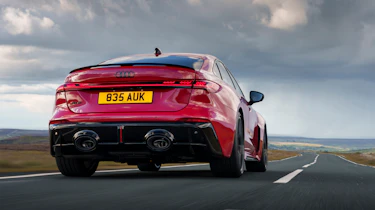
However, turn up the wick and the RS 5’s 630bhp feels evident, as it has very impressive straight-line performance. In its Dynamic or RS modes, the Audi pretty much drives like any other high-performance petrol car, with the electric motor chiming in to fill gaps before the turbochargers have the chance to spin and give that final electric boost. The RS 5 also now produces some interesting, albeit muted, acoustics from those massive exhaust pipes.
However, the most impressive part of the Audi’s dynamic capability is its truly excellent ride and handling. This is a heavy car, but to the RS 5’s credit it doesn’t feel it. The combination of superbly calibrated suspension, a subtle but effective rear-wheel-steering system and accurate steering full of feel gives the car almost supernatural capabilities.
Audi has long been associated with making fast road cars for all weathers and conditions, and this is certainly still the case here. Sure, it lacks the edge and excitement of a BMW M3 Competition, and if you take these cars on track, the M3 would run rings around the bigger and heavier Audi. But for everyone else, the RS 5 feels like a different, more versatile and more capable type of high-performance executive car.
However, beyond this car’s spread of driving talent, there’s another reason this RS 5 might be the right car for right now. Because the BMW M3 Competition does without any form of hybridisation, its high CO2 figure puts it in the maximum Benefit in Kind tax bracket if purchased through a business – as many high performance cars like this are. Thanks to a bit of help from the PHEV system, the Audi avoids this.
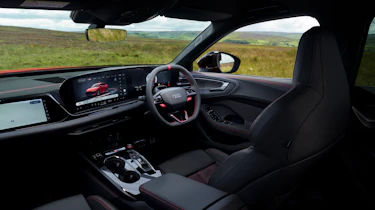
The two might cost largely the same on paper, but the Audi’s 50-mile electric range means you’ll see a saving of over £400 per month just in tax. That electric range will also come into its own if you have access to cheap home charging and regularly do short journeys, increasing the gulf in running costs. Unfortunately, there’s no DC fast charging for the batteries, so a quick top-up on the move isn’t really an option. On the 11kW AC system, it’ll take close to three hours to charge.
Audi RS models have long directly competed with rivals from AMG and BMW M in terms of size, price and the capabilities they offer. But thanks to its PHEV system, this new RS 5 largely sits in a class of one. And while two new BMW M3 models are coming, these will operate with either mild-hybrid or full BEV powertrains only. If you want a PHEV M car, you’ll need to find an extra £25,000 and a few extra feet of driveway for a BMW M5.
AMG’s Mercedes C-Class competitor is also absent, although not for the lack of trying. Mercedes made the decision to design and engineer a system based around a four-cylinder petrol engine paired to a less substantial hybrid system that offered almost no electric range. This, plus some rather uninvolving driving dynamics, landed with fans like a lead balloon, causing AMG to cancel the model entirely. Its C 53 replacement will pack an inline-six, but this should be considered more of an S5 rival due to some fairly underwhelming performance stats.
So while the RS 5 might not be the most exhilarating compact executive hot rod in history, it might well be the only one you can actually justify in 2026. It seems Audi has once again delivered on its mission to create an ultimate everyday driver.
| Model: | Audi RS 5 Carbon Black |
| Price: | £95,485 |
| Powertrain: | 2.9-litre V6 petrol PHEV |
| Power/torque: | 630bhp/825Nm |
| Transmission: | Eight-speed auto, all-wheel drive |
| 0-62mph: | 3.6 seconds |
| Top speed: | 155mph |
| Economy: | 70mpg, 92g/km |
| Size (L/W/H): | 4,896/1,952 (no mirrors)/1,428mm |
| On sale: | Now |
Want the latest car news in your inbox? Sign up to the free Auto Express email newsletter...