Rejoice! Electric VWs getting cheaper thanks to breakthrough battery tech
VW is ready to use new battery technology to drive down the cost of its new, affordable electric cars

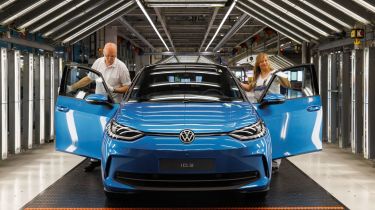
Volkswagen electric cars are set to become more affordable as the firm rolls out new LFP battery tech – packing good energy density and lighter weight – from its new small EVs to the ID.3, ID.4 and ID.7.
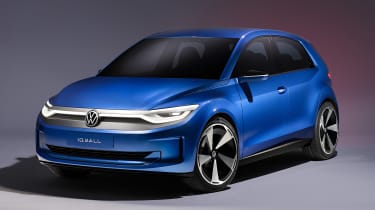
The Polo-sized ID.2 – going public in autumn 2025 – should have an entry price close to £20,000, and the 2027 ID.1 production version of the ID.Every1 concept could come in around £17,000. Today’s cheapest electric Volkswagen is the £30,000 ID.3 hatchback – but this could get some pricing wriggle room as it adopts the cheaper new tech.
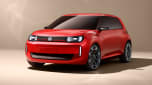
VW’s baby BEVs are introducing lithium iron phosphate (LFP) batteries, which use raw materials that are typically cheaper than the Nickel Manganese Cobalt (NMC) cathode design powering the current ID range. LFP isn’t as energy dense as NMC but Volkswagen will overcome that by cramming more cells into its cars using a new ‘cell-to-pack’ system. And the existing MEB platform – which underpins all electric Vee-dubs – will be revamped into an 'MEB Plus' version accommodating the new battery pack for early 2026.
"We decided to upgrade to MEB Plus next year, and to roll out the cell-to-pack battery systems with LFP. It'll be a major step forward in terms of cost for us," Volkswagen brand boss Thomas Schäfer told Auto Express in a meeting at the Financial Times' Future of the Car Summit.
"It's all in the plan. We come in with MEB Plus across the models including ID.3, ID.4, ID.7 – all have LFP. In the volume game, LFP is the technology." And the changes won't just be under the skin, with the revamped ID.3 getting the ID.2's new family look.
Cell-to-pack battery design
The cell-to-pack design is similar to the Blade battery of Chinese car maker BYD, which layers long cells across its battery pack to boost energy density. The MEB31 battery module in today’s VW EVs needs a series of metal ribs to hold the rectangular modules in place, unnecessary structure the new design can jettison.
“The usable space is much better, we can pack in more energy density and it’s lighter,” VW engineer Malte Schulz told Auto Express in VW's Wolfsburg HQ. As a result, VW can get sufficient battery cells into the ID.1’s short wheelbase, while trimming some weight given that the Up! replacement has only a 94bhp motor.
The new cell-to-pack design is scalable to boost cost competitiveness: the same layout can also accommodate higher performance NMC cells for Porsche and Audi models. For MEB Plus they won’t be a ‘cell-to-body’ design – where the battery pack forms a structural part of the car, as in BYD’s Seal – though Volkswagen says this will come in a later stage.
Batteries made in Europe
The batteries will be manufactured in Europe, with pilot production underway at the Salzgitter gigafactory in Lower Saxony owned by VW spin-off PowerCo.
“The battery cell is the combustion chamber of tomorrow,” says Volkswagen Group CEO Oliver Blume. “It’s a core competency for VW Group, so we need the engineering knowledge and to own production. Salzgitter will ramp up this year.”
The plant will have a capacity of around 40 gigawatthours, and cell production will be split between LFP and NMC chemistries. At Salzgitter, "the majority will be LFP but it will also make NMC," Schäfer confirmed to Auto Express. "You can see the move towards LFP across the board, except for performance applications in upper end segments."
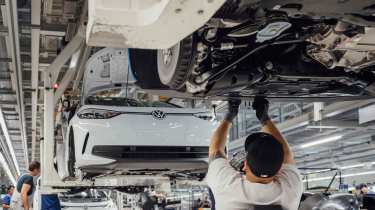
Another 60gWh will come on stream at PowerCo’s second European plant in Valencia, Spain, in 2026. A third factory is underway in Ontario, Canada, with up to 90gWh, which is due to open in 2027. That gives PowerCo and Volkswagen a capacity of around 200gWh.
Did you know you can sell your car with Auto Express? Get the highest bid from our network of over 5,500 dealers and we'll do the rest. Click here to try Auto Express Sell My Car now...