Future VW safety tech uncovered: from ‘soft bonnets’ to cars that pull over if you fall asleep
Volkswagen aims to increase safety for both vehicle occupants and vulnerable road users

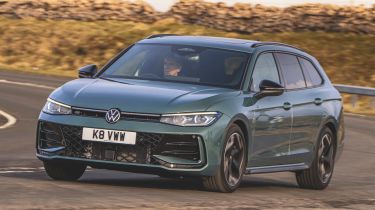
Volkswagen has given Auto Express an exclusive sneak peek at its current and upcoming driver assistance functions which aim to not only boost safety for occupants in a vehicle, but also vulnerable road users as well.
Proactive Pedestrian Protection (coming soon)
For a while now, so-called ‘active bonnets’ have been a key element of pedestrian safety, popping up to increase the distance between relatively soft human bodies and the comparatively rock-solid metal engine block, thus decreasing the chance and severity of injury.
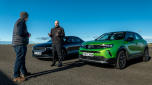
Volkswagen’s new solution, titled Proactive Pedestrian Protection will, like most active bonnets, work in tandem with the autonomous emergency braking system (AEB). Yet, while most systems utilise accelerometers to detect movement and pyrotechnics to deploy the bonnet, VW’s alternative instead incorporates the sensors from the AEB set-up to detect the size of an obstruction and – if it identifies something it believes could be a vulnerable road user – the bonnet will pop up utilising a spring-loaded mechanism.
This might not seem all too different at face value, but it does mean that if the active bonnet system is activated, it won’t require a technician and new actuators – something that can cost from a few hundred pounds to well over a thousand. VW says if a collision does occur, then the lack of pyrotechnics should make the set-up easy to repair, too.
Proactive Occupant Protection
Picture this: you’re sitting in a car, knowing full well that you’re about to be crashed into. Thankfully, on this occasion, the incoming vehicle is nothing more than the world’s most expensive soft play set, and you’ve got VW’s Proactive Occupant Protection (POP) system to keep you firmly in place.
To demonstrate this system, Volkswagen decided to crash its appropriately-named ‘soft car’ (essentially some foam pieces and tarpaulin attached to an £800,000 robotic platform) into a Volkswagen Passat, with us sat in the driver’s seat.
As the vehicle collided with us, the pre-tensioning seatbelts ripped us back into our seats like an overly-aggressive bear hug, while the windows closed to a crack to optimise airbag effectiveness; these, as you’d expect, were turned off for this experiment for our own safety. The car also put on the hazard lights and, in the event of a real crash, would automatically call the emergency services.
Emergency Assist (coming soon)
Imagine you’ve fallen asleep at the wheel, or worse: you’ve had a medical emergency leaving you incapacitated. In this scenario, VW’s upcoming ‘Emergency Assist’ system aims to not only protect the driver, but also those around them.
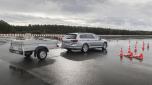
Once it detects that there haven’t been any inputs on the steering wheel for more than 20 seconds, the driver is given a notification on the gauge cluster to regain control of the vehicle. If no response is given, the car will create small jolts from the brakes and via the pre-tensioning seatbelts to try and wake the driver.
A further lack of input will result in the car pulling over to the side of the road and onto the hard shoulder, utilising the various sensors around it to safely change lanes if necessary. The car will display the hazard lights and honk the horn to make other drivers aware, calling the emergency services whilst also ensuring the doors are unlocked and the dome lights are switched on to provide easy access in case the driver is seriously ill.
Intersection assist
Pulling out of a junction can be difficult – especially when a car appears from seemingly out of nowhere. VW’s Intersection Assist aims to avoid collisions by employing the radar detectors on each side of the front bumper to identify any cross traffic and apply the brakes. Within 400 milliseconds, the vehicle is able to determine whether a collision could be possible and thus apply the brakes. Such a quick reaction means it’s also possible for this function to work at blind junctions and at speeds of up to around 40mph.
Automatic Cyclist Evasion (coming soon)
Laws in Europe mean an autonomous safety system cannot move into oncoming traffic in order to avoid a collision. With VW’s safety tech boffins explaining that “braking is only useful to avoid a crash at speeds of up to 60kph [37.2mph]”, the team have developed a new system utilising pre-existing hardware that will be able to accurately thread the needle between a cyclist or other vulnerable road user and the central markings on the road – all without driver intervention.
Volkswagen tells us that the system could come as an over-the-air update further down the line, although it’s currently in its pre-developmental stage. Once again, the car can deliver jolts through the braking system to make the driver aware of a potential hazard, while one can also override the system if further steering over the central markings is required.
Connected Travel Assist
Volkswagen, like most manufacturers, has its own version of Level 2 autonomous driving, which incorporates elements such as adaptive cruise control, automatic lane centering and even automatic lane changing.
What perhaps makes VW’s take on this type of system unique is its integration of so-called ‘swarm’ data; there are millions of VWs on the streets and this technology will be able to observe the speed and direction of movement of other surrounding vehicles in order to predict hazards, stay in lanes without road markings or redirect sat-nav routes to avoid traffic. All of this data is, as you’d hope, kept anonymous in order to preserve owners’ privacy.
More features are on the way, including traffic light detection which will bring the car to a stop at a red light, but also allow it to proceed without the need for intervention whenever the light goes green.
Which safety feature do you think would be the most useful? Let us know in the comments below...