Toyota Auris Touring Sports
Toyota Auris Touring Sports adds practicality to already capable family car package

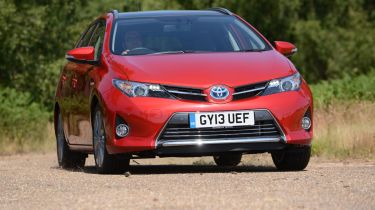
The Touring Sports is certainly more appealing than the Auris hatch. But this Hybrid model only really makes sense if you do a lot of city driving, and the Toyota’s family car potential is hobbled by the cramped back seats and relatively small boot.
It's been a while since Toyota has offered a compact estate. The last one was phased out when the Auris replaced the Corolla back in 2006, but now the company is back with the Auris Touring Sports.
From the front bumper to the rear wheelarches, the newcomer is identical to the hatchback. The pointed nose and jewelled lights give it a smart, sleek look compared to the gaping grilles of the Skoda and Kia.
• Toyota Auris Touring Sports review
Our Hybrid test car adds blue-tinted badges, while all Touring Sports come with silver roof rails, as well as an extra 285mm of bodywork behind the rear axle line. From the side, this added length gives the Auris a more handsome look than the hatchback, but from the back the pinched tail andsloping rear end seem a little awkward.
Inside, the newcomer is identical to the five-door. That means it’s well built, the layout is easy to get on with and the plastics used are better than those in the Cee’d. There’s plenty of space in the front, too, although the seats don’t offer as much adjustment as the Skoda’s.
Used - available now

2016 Toyota
Yaris
76,100 milesAutomaticPetrol1.5L
Cash £7,994
2014 Ford
C-Max
52,900 milesManualDiesel1.6L
Cash £6,995
2018 Bentley
Bentayga
32,250 milesAutomaticPetrol6.0L
Cash £51,995
2020 BMW
4 Series
70,000 milesAutomaticDiesel2.0L
Cash £14,999The rear doors don’t open as wide as those of either rival, while passenger room in the back is tighter, too. The Excel-spec car in our pictures came with the optional £550 panoramic glass, which cuts headroom, while all versions have less legroom than the Skoda.
At the back, the Auris trails for practicality. The tailgate is narrower and doesn’t open as high as the other cars’, and while the 530-litre boot is two litres bigger than the Kia’s, it’s 80 litres down on the Skoda’s. Pull two levers to fold the rear seats flat, and the 1,658-litre maximum capacity trails the Octavia’s again. The load area is long and narrow rather than short and wide as well.
There’s carpeted underfloor storage and a set of plastic trays behind that, plus a deep well where the spare wheel would normally go. However, the battery is located in the boot, which eats into the available space slightly – the hybrid cells are hidden under the rear seat.
Another niggle is the load cover. There are grooves for it in the boot sides and up the rear pillars, but it’s fiddly to use – although a net partition stops items sliding into the cabin.
Start the Toyota, and it’s as silent as any other hybrid. The electric drivetrain means it responds instantly to throttle inputs, and at the track the Auris had the fastest acceleration.
It sprints forward on electric power alone before the engine kicks in, but the switch to petrol power is seamless. It’s just a shame the engine is a bit noisy, as the CVT gearbox holds maximum revs to deliver full power. Still, this is only in extreme cases, and most owners are likely to drive their Auris gently to keep it in silent electric mode for as long as possible.
That’s a good thing, as the rest of the driving experience is numb. The light steering offers next to no feedback, while the regenerative braking makes it difficult to come to a halt smoothly. Still, the Toyota compensates with its low running costs. We returned exactly 45mpg on test – similar to the Octavia, but behind the Cee’d. Emissions of 85g/km make the Auris a far cheaper company car, although they’re not as low as for the hybrid hatch.
But the tax benefit isn’t so great for private buyers, and while our £21,495 Icon is cheaper than the Octavia, it trails its rivals on kit. There aren’t as many options – you have to upgrade to £23,245 Excel trim for more equipment – and depreciation is heavier than for the Skoda.