New Renault Megane and Scenic tech details promise 466-mile EV range and 10-minute charging
The French car maker will launch long range EVs and range-extender hybrids, in its 22-car new model blitz

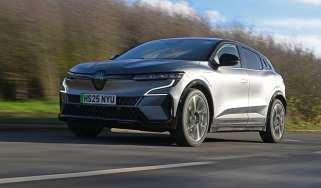
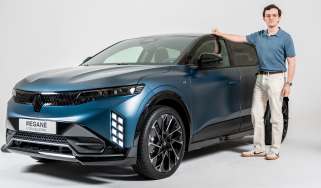
Renault’s next-generation Megane and Scenic EVs are set to pack more than 450-miles of range and 10-minute recharging, the company has confirmed. They are also set to embrace range-extender hybrid technology as well as pure electric power, with both drivetrains outlined in Renault’s next-generation technology blueprint revealed today.
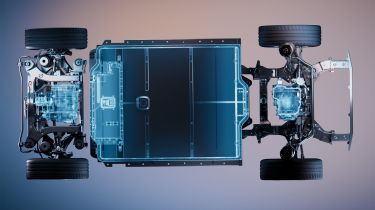
The big news is the confirmation of an all-new electric car platform, uncovered by Auto Express last November, which will underpin mid-sized cars such as the next-generation Scenic and Espace. “Bigger cars are one of our priorities,” new CEO Francois Provost told Auto Express before Christmas. “In the next mid-term plan we propose a new platform and solutions to continue our ambition to grow in the C-segment in the heart of Europe.”

New platform enables next-generation EVs
The new, hi-tech chassis is called RGEV Medium 2.0 and is expected in service around 2028. Highlights include an 800-volt electric architecture (twice the power of the current Tesla Model 3 and Y), which enables faster charging and reduced wiring to save cost and weight. Another breakthrough is a ‘cell-to-body’ construction, where the battery pack is a section of the car’s floor, as in current BYD and Tesla cars. Again this eliminates structure and reduces mass.
The battery compartment will be highly modular, able to accommodate different-shaped pouch, prismatic and blade cells with two different chemistries. Renault is labelling them as ‘high-energy density’ and ‘affordable’, equivalent to today’s nickel manganese cobalt oxide (NMC) and lithium iron phosphate compositions – although the introduction of solid-state batteries could further extend choice over time.

High-energy density vehicles will unlock high performance and that tantalising long range of up to 750km (466 miles), much like NMC does in premium EVs today. Renault also promises that 10-minute charging target will be offered with the ‘affordable’ batteries, too, with 800-volt electric architecture common to all ‘C’ and ‘D-segment’ cars.
MPVs will make a comeback
And those models will be a mix of SUV, saloon and MPVs, with RGEV medium 2.0 sufficiently flexible to underpin high-riding SUVs and low-slung hatchbacks and saloons. It’s also flexible enough to enable one-box ‘monospace’ vehicles with short noses and a front bulkhead that’s pushed forward, to maximise space in the cabin.
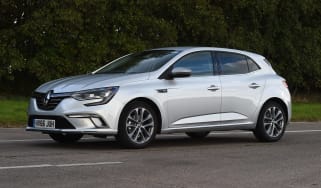
That’s the silhouette that underpinned classic MPVs such as the original 1984 Espace and the 1997 Megane Scenic. And with Chinese car makers set to bring MPVs to Europe, the French are getting ready to respond.

EV range-extenders in the pipeline
Renault’s 2026 Strategy Day also formally announced the group’s embrace of range-extender hybrids (REx), or EV Range Extenders in Renault-speak. These feature an efficient combustion engine which acts as a generator to charge the battery, feeding an electric motor to provide propulsion. Nissan offers a REx in the ePower versions of the Qashqai and X-Trail (though it isn't a plug-in and has a small battery onboard); Leapmotor is also bringing the technology to the UK in 2026.
Renault says its plug-in EV Range Extenders are targeting 1,400km of range, a cool 870 miles. That figure likely includes the vehicle setting off with its battery fully-charged from a wallbox.
“Do we want serial drive or direct drive?” Renault brand CEO Fabrice Cambolive has said, musing on whether the engine would directly spin the wheels or act in a ‘series’ along with a battery and motor. “I think the logic is to go to serial drive, which means electric traction.” Offering a hybrid driving experience that feels close to an EV’s would dovetail nicely with Renault’s role as one of the electric pioneers in Europe.
The group will tap its Horse powertrain joint venture with Geely for the REx drivetrain. Horse last year revealed a compact range extender which packages a 1.5-litre four-cylinder engine, generator and inverter into the space of a briefcase. Developing 94bhp or 161bhp with a turbocharger and meeting upcoming Euro 7 emissions standards, Horse says the powertrain can be used to hybridise existing EVs, integrating with a vehicle’s existing electric motors.
Efficient new motor to spin the wheels
Renault is working on a new electric motor with 266bhp – a circa 25 per cent power bump over the 215bhp maximum in today’s Scenic. It can be deployed on the front or rear axles, and potentially paired together for all-wheel drive.
The group will introduce the third-generation of its Electrically Excited Synchronous Motor with copper wiring, a design known for its efficiency and devoid of rare-Earth materials. Renault says the new motor is targeting 93 per cent motorway efficiency.
The new tech package will drive down costs: Renault claims the new motor will be 20 per cent cheaper, while the RGEV Medium 2.0 is 40 per cent more cost efficient than today’s EV underpinnings.
The new cars utilising this technology will be Software Defined Vehicles (SDV), Renault’s first passenger cars with this capability. The 2026 Trafic van will introduce the Renault SDV concept, with superfast core computing systems delivering stepchanges in the user experience, over-the-air upgrades and connected features, plus advanced safety and driver-assistance systems.
New upgrades for next Renault Captur and Austral
Renault CEO Francois Provost has told Auto Express that he will continue to invest in the RGMP small platform (standing for modular platform B- and C-segments), which underpins petrol/electric cars such as the Clio, Captur, Symbioz and Austral. These models will benefit from a new hybrid engine with less power than the 158bhp Clio hybrid, arriving in the UK in early 2027.
These smaller cars are not tipped to be SDVs, continuing with their ‘domain control’ electronic architectures with segmented systems for cockpit features, driver assistance and so on, rather than them being united by a sophisticated SDV central nervous system.
Renault plans to launch 22 cars in Europe in the next five years, with 16 of them being pure EV. And by 2030, Renault plans to phase out solely combustion engines in Europe, although hybrid engines will continue into the 2030s.
Did you know you can sell your car through Auto Express? We’ll help you get a great price and find a great deal on a new car, too.