New Renault 5 Turbo 3E ride review: this EV is anything but sensible
As ambitious as it is entertaining, the Renault 5 Turbo 3E is a living and breathing technology testbed

Verdict
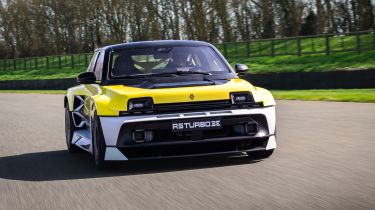
The Renault 5 Turbo 3E is a unique beast, that much is obvious. As a showcase of the company’s ambitions – the bespoke 800-volt platform, innovative in-wheel motors and looney performance – it’s a winner, even though it’s of limited use in the real world. If the Renault Group’s next-generation EVs have even a whiff of Turbo 3E about them, we’re in for a treat.
The world stood open-mouthed when the covers finally came off the production version of the Renault 5 Turbo 3E at the tail end of 2024. Despite sharing its fundamental shape with the conventional R5, the two EVs have about as much in common as the latest Espace does with an Alpine F1 car.
The platform is bespoke, at least for now. Using an 800-volt electrical architecture and cutting-edge in-wheel motors, the Turbo 3E promises insane performance, plus ultra-rapid 350kW charge speeds. The 70kWh battery, Renault claims, is good for almost 250 miles of range – though presumably not at the same time as its sub-3.5-second 0-62mph time.
But the hype is real. Renault has form building bonkers, rear-wheel-drive hot hatchbacks – a quick glance at the maker’s back catalogue throws up legends like the original eighties R5 Turbo, and the legendary Clio V6 from the early noughties. Standing on the shoulders of giants, the Turbo 3E is the first of its breed to swap petrol for electric, so there’s plenty at stake.
Used - available now


Production of the R5 Turbo 3E is set to start next year and a total of 1,980 will be built, with prices starting from around £135,000. The sky’s the limit though, with myriad colour packs and personalisation options to make each one unique to the lucky owner’s spec.
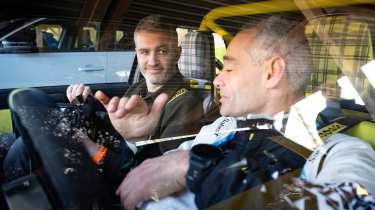
While we’ll need to wait a little longer until we can drive one ourselves, Renault UK recently presented us with an opportunity we couldn’t turn down: a chance to sit alongside test driver David Praschl for a couple of hot laps of the Goodwood Motor Circuit in West Sussex. This fast and flowing track is far outside a traditional EV’s comfort zone, so we were intrigued to see how it’d fare.
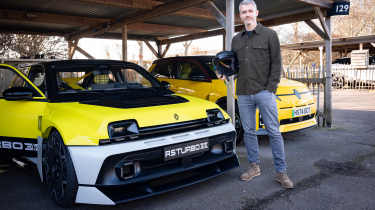
Next to a standard Renault 5, the Turbo 3E makes the supermini look tall, gawky and a little bit frumpy. The 533bhp super-EV is low, wide and squat – with enough aura to draw attention away from passing Ferraris.
Before hopping inside, we were confronted with a typically tall race-car like sill to climb over, lowering ourselves into the sculpted seats and then being strapped in via five-point Sabelt race harnesses. There’s almost nowhere to put our feet, and we immediately knock the big emergency stop button with our left knee.
This is still very much a working prototype, then – confirmed by the perspex side windows and navigation system that seems fixed somewhere on the other side of the English Channel. The cabin is raw, stripped back and exposed; there’s a visible roll cage and little in the way of creature comforts or sound deadening.
A quick glance over at the driver’s display and we notice the battery’s state of charge is hovering at around 25 per cent. We trundle down the pitlane and wait for the marshal’s signal to let us out on track.
As soon as his arm goes down, we’re pinned into our seat with a force akin to only the very fastest road-going EVs. There’s no loss of traction as we surge off the line, and – perhaps unsurprisingly – no noise, either. Whether Renault decides to engineer in any kind of augmented soundtrack to accompany the Turbo 3E’s ballistic performance remains to be seen, but for now it’s purely mechanical; you can hear the motor, the brakes and small stones pinging around the wheelarches. But that’s about it.
As we approach the first bend, it’s noticeable how much pitch there is under braking, as well as how much movement there is in the suspension and chassis as Praschl hurls the car into the open right-hander. Despite its wide track and low-mounted battery, there’s more body lean than you might expect.
“The production car will be different”, Praschl shouts over to us. “In two or three months, it will be different”. Yet judging by the smile on his face, he’s clearly having fun. Despite the exaggerated roll, grip is absolutely steadfast – until, that is, Praschl pulls the hydraulic handbrake to draw the rear end round, showing the car’s playful side in full.
It’s only on the really long straights that the 3E runs out of puff. Coming out of turn five we’re hot on the power and quickly approaching 120-130mph; at this point, the quoted 168mph top speed feels a long way off, and another look over at the instrument cluster suggests we’ve used almost 10 per cent of the car’s remaining charge in a single lap of the 2.4-mile track.
Praschl is keen to carry on, and while the second lap isn’t quite as ragged as the first, it’s evident that a lot of work has been done to make this a driving experience like no other. The in-wheel motors offer instantaneous torque of up to 4,800Nm and the ability to slingshot out of corners, while – from the passenger seat, at least – there appears to be plenty of stopping power under that left pedal.
As we return to the pitlane, Praschl tells us Renault has used the petrol-powered Alpine A110R as a benchmark for performance and dynamics. No surprise really – the Turbo 3E’s platform will eventually underpin the A110’s electric replacement, due later this year.
| Model: | Renault 5 Turbo 3E |
| Price: | £135,000 (est) |
| On sale: | 2027 |
| Powertrain: | 70kWh battery, 2x electric motors |
| Power/torque: | 533bhp/4,800Nm |
| Transmission: | Single-speed automatic, rear-wheel drive |
| 0-62/top speed: | <3.5 seconds/168mph |
| Range: | 248 miles |
| Max. charging: | 350kW (15-80% in 15min) |
| Size (L/W/H): | 4,080/2,030/1,380mm |