Porsche 718 Boxster (2016-2025) review
Latest Porsche 718 Boxster gets four- and six-cylinder engines that blend power, performance and efficiency


Just so you know, this is an older review of the 2016-2025 718 Boxster. If you are interested in information about a used Porsche 718 Boxster, or news about the latest Porsche models, please follow the links provided.
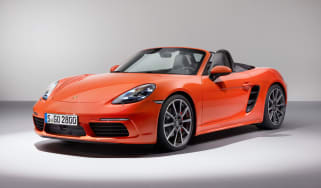
Despite the changes to its exterior being best described as subtle, the Porsche 718 Boxster has seen the most far-reaching updates under the skin since its debut more than 20 years ago. The adoption of four-cylinder engines was tough for some purists to swallow, but what these units lack in ultimate character, they make up for with scorching performance and decent efficiency.
The Porsche Boxster has come a long way since it first went on sale in 1996. It's no longer the cheapest way to Porsche ownership - the mechanically identical 718 Cayman coupe costs less - while the specs have changed over time to help it maintain its position as one of the best-handling cars for sale in the UK.
The current car is actually called the 718 Boxster, with the number being a reference to Porsche's four-cylinder racing cars of the 1950s and 1960s. In the Boxster and Boxster T there's a 2.0-litre flat-four, while a larger 2.5-litre version features in the Boxster S. Both engines are turbocharged and they offer power outputs of 296bhp and 345bhp, respectively. To much fanfare, Porsche has reintroduced six-cylinder power, in the form of the 4.0-litre Boxster GTS. This version uses the same unit found in the 718 Spyder, although producing slightly less power at 394bhp.
Used - available now

2016 Porsche
Boxster
55,600 milesAutomaticPetrol2.7L
Cash £26,995
2016 Porsche
Boxster
20,550 milesAutomaticPetrol2.7L
Cash £34,500
2016 Porsche
Boxster
44,800 milesAutomaticPetrol3.4L
Cash £36,600
2016 Porsche
Boxster
18,200 milesAutomaticPetrol2.7L
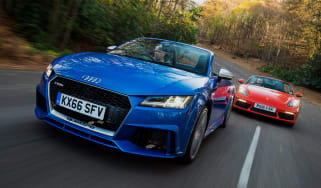
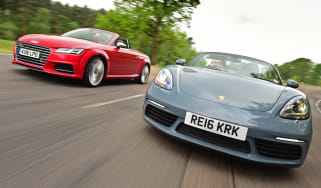
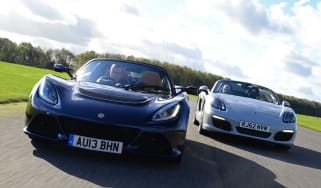
Cash £31,495There aren't many mid-engined two-seat roadsters for sale in the UK. In fact, apart from the Boxster, there's the Lotus Elise, and that's it. Boxster prices start from around £47,000 for the standard car, and around £56,000 for the Boxster S. The closest models in terms of price and execution include top-spec versions of the Audi TT Roadster, chiefly the four-wheel drive TTS and TT RS, while the latest BMW Z4 roadster is another opponent.
If you can forego open-top motoring, then the 718 Cayman costs slightly less, while the Alpine A110 follows a similar template.
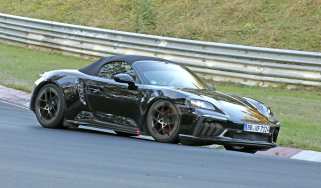
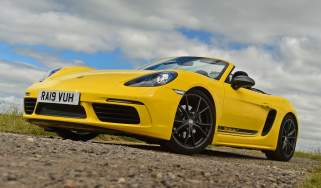
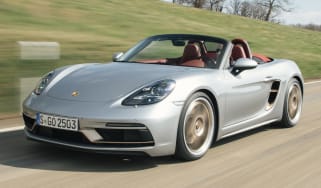
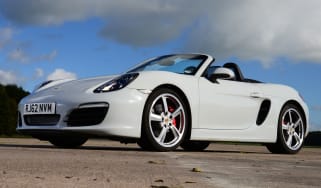
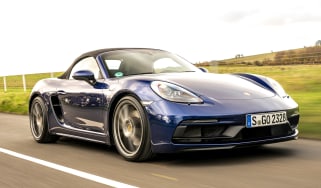
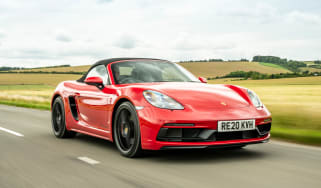
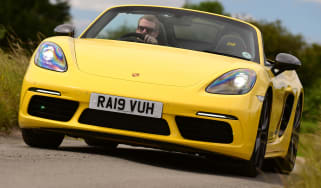
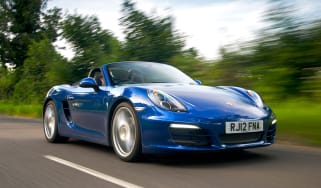
From the outside, the 718 Boxster is very much an evolution of the previous generation Boxster, and only dedicated Porsche fans will be able to tell the difference. The mid-engine roadster layout determines the car's shape, while the 718 has a smoother nose and a black bar across the rear joining the tail-lights. Apart from that, it's largely the same as before, although the slightly droning four-cylinder engine note is obvious when the car is running.
And that's about the harshest criticism there is of the 718 Boxster - the four-cylinder units don’t sound quite as good as the old, naturally aspirated flat-six. But the offset of this is performance that's better than ever, while the car also delivers even greater efficiency than before. The lighter weight of the four-cylinder engines mean the Boxster's handling is sharpened, while the responsive steering is alive with feedback. Chassis grip is near-unbreakable, too, meaning the Boxster is a confidence-inspiring sports car that can help a novice improve their driving ability, especially on track days.
Opt for the particularly driver-focused Boxster T, and you’ll benefit from a slightly cheaper asking price than a standard car with similar options, along with lower suspension, PASM dampers, adaptive engine mounts and a mechanical limited-slip differential. It’s not a fully stripped-out track special, but is the best choice for keen drivers.
Engines, performance and drive
When Porsche overhauled the Boxster’s engine line-up, it also treated its chassis to a thorough makeover. The 718 gets the 911 Turbo’s steering rack, which is 10 per cent more direct than the old car’s.
And that’s not all, because you can add Porsche’s PASM adaptive dampers that come with a 10mm lower ride height, while the S models can also be fitted with a 20mm lower Sport pack. And as before, there’s the option to add a limited-slip differential, which helps boost traction out of slower corners.
On the road, these changes make an already excellent car exceptional. The faster steering delivers scalpel sharp turn-in, plus there are huge reserves of front-end grip to lean on, allowing you to place the car with uncanny precision. What’s more, the smaller steering wheel is perfectly weighted and delivers just the right amount of feedback.
The mid-engined layout means the Boxster feels beautifully balanced mid-corner, plus it allows the car to change direction with acrobatic agility. And, because all the engines in the Boxster line-up deliver so much more torque, it’s easy to trim your line through a bend using the throttle.
Cars equipped with the PASM system are even more impressive, although the Sport mode is a little too stiff for really bumpy back roads. Even in the Normal setting the Porsche benefits from hugely impressive body control – there’s barely any roll through corners, while big compressions and sudden crests are effortlessly shrugged off.
Another dynamic highlight is the upgraded braking system. Standard and Boxster S models get the same 330mm discs and four-piston calipers. Both versions serve-up eye-popping, fade-free stopping power, plus they boast a beautifully weighted and progressive pedal action that makes it easy to modulate your braking.
Yet there’s more to the Boxster than back road driving thrills. The perfect driving position and decent visibility make it a doddle to place on the road, while the revised clutch is much lighter meaning you no longer have to build up a sweat in stop-start traffic.
In their Normal setting the dampers provide a remarkably supple ride, while the well-insulated fabric hood does a good job of keeping out wind noise on the motorway. You can lower the powered roof in a matter of seconds and the standard wind break between the front seats helps to keep buffeting to a minimum.
The 718 Boxster T was a later addition to the range and uses the same 2.0-litre unit as the entry-level car, but adds a number of sporty updates to promote a more driver-focused character. The car concentrates on mechanical changes like lower suspension, adaptive PASM dampers and a limited-slip differential with torque vectoring, along with Porsche’s Sport Chrono pack. Adding all these extras individually to the standard 718 would be more expensive, too.
Porsche has focused its efforts on making the T one of the purest sports car experiences in the range – it’s worth considering if engagement is more of a priority than outright speed. The T’s excellent chassis is brilliant enough to outshine its slightly lacklustre engine. If you can afford the extra £12,000, the six-cylinder GTS moves the game on somewhat, with bags of extra power and similar mechanical changes to the T version.
Engines
The entry level-Boxster gets a 2.0-litre flat-four ‘boxer’ engine that develops a healthy 296bhp, which is a 35bhp increase over the old six-cylinder model. More impressively, peak torque has swelled by 100Nm to 380Nm and is delivered at just 1,950rpm.
As a result, this model is far faster than its predecessor, with the six-speed manual version sprinting from 0-62mph in just 5.3 seconds. Add the launch control-equipped seven-speed PDK twin-clutch transmission and this time drops to 4.7 seconds.
The Boxster S uses a larger 2.5-litre version of the same boxer engine, plus its turbocharger benefits from the same variable vane geometry technology as found in the 911 Turbo. As a result, it pumps out an impressive 345bhp and a thumping 420Nm of torque, at a lazy 1,900 rpm. This allows the standard car to scorch from 0-62mph in a blistering 4.9 seconds, while the PDK version reduces this time to a supercar-baiting 4.2 seconds.
With both turbocharged four-cylinder engines, it’s the massive improvement in real world performance that really impresses. With so much torque on tap at low revs, the Boxster feels incredibly quick. It doesn’t matter what gear you’re in, simply squeeze the throttle and the 718 is catapulted down the road. Better still, the flat-four units have a similar appetite for revs as the old six-cylinder cars and will spin eagerly and happily to a 7,500rpm redline.
Surprisingly, it's actually the 2.0-litre engine that's the better bet. It lacks the outright performance of the S, but revs more sweetly and sounds less strained when extended. And because there's less mid-range muscle than in the 2.5-litre machine, you have to work the engine harder, which means you feel more involved in the process of driving the Boxster quickly.
Of course, what’s missing from both engines is the spine-tingling howl of the traditional flat-six. That said, the gravelly low-speed soundtrack and high-rev growl isn’t without appeal, especially if you add the optional sports exhaust. This addition delivers a high-rev scream that's reminiscent of the old 356 Carreras of the Sixties, while lifting off the throttle results in the odd delicious pop and crackle from the exhaust.
In terms of transmissions, the seven-speed PDK is very easy to live with. Not only does it boost performance, it responds quickly and crisply to the wheel-mounted paddles, yet is silky smooth when left in automatic mode. However, for the ultimate sports car experience we’d stick to the standard six-speed manual, which draws you into the action with its short throw and beautifully mechanical action.
The 718 Boxster GTS returns to full-blooded, six-cylinder power, producing 394bhp and 420Nm of torque. It makes the 0-62mph sprint in 4.5 seconds, with a maximum 182mph.
MPG, CO2 and Running Costs
You don't buy a turbocharged mid-engined roadster to save on your motoring bills, but the 718 Boxster is more cost effective to run thanks to its new four-cylinder engines, even when you consider the revised MPG figures from the latest WLTP test regime.
For instance, when fitted with the optional PDK gearbox the entry-level car now claims up to 33.2mpg and emits 180g/km of CO2. Stick with a six-speed manual model and Porsche’s figures suggest you’ll return up to 32.5mpg, while emitting 186g/km. Not too shabby for a 170mph sports car.
The Boxster S isn’t quite as efficient, but like its less-powerful brother it’ll make a smaller dent on your wallet than its predecessor. Once again, it’s the PDK-equipped car that’s the most frugal, with figures of 30.7mpg and 194g/km claimed by Porsche. The manual car records 29.1mpg and 210g/km.
The 718 Boxster T six-speed manual returns 32.5mpg and emits 187g/km, with the PDK version slightly more efficient at 32.8mpg and 181g/km.
Meanwhile, the hardcore GTS is only offered with a six-speed manual box and delivers figures of 25.9mpg and 246g/km of CO2. Of course, if you frequently access the full performance potential of these cars, then you can expect to see your fuel returns plummet. And, while the Boxster’s CO2 emissions have been reduced, an increase in list price means company car users will be no better off when it comes to benefit-in-kind tax bills.
Insurance
British security and insurance experts Thatcham have placed the Boxster in groups 48-49, which isn't far off the top grouping of 50. In comparison, the hard-topped 718 Cayman sits between group 42-46, despite it having the same performance - that's the price you pay for the Boxster's more vulnerable fabric roof.
That said, all models get a Thatcham category one alarm and immobiliser, plus there’s also a standard tracking device – although you’ll have to pay an annual subscription fee to its service provider.
Depreciation
Given the desirability of the Porsche badge, it’s no surprise to find the Boxster is sought after on the second-hand market. As a result, our experts have calculated that the 718 will retain around 50 percent of its new value after three years and 36,000 miles.
Surprisingly, it’s manual gearbox cars that are the most resistant to depreciation, with both standard and S models attracting just over 53 percent of their list price over the same 36-month period. The PDK cars attract a figure of 47 percent.
To get an accurate valuation on a specific model check out our free car valuation tool...
Interior, design and technology
Porsche has tried not mess with a winning formula when it came to redesigning the Boxster. In fact, glance at the 718 and you’d struggle to tell it apart from the old car.
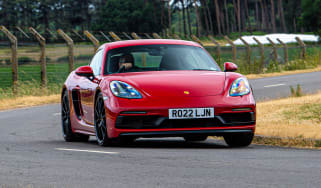
However, apart from the bonnet, tailgate and windscreen, every external component on the Porsche has been changed. The reprofiled bumpers and more defined bodywork creases help give it an even wider and more purposeful stance, while the distinctive LED lights front and rear add an extra layer of visual interest.
At the rear there’s a dark strip of trim between the taillights that is emblazoned with retro Porsche script. Both cars get a powered spoiler that raises automatically at 74mph, or can be raised manually using a button on the centre console.
The standard Boxster is identified by its 18-inch alloys wheels and trapezoidal centre exit exhaust, while the more powerful S gets 19-inch rims and a twin exit tailpipe.
Inside, the changes are even more subtle. There’s Porsche’s latest generation of touchscreen infotainment system, reprofiled air vents and a smaller diameter three-spoke steering wheel (375mm as standard, or 360mm as an option). That said, there wasn’t a lot wrong with the previous car, so not many changes were needed. The high centre console and traditional five-dial instrument layout create a driver focused environment, while all the major controls are perfectly placed.
Equally impressive is the top notch fit and finish. All the materials have a high grade look and feel, while the tight build quality is second to none. As before, it’s possible to personalise the interior with various leather upgrades and colourful trim inserts.
Sat-nav, stereo and infotainment
All versions of the 718 Boxster now get the latest Connect Plus infotainment system, which includes online navigation, Apple CarPlay, wireless internet access, an integrated 4G SIM and DAB digital radio. This a big step up from the old Porsche Communication Management infotainment unit.
Other upgrades include the Bose surround sound stereo upgrade for around £850, which features a 505 Watt power output and 10 speakers. Buyers wanting an even richer listening experience can order the eye-wateringly expensive Burmester sound system for around £2,800. This features a thumping 821 Watt output and 12 speakers, including a 300 Watt active subwoofer.
Practicality, comfort and boot space
Despite its thoroughly overhauled exterior, the 718 Boxster is no bigger inside than its predecessor. That said, this is still one of the roomiest and most practical roadsters you can buy.
There are two boots, one in the nose and another at the rear, behind the engine. But, unlike the BMW Z4 the Boxster’s carrying capacity isn’t compromised when the roof is folded.
The cabin is wide and there are plenty of handy storage trays, including a large glovebox and Porsche’s trademark pop-out cupholders. However, the door bins are narrow and shallow, making them suitable only for small items.
Dimensions and size
In terms of its external dimensions, the 718 Boxster is pretty much the same size as its predecessor. The revised bodywork has resulted in a 5mm increase in length and a 1mm drop in height, but it’s the same width as before.
The wide opening doors make access relatively easy, and while the Boxster is quite low, you don’t have to clamber over wide sills as you slide behind the wheel.
With the fabric roof in place over-the-shoulder visibility is compromised, while the glass rear screen is quite small. As a result we’d recommend forking out for rear parking sensors (around £360, while front and rear sensors can be added for around £620). At least the wide windscreen and relatively thin A-pillars give a panoramic view forward.
Lowering or raising the powered roof can be achieved in 10 seconds or so and while travelling at speeds of up to 20mph. The top folds neatly away underneath a panel behind the seats.
Legroom, headroom and passenger space
You don’t buy a two-seater sports car for its practicality and space, but the Boxster is better than most when it comes to interior comfort.
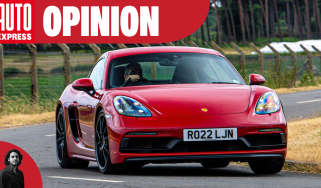
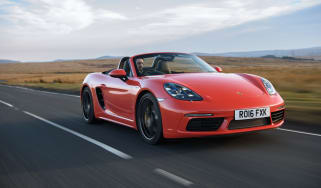
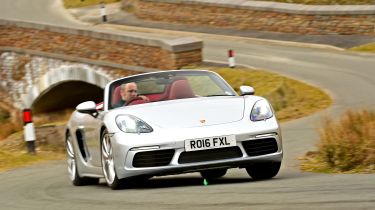
There’s plenty of leg and shoulder room for both the driver and passenger, while headroom is decent with the roof raised. However, the small side and rear-windows create a slightly claustrophobic feel. This can be countered by specifying a lighter coloured interior trim, such as the red leather seen in these pictures.
You can’t really consider the 718 Boxster a family car, but Porsche will add an Isofix child seat mount and an airbag cut-out switch for the front passenger seat for around £150.
As with all Porsche models you sit low and there’s a wide range of seat adjustment, plus the steering wheel can be tailored for height and reach. The standard Sports seats are well-padded and supportive and can be enhanced with the 18-way electric Sports seats Plus option for around £2,000.
Boot space
Thanks to its mid-engined layout the Porsche Boxster has not one but two boots. At the front is a 150-litre compartment, while at the rear is a slightly smaller 125-litre load bay.
The nose-mounted boot is deep, well-shaped and capable of carrying at least two or three squashy bags. At the rear is a much shallower boot, but it’s wider and features a large opening. Unlike rivals such as the BMW Z4, the mechanism for the Porsche’s folding fabric roof doesn’t intrude into the luggage space when it's lowered, meaning you get the same amount of luggage space whether the roof is up or down.
Reliability and Safety
The 718 Boxster is essentially a thorough facelift of the previous generation 981 model. That said, there are so many new parts that the latest version could be considered an all-new car. However, with Porsche’s hard-won reputation for engineering integrity, there should be very few nasty mechanical surprises.
Both the 2.0-litre and 2.5-litre flat-four engines are closely related to the turbocharged flat-six units that debuted in the 2015 991.2 911 models. That means that despite having two fewer cylinders than the bigger cars, these units should be relatively unstressed. The six-speed manual gearbox has also been tweaked, while the clutch has been overhauled to deliver a lighter action and greater durability.
While the 718 Boxster has been developed to deliver the ultimate in driving thrills, the brand’s engineers haven’t overlooked safety. All versions of the Boxster get six airbags, stability control and a pair of fixed rollover bars behind each seat. Both the standard car and the S get bigger and more powerful brakes than before, while carbon ceramic set-up can be added, although it's pricey, costing in excess of £5,000.
The Porsche 718 Boxster did not feature in our 2019 Driver Power owner satisfaction survey and Porsche itself was notable by its absence. However, results in previous surveys suggest that Porsche models are well built and reliable. Don’t expect to encounter many issues.
Warranty
As with every Porsche model, the 718 Boxster gets a three-year unlimited mileage warranty, which is backed-up by a breakdown recovery package for the same period. The car’s paint is also covered for three years, while the anti-corrosion guarantee runs for 12 years.
If you’re planning on keeping your Boxster for a few years, then it might be worth considering an extended warranty. This package can be added for one or two years, provided you sign-up within 12 months of the car being registered.
Servicing
There’s no getting away from the fact that a Porsche is going to cost more than the average family hatchback to maintain. This is mainly down to the fact that the Boxster’s high performance components tend to be expensive to replace.
That said, Porsche has tried to make running the Boxster as cost effective as possible by providing lengthy service intervals of two years or 20,000 miles, whichever comes first. The brand also has fixed price servicing costs for all its models, so you should know beforehand what the financial damage is likely to be. However, bearing mind that consumable items such as tyres and brakes are likely to be expensive.