EV charger more than 10 minutes walk? Brits won't use it
Long walks to EV chargepoints mean fewer disabled drivers have the confidence to make use of the UK public charging network

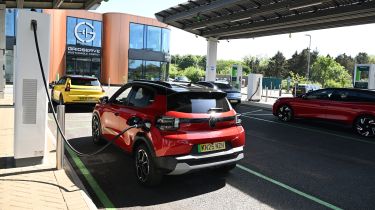
Fewer than one in three Brits would be willing to walk more than 10 minutes to access an EV charger at home – that’s the result of a survey by the Motability Foundation which is calling on the government to prioritise the installation of local charging infrastructure outside of London in order to better serve the country’s disabled population.
Partnering with data analytics firm, Field Dynamics, and EV charging site, ZapMap, Motability discovered that the average walk-time to a public charger for UK households is 12 minutes – two minutes longer than 69 per cent of those surveyed said they would be willing to travel.

In contrast, the average walk to an electric car charger for a London home is just three minutes, revealing a huge disparity in charger availability. This is no surprise when you consider that Greater London contains over 26,000 public chargers, or the equivalent of 30 per cent of the entire UK’s EV infrastructure.
As you would expect, long distances between homes and on-street chargers has a bigger negative impact on those with mobility issues. These people might not be able to traipse to and from a chargepoint regardless of whether or not they’d be willing to do so.
Disabled access to EV chargers
It’s perhaps no surprise then that, taking into account other issues such as the inaccessibility of charge points – according to a recent study by Vauxhall, only a third of councils employ on-street chargers that confirm with disability guidelines – just four in 10 of the 1,500 disabled drivers Motability surveyed would consider relying on the public charging network at all.
Motability’s CEO, Andrew Miller, said: “Too many drivers don’t trust that they’ll be able to charge easily, locally or reliably. If we’re serious about meeting the 2030 ban on petrol and diesel sales, chargepoints need to be where people live, easy to use, and designed with everyone in mind. Until this happens, we risk leaving thousands of drivers behind.”
While managing director of Field Dynamics, Craig Stephenson, pointed out that “the UK has made real progress in expanding its charging network, helping more drivers feel confident about moving to EVs”, it’s evident that isn’t necessarily the case for disabled drivers.
Ultimately, just 12 per cent of Motability drivers feel there are a sufficient number of chargers where they live, compared with 28 per cent for the general population. Motability scheme user, Vanessa, explained how “Not only is it difficult to find chargers, as a disabled person you also have to consider whether the bays will be big enough, cables too heavy, or facilities too far away.”
Auto Express has approached the government’s Disability Unit asking what it plans to do to support disabled drivers in the transition to EVs, but has yet to receive a response.
Are you ready to make the switch to an electric car? There are loads of great electric car deals via the Auto Express Buy a Car service. We can even help you sell your old car, too...