New Audi RS 5: UK prices, specs and full details for 2026 super saloon and Avant
Audi’s new RS 5 might have 630bhp, but it comes with huge weight and a price to go with it

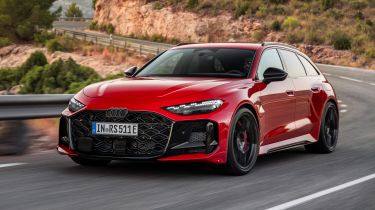
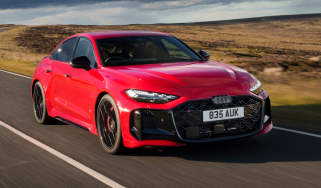
The heavyweight Audi RS 5 now has UK pricing to go with its other big-hitting numbers, starting at £89,400 in saloon form and £91,300 for the more practical Avant. As has already been established, the new RS 5 saloon and Avant will in effect replace the RS 4 Avant and RS 5 Sportback, and do so with a high-performance plug-in hybrid powertrain.
In the UK, both saloon and Avant RS 5s will offer the same three-prong trim line-up, with the base car joined by Carbon Black and top-spec Vorsprung models. All have plenty of standard equipment, including matrix LED headlights, heated, ventilated and massaging sports seats, and the full screen layout including passenger and head-up displays.
The Carbon Black variant costs an extra £6,085 and features a larger set of 21-inch forged alloy wheels, plus a range of carbon-fibre elements both inside the cabin and across the car's exterior.
Plump for the Vorsprung and you’ll add not only more equipment, but new styling elements that come as part of the RS Sports package in other markets. This sees a new front bumper with forged carbon elements, plus more of the same forged carbon fibre inside and on the rear bumper. Other elements include Nappa leather seats, OLED rear lights, a panoramic sunroof with switchable transparency and more.
There’s also a couple of mechanical additions as part of the Vorsprung model, including the RS Sports Exhaust and an increased top speed of 177mph. All of these elements don’t come cheap, though. The Vorsprung costs £18,085 more than the base RS 5, meaning a fully loaded RS 5 Avant Vorsprung will cost £109,385. Carbon ceramic brakes are optional on all models for a hefty £8,490, or £8,990 for ones with contrasting brake calipers.
If you’re in the market to buy a high performance family car, check out the Auto Express Buy a Car service where you’ll find top deals on everything from RS Audis to AMG Mercedes and BMW M cars.
What powers the new Audi RS 5?
Core to this new era of Audi RS is the high-performance plug-in hybrid powertrain. This features a heavily updated version of the twin-turbocharged 2.9-litre V6 engine from the previous Audi RS 4 (and a few Porsches), with a plug-in hybrid module made up from an electric motor and 25.9kWh battery pack.
This is a similar set-up to the one found in some hybrid-powered Porsche Panameras, but the power and torque figures are much higher, and sits within the Audi A5’s more compact PPC platform. Peak combined power is quoted at 630bhp, with torque rated at 825Nm. Of these totals, the V6 engine produces 503bhp, with the e-motor capable of adding 174bhp and 460Nm to the driveline.
The engine has gone through some substantial changes in order to produce more power than its 444bhp predecessor, and still remain compliant with tough Euro 7 emissions regulations. The turbochargers are twin-scroll, plus there’s a new fuel injection system and water-to-air intercoolers.
Power is sent through an eight-speed Tiptronic automatic transmission – this is a standard torque-converter style, rather than dual-clutch – to a brand-new centre differential that’s able to split torque front-to-rear between 70:30, right out to 15:85.
There is a fresh differential set-up on the rear axle, which integrates another small electric motor that finely controls drive to the rear wheels. This system is capable of torque-vectoring – the ability to send power to each rear wheel individually – and fully locking the rear differential.
How fast is the new Audi RS 5?
Audi quotes a 0-62mph time of 3.6 seconds, which is 0.5 seconds faster than the previous-generation RS 4 Avant, and a top speed of up to 176mph with the Audi Sport Package fitted. However, as with all plug-in hybrid powertrains, this isn’t the only interesting figure. Audi quotes a 52-mile all-electric range, and under latest MPG testing regulations, the RS 5 is capable of between 62-74mpg, and a CO2 emissions rating of between 102-86g/km.
What changes has Audi made to the chassis and suspension?
Audi’s efforts to separate the RS 5 from its base A5 donor car is considerable. The body is considerably stiffer, and has 90mm added to the overall width. Almost every exterior body panel is new – only the bonnet, front door skins, roof panel and tailgate are shared.
To this Audi has fitted a coil-spring set-up with dual-valve dampers. These are capable of controlling both rebound and compression separately, giving engineers a much wider spectrum to work with in how the car rides and handles.
There are a few other high-end pieces of chassis hardware notable by their absence, though. There’s no rear-axle steering, cross-linked hydraulic dampers or air-springs. Yes, the RS 5 is at the smaller end of the range, but Audi has confirmed a kerbweight of 2,355kg for the saloon and 2,370kg for the estate, so this type of weight-managing tech wouldn’t have been too far of a stretch.
In order to slow down this much mass, there’s a set of 420mm front and 400mm rear steel discs as standard, and a ceramic set-up is optional. The latter uses 440mm front discs and 420mm rear, and is equal to the largest combination in any production car – it’s shared with the Lamborghini Urus and Bentley Continental GT Speed, no less.
Let’s talk about the styling
With such extreme dimensions, it’s not surprising to see how aggressive the new RS 5 looks in the metal. The three-dimensional grille features a complex mesh pattern and a black mask connecting it to the outer intakes. The massive wheelarches house 20-inch wheels as standard, but the 21-inch option will be the more popular choice.
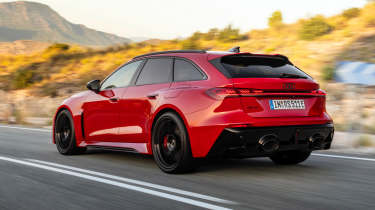
The rear end is also dramatic on both saloon and Avant versions, because Audi has fitted two large oval exhaust outlets inside an oversized rear diffuser insert. In this case, they are closer to the centre of the rear bumper, due to the complex muffler that sits behind.
Unique to RS 5s fitted with the optional Audi Sports Package is a range of forged carbon-fibre trim elements. This also includes unique front bumper inserts, plus standard 21-inch forged wheels. Saloon models also include a small lip spoiler.
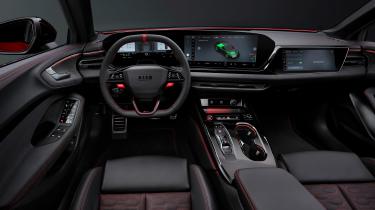
Inside, Audi’s new screen-heavy design is applied, but there’s a fresh set of sports seats and carbon-fibre interior trim pieces. There’s also a range of new Audi Sport graphics within the digital interfaces, and the steering wheel features a Boost button, which will unlock maximum power and torque for a 10-second period no matter the drive mode selected.
Who does the new Audi RS 5 have to beat?
The RS 5’s traditional rivals come in the form of the Mercedes-AMG C 63, BMW M3 and Alfa Romeo Giulia Quadrifoglo, but all are in various states of undress in 2026. BMW’s next M3 is expected to pick up mild-hybrid technology when it arrives in 2027 or 2028, but should fundamentally retain its basic package for the next generation. This will also be available in an estate form, and there’ll be a pure-electric version too.
Alfa Romeo will build the existing Giulia and Stelvio Quadrifoglio in their current forms until further notice, or more accurately, until Euro 7 regulations kill them off completely. But it’s AMG which might shed light on how wise Audi’s choices might have been, and not for good reasons.
Mercedes-AMG made the biggest change in this class with the latest iteration of C 63, and it hasn’t gone well. Mercedes has recently cancelled production of the latest four-cylinder version, and will instead replace it with a mild-hybrid C 53 with a six-cylinder petrol engine. This won’t offer nearly as much power, and therefore will act more as a rival to the S5, rather than the RS 5.
The reason for this lack of popularity was the adoption of a plug-in hybrid module, but there are many differences between the AMG system and Audi’s. First, the RS 5 has significantly more electric range, with both driveability and fiscal benefits in terms of running costs.
But the big one is the combustion engine itself. Merc’s downsized four-cylinder petrol engine was heavily criticised for being not in keeping with the C 63’s character. By contrast, the Audi’s V6 has been retained, with the PHEV system only adding to its overall package. BMW did a similar thing with its new M5 by continuing to use its V8 engine, and by contrast has sold extremely well.
Don't miss out! See more of Auto Express in your Google Top Stories. Click here...