McLaren’s future uncovered: Brand makes ‘move fast and surprise’ promise
McLaren CEO Nick Collins reveals his plans for a new era at the supercar maker

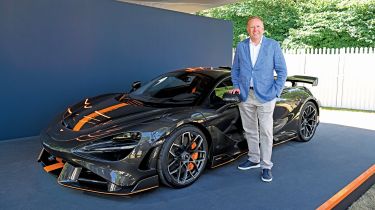
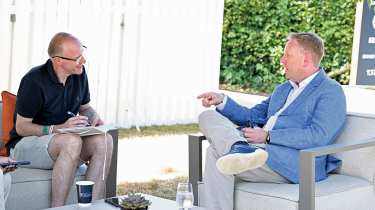
McLaren is on the brink of a new automotive era, which will transform the supercar maker’s portfolio under new owners and new leadership. “I know what’s coming and the [cars’] frequency, and I’m super-energised and excited,” McLaren Group Holdings CEO Nick Collins told Auto Express at the Goodwood Festival of Speed. “I’ve been around this industry 33 years and I’ve never been involved in a story as exciting as the one that’s about to unfold.”
Collins is no stranger to developing great cars: his swansong as JLR’s executive director of vehicle programmes were the latest Range Rover and its Sport sibling. Then he was at the heart of McLaren’s acquisition by Abu Dhabi’s CYVN Holdings in April 2025, and has spent the past 17 months reshaping the business for the future.

“We’ve been in a year of deep planning, deep decisions, the right foundational things that this company’s [not had the resources to previously do],” said Collins.
Despite the ongoing US-Iran war, he says the determination of the owners – who immediately cleared McLaren’s debt pile – hasn’t wavered. “With the backing of my shareholders we can take the right decisions for the customers, the brand and the company’s future, not decisions that the [financial] market expects quarter-by-quarter.”
Bold action plan
Collins fires off a list of actions: reducing annual production to around 2,000 cars to better balance supply and demand and protect used-car values; improving quality; and launching the latest ‘Ultimate Series’ car, the W1, the successor to the legendary F1 supercar and monster P1 hybrid.
Crucially, the CEO has also pumped “double-digit millions” into McLaren’s design capability and recruited a new chief design officer, Kemal Curic, to shape the portfolio. “We’d laid it out for a multi-year period but now we’re taking it to an all-new level. For any designer coming into a business, there’s stuff near the end, mid-flight and early flight. Kemal has had an influence on all three flights, plus the methods and technology we use to work.”
Grow the McLaren audience
So what’s in the new McLaren line-up? “I’ve said it before: we’ll do everything we’ve always done but better, and a few more things around that. We’ll cater to a wider audience but in a McLaren way.”
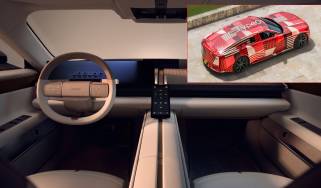
Collins kicked off his career at Ford, and 22 years ago was running an innovations team experimenting with new vehicle concepts. “One of the three cars I was blown away by was done by a very young designer in Cologne, and that designer was Kemal.” The pair hadn’t seen each other since but clocked one another at California’s Pebble Beach event last year; now Curic has swapped Ford’s premium brand Lincoln for the McLaren Technology Centre in Woking.
Will McLaren go EV?
Don’t expect Curic’s first production car to be electric-powered. “We will only do an electric car when our customers ask for it. And right now, they're not asking,” asserts Collins. “But when they’re ready for it, we can do it.” Instead, the boss sees a portfolio powered by pure-petrol and hybrid powertrains, with electrification a means to boost power. “Hybridisation plays a role in the design of the base ICE unit, particularly when you look into the specific technical regulations.”
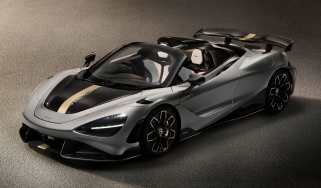
One Goodwood unveil was the 788 HS (High Sport), the final bow for the Super Series that began with the 720S in 2017, upgraded to the 750S in 2023. Its 4.0-litre twin-turbocharged V8 is stretched to 788PS (777bhp), delivering the carbon-fibre series’ highest-ever power-to-weight ratio.
“This is the ultimate expression of that line of cars,” enthused Collins. “We’ve refocused the aero, the car’s dynamics, the control systems, the engine note and exhaust tone: we’ve really dialled up the character, twisting every knob and then some!” McLaren will only manufacture 200 – and all were sold long before the High Sport’s unveiling.
Very special operations
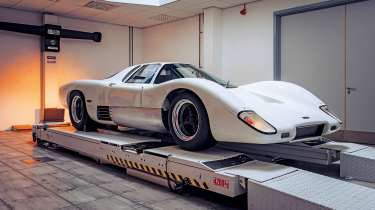
McLaren Special Operations has also delivered its first continuation car, the exquisite M6GT. Having recovered the original body moulds for Bruce McLaren’s 1967 Can-Am racer for the road, the team painstakingly rebuilt the chassis to go with it, powered by a period Chevy small-block V8 with 400bhp.
It sounds like Collins is revelling in leading McLaren. He recalls a day in 1993 when he arrived at Bedfordshire’s Millbrook test facility with Ford engineers driving an Escort RS Cosworth. They watched as a helicopter landed, with the occupant jumping into a McLaren F1 for a full- throttle test. “Last summer I was at a dinner, sitting next to the guy who got out of the helicopter – Jonathan Palmer [the eighties F1 driver]. And I told him that story, and how my life had gone from that day in 1993 to sitting beside him as McLaren CEO.”
What does the McLaren F1 mean to Collins? “It broke the rule book of what people thought was possible. It made me think: you have to be bolder, more creative and be prepared to take some risks in this industry.”
That’s the legacy that Collins and his team are following. The W1, M6GT and 788 HS are “the prologue” to the new McLaren story, says the CEO. “We are going to move very quickly. It’s a really exciting journey. The new chapters will come with a regularity that will take people by surprise.”
Did you know you can sell your car through Auto Express? We’ll help you get a great price and find a great deal on a new car, too.