New Mazda CX-5 2026 review: spacious SUV is a step in the wrong direction
The new CX-5 a fair bit different to the old model, but that's not necessarily a good thing


Verdict
The new Mazda CX-5 feels like a step backwards from the previous generation. It’s certainly a handsome-looking, reasonably well-equipped family SUV that’s more practical and spacious than the last one. However, interior quality is disappointing, the tech onboard already feels dated and it’s rather dull to drive, which is not what you expect of a Mazda. Meanwhile the one and only powertrain on offer is underpowered, noisy and simply isn’t as frugal as the more advanced hybrid powertrains available in key rivals. Other than the appeal of its badge, it’s hard to find a unique selling point for the new CX-5.
The Mazda CX-5 has held the title of the Japanese brand’s best-selling model in the UK, across Europe and globally, for nearly a decade. Over five million examples have left showrooms since it was introduced in 2012, which is no mean feat when it competes in the cut-throat mid-size SUV segment against the likes of the Kia Sportage, Nissan Qashqai, Toyota RAV4 and Volkswagen Tiguan. Plus myriad newcomers fresh off the boat from China.
Considering that, it’s not surprising that Mazda – a company that enjoys swimming against the current – didn’t want to mess with success, so took a largely evolutionary approach when creating the latest third-generation of its family-focused SUV. And yet there’s major differences between this new CX-5 and the last one – some good, some definitely not.
Used - available now


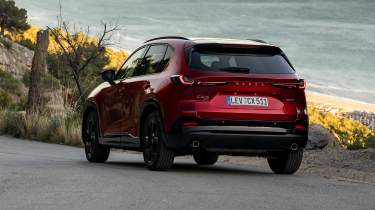
The new CX-5 will look very familiar to owners of the previous model because they’re not that different at a glance. But that’s by no means a bad thing; it’s handsome and has a more traditionally sophisticated, understated look compared to the sci-fi-esque profile of the Sportage or Qashqai. The Mazda does at least look more assertive than the last model, taking some inspiration from the brand’s posher SUVs: the CX-60 and CX-80.
The twin exhaust tips poking out the back give the CX-5 a slightly sportier flavour than its pricier siblings, and the traditional badge on the tailgate has been replaced by Mazda lettering – something that has become a bit of a trend as brands like Porsche, Skoda, Lexus and Tesla have all done the same. Base models ride on 17-inch alloy wheels, while all others get 19-inch rims which, to our eyes, look rather small as they don’t fill the wheelarches.
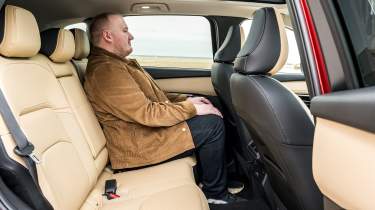
As you might expect, the CX-5 has grown slightly as well. It’s now 115mm longer, 15mm wider and 30mm taller, plus the wheelbase has been stretched by 115mm, providing rear-seat passengers with more room. Six-foot tall adults have loads of legroom to stretch out, headroom to spare, and space under the front seats to tuck their feet.

Unfortunately, the large hump in the floor eats into the available space, and the cabin doesn’t feel that wide, so you may struggle to squeeze three people into the back. But if you’ve got kids to ferry around, the rear doors are bigger and open wider, which will help when fitting a child seat with this car’s two sets of Isofix mounting points (both in the back) easily accessible behind their plastic covers.
The growth spurt has also resulted in a whopping 583-litre boot capacity, which is 61 litres up on the previous model and more than any version of the Qashqai, MG HS or Jaecoo 7 can haul. It’s not far off the Sportage’s (up to) 591 litres, either.
But it's not just the size that’s impressive. Mazda has lowered the boot opening, which is especially useful for lugging heavier cargo, and there’s no load lip to lift stuff over. The boot area is longer and deeper than the last one, too. When you need to haul as much stuff as possible, the 40:20:40 split rear seats fold down to provide 2,019 litres worth of space to play with, and the 2,000kg towing capacity is the same as the previous CX-5.
All positive so far then. But let's now turn our attention to the front of the cabin which is so minimalist you might not believe it’s a Mazda. There isn't even a volume dial; pretty much every physical button or switchgear has been eradicated. It looks and feels far closer to one of this car’s Chinese rivals like the Omoda 7, rather than the previous CX-5.
The loss of the rotary controller you got in the old model isn’t too big a deal in our opinion. For one thing, it didn’t work well with Apple CarPlay or Android Auto, which most people use these days. But not having any physical climate controls does feel like a misstep, as other SUVs have proven you can still create a modern or even futuristic interior without compromising on functionality in this way.
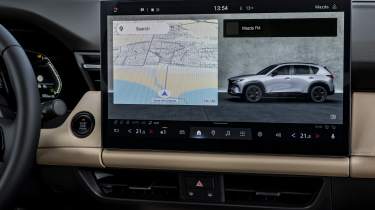
That means almost all of the car’s functions are done via the touchscreen. Most models come with a 12.9-inch central display, but the range-topping Homura version like the one we tested gets a whopping 15.6-inch screen – almost the same size as the Tesla Model Y’s.
Both set-ups use Mazda’s latest infotainment system which incorporates Google Maps, Google Assistant and other services, and we found it relatively easy to navigate though the various apps and menus. That said, it’s not as impressive as the Google-powered tech you get in a Renault or Volvo now, nor is it the most responsive system in this class as menus often take a second or two to load up. The graphics aren’t particularly sharp either; the 3D model of the CX-5 on the homepage is so blocky it looks like something from a nineties video game.
Similarly, while temperature and fan speed are permanently displayed along the bottom of the screen – along with some other key shortcut icons – adjusting the airflow or activating the heated seats is done via a separate pop-up menu with a very dark background and small icons that make it rather difficult to use on the go.
Thankfully, the steering wheel still gets physical buttons, including a volume control and a drive mode selector. We also like there’s a button for activating the surround-view camera system, which could come in handy in tight car parks. Behind it there’s a 10.25-inch instrument display which is clear enough, but there are only three very basic layouts and, disappointingly, a full-screen map-view is not one of them.
But while we have our gripes with the technology and how much you have to use the touchscreen in the new CX-5, more disappointing is the material quality. This was a stand-out feature of the previous model, which looked and felt more premium than many of its rivals, whereas this one features mostly hard scratchy, cheap-feeling black plastic.
Range-topping models like the one we drove feature tan leather across the dashboard and doors, but it’s just an incredibly thin layer concealing yet more hard plastic. The centre console is also plastic, with no padding for your knees. The only slightly squidgy material we could find was the top of the dashboard, but only on the passenger side. We get the sense Mazda tried to save cost here but clearly didn’t know when to stop. At least the cabin feels solidly built and capable of standing up to the abuses of messy rugrats.
Speaking of disappointing, at launch (and for the foreseeable future) the CX-5 is available with only one powertrain. It consists of a 2.5-litre naturally aspirated four-cylinder petrol engine with mild-hybrid assistance and cylinder deactivation to boost efficiency. The motor makes just 140bhp – less than any version of the previous generation – and 238Nm of torque. It makes quite a racket as it drags the car from 0-62mph in nearly 11 seconds.
Meanwhile, the six-speed auto is a little slow to shift, can hold on to gears for too long and is easily caught out when you put your foot down as it takes a second or so to fumble around and kick down to the right gear before you suddenly start to accelerate.
Combine the lack of power from the engine and dimwittedness of the gearbox, and it’s hard to exploit gaps in traffic – overtaking on the motorway is a slow process and occasionally we felt the CX-5 was struggling to get up steep hills. You also have to be very gentle with the throttle to not aggravate the engine.
The mild-hybrid tech does help making stopping and starting in town traffic smoother, but it doesn’t offer any pure-electric driving capabilities. As a result, the CX-5 is able to return up to 40.3mpg at best. That is on par with the equivalent versions of rivals like the Qashqai and Sportage, plus we managed to average a little under 37mpg during our test drive so the claimed figure seems achievable at least. However the full-hybrid or plug-in hybrid systems available in pretty much every rival SUV will be far more efficient and save owners money in the long run.
Mazda says it’s working on its own full-hybrid powertrain for the CX-5, which we really hope is more powerful as well as more efficient, but no technical details have been confirmed yet and we don’t know when it’ll be available either.
We praised the last CX-5 for how well it handled, but the downside was a slightly firm ride. So Mazda decided to make the suspension on the new one softer, to try and give it a more comfortable feel better suited to family buyers. We think it’s done that; we certainly found the car did a good job absorbing the impacts from the few potholes and speed bumps on our test route around Barcelona.
The new CX-5 leans more in the corners, though that’s not surprising. But even on smooth Spanish roads, the new CX-5 wallows around and never fully settles down. A lot of road noise comes into the cabin at motorway speeds too, and the steering feels unnatural, as it’s incredibly eager to self-centre. It’s fair to say the CX-5 has lost its edge in this regard.
The new CX-5 is due to go on sale in the UK at the start of April. We don’t know exactly how much it will cost yet, but the starting price is expected to be around £31,000, which would be similar to the previous model and about the same as its key rivals like the Sportage, Qashqai and Tucson.
There may only be one powertrain for now (with the option of front or four-wheel drive we should add), but customers will have a choice of four trim levels: Prime-Line, Centre-Line, Exclusive-Line and Homura. Standard kit will include the two large displays with Google apps built-in, LED headlights, wired Apple CarPlay and Android Auto, cruise control and other safety tech.
Higher-spec models will add a head-up display, wireless smartphone connectivity, a powered tailgate, keyless entry, heated and ventilated seats, plus optional extras like a Bose sound system and panoramic sunroof.
| Model: | Mazda CX-5 Homura |
| Price: | £37,000 (est) |
| On sale: | April |
| Engine: | 2.5-litre 4cyl petrol MHEV |
| Power/torque: | 140bhp/238Nm |
| Transmission: | Six-speed automatic, front-wheel drive |
| 0-62mph: | 10.5 seconds |
| Top speed: | 116mph |
| Economy: | 40.3mpg |
| CO2: | 158g/km |
| Dimensions (L/W/H): | 4,690/1,860/1,695mm |