New Range Rover Electric revealed: How far does it go? How much is it? And why is it so late?
After what seems like a very long wait, the Range Rover Electric is finally upon us, with full details out in the open and prices from £154k

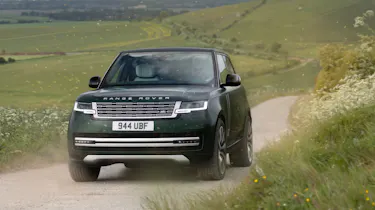
Today, the Range Rover Electric is finally laid bare in all its technical detail, with the range, price, acceleration and weight revealed as customer orders officially begin for the “ultimate Range Rover”.
Those are the words of global project manager Rachel Hogg, who’s spent five years running the programme to make the zero-emission luxury SUV a reality. It’s a journey that’s been the polar opposite of a Range Rover’s typically imperious progress, running two years behind schedule due to a huge hardware U-turn and a dogged determination to engineer the benchmark for quiet, powerful and efficient electric SUVs.
Production of the Range Rover Electric EV550 – available in both standard and long-wheelbase forms – has begun, with cars due in retailers in late 2026. Its Range Rover Sport Electric sibling, packing the same powertrain, follows soon after. Land Rover says the battery, motors and thermal management system have been developed entirely in-house, to maximise performance and range, and because ‘off-the-shelf’ components proved unsuitable.
Don't miss the best of Auto Express on Google! Make us a preferred source. Click here...
A true Range Rover for performance and effortless driving
The Range Rover Electric packs a huge 118.5kWh battery, bested only by the revised Mercedes EQS saloon’s 122kWh. The Rangie’s twin-layer design in effect couples two slabs of nickel manganese cobalt (NMC) cells (344 in total) into one energy-rich, 800-volt battery. JLR says it passes the ‘nail penetration test’ popularised by BYD, which can trigger fires in other NMC batteries.
Fitted on top is the battery electric module (BEM), which manages the electrical supply to the motors, ultra-rapid charging and cell balancing, housed in a shrunken, coffin-shaped case. It’s external to make it easier to access; the battery is protected by an eight-year/100,000-mile warranty, with JLR creating a digital twin of every car’s powerpack monitoring 900 data points to assess reliability. The Solihull production line will bolt this entire ‘cell-to-pack’ battery between the Range Rover’s wheels, with the BEM slotting into the combustion car’s transmission tunnel.
That’s because the electric Range Rover shares the MLA architecture of its combustion, hybrid and Sport derivatives, with the platform future-proofed for EVs on conception 11 years ago. The battery feeds two motors (electric drive units, or ‘EDUs’ in JLR speak), capable of spinning to 15,000rpm and producing up to 326PS (322bhp) for each axle.
“But we don’t offer the full 652PS: you don’t need full power from either EDU at any one time,” said programme chief Simon Fairbrother. Instead, the total is limited to 542bhp (550PS). “That’s the sweet spot,” he told Auto Express. Delivering more power would trigger more torque management interventions and sap efficiency, he argues.
Maximum torque is a mighty 850Nm – about 100Nm more than the Range Rover’s 4.4-litre twin-turbo V8 can muster. That’s enough punch to launch the electric SUV from 0-62mph in 4.5-seconds – two-tenths slower than the V8 – but its in-gear acceleration from 50-75mph is superior. And that’s despite the Electric’s heavier weight, around 75kg more than the heaviest Rangie, the 2,735kg P550e hybrid.
With that level of performance, the Electric sports dual-chamber air suspension to control squatting under acceleration and pitching under braking. The 800kg battery pack lowers the centre of gravity by 88mm, enhancing cornering stability, and boosts rigidity by 56 per cent.
Land Rover’s case for this being the ultimate Range Rover also stems from its “effortless” driving experience, especially when the going gets tough. Integrated traction management software reacts in 50 milliseconds – faster than the blink of an eye – to throttle the motors to maintain traction on an icy road. And with that broad torque band orchestrated by one-pedal driving, it’s easier to maintain momentum off-road – without any need for a petrol Rangie’s low-range gearing. The SUV can conquer a 33-degree slope from a standing start, and wade to 900mm like its siblings.
“The Range Rover Electric is more effortless and refined, with traction management reacting 100 times faster than the petrol car’s,” said Martin Limpert, Range Rover global managing director. Thank silicon carbide inverters for the super-fast reaction times.
Electric power makes for the quietest Range Rover ever
This civility also encompasses a serene cockpit experience, claimed to be up to seven decibels quieter than the combustion car. “It’s a library compared with a living room,” said the boss – or “the quietest Range Rover ever”, according to Andy Hughe, the noise, vibration and harshness (NVH) manager.
Hughes says painstaking sound suppression is vital, and explained: “EVs are not silent, they present their own challenges.” Jettisoning combustion’s grumble creates a new rearward noise source from that motor, while stiff high voltage cables can act as pipework transmitting sounds.
His team’s action plan included distancing the front EDU in a noise-suppressing subframe, deploying acoustic packs to absorb noise and extensive testing in JLR’s semi-anechoic chamber to identify and isolate sounds. Active noise cancellation, which uses microphones to detect noise at the car’s extremities and offset it with inverted sound waves from the optional Meridian sound system’s speakers, is standard on SV and Ultra editions.
And, given combustion’s eradication, how has Land Rover tackled that thorny question of how its EV should sound? While Abarth and Hyundai incongruously relay petrol engine revs and many go full Kraftwerk with synthesised sound generation, the Range Rover Electric’s soundtrack is based on the F major chord played on a piano. Alex Vine, who previously designed the sound at music festivals, layered on additional notes to “add texture and excitement”. The result is warm, classical and feels appropriate for Range Rover’s stately positioning – and anyone who doesn’t like it can switch it off.
Electric range, towing, charging – even a Range Rover wallbox
With its 118.5kWh battery, the Range Rover travels 372 miles according to the WLTP industry standard. Not bad for a boxy, heavy SUV in excess of five metres long but no pinnacle when the Mercedes EQS, Volvo EX60 and BMW iX3 all hit the 500-mile mark.
Rob McKay, JLR’s head of public charging services, accepts “range anxiety is an understandable worry” for customers used to their Range Rover being the car for all seasons. He acknowledged: “There are moments of uncertainty driving outside a known area: going skiing or to the south of France.” But he says the company analysed more than 360 million trips to conclude the range would cover 97 per cent of owner journeys. And to avoid disappointment, JLR focuses on the ‘real-world range’, which it pegs at 333 miles.
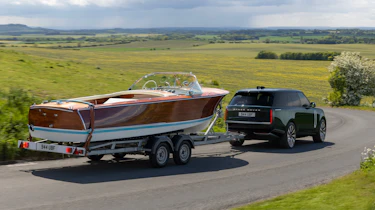
With more than 300 patents, Land Rover claims this Rangie is the most innovative vehicle in its history, and among these is an AI-powered intelligent range prediction tool which owners can rely on, according to McKay. He told us: “When the range indicates 150 miles, that’s 150 not 130.” The tool will also accurately recalibrate when customers are towing, with the EV550 able to haul up to 2,500kg.
Crucially, topping up the massive battery on a 350kW DC public charger should replenish 137 miles in about 15 minutes, with a 10-80 per cent charge taking 22 minutes. McKay says ‘ThermAssist’ will heat or cool the battery for optimum charging, as well as capture waste heat to efficiently warm a wintry cockpit, eking out another 25 miles of range. A new Range Rover charging service has already launched, offering access to around a million British and European chargers.
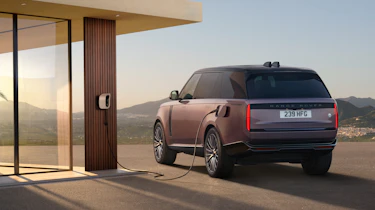
For home charging, Range Rover will offer its own wallbox design, promising smooth interoperability with the car and app. Charging the battery takes seven hours on a 22kW wallbox, so it’ll require a few sessions to reach capacity at homes with single-phase electricity. A couple of EV capabilities – ‘vehicle to grid’ to sell electricity back to the network and ‘plug and charge’ automated billing – aren’t ready to roll out to UK customers at launch.
Looks like a Range Rover, and no compromise on practicality
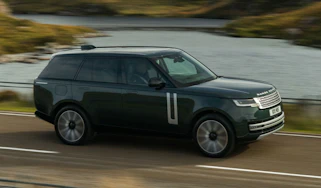
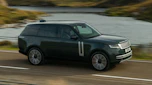
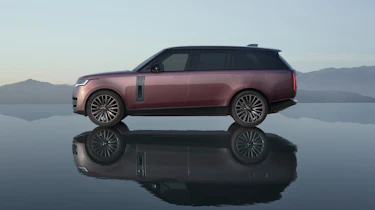
Externally, the Range Rover Electric looks almost identical to its siblings, apart from the blanked off grille and new alloy wheel design to smooth airflow. But due to the lower-hanging battery and reduced ride height it sits slightly closer to the ground, boosting efficiency along with the optimised underbody. The bespoke rear diffuser also helps while protecting off-roading approach and departure angles.
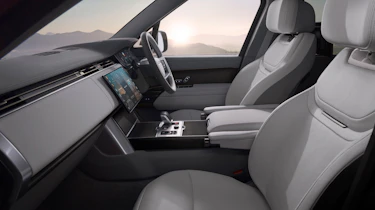
“From the carpets up, the interior is identical to the combustion version’s, with no compromise on cabin space,” said Simon Fairbrother. That preserves the huge 818-litre cargo area. But there’s no hidden ‘frunk’ in the nose: users would likely get their clothes dirty trying to reach into the distant storage area.
Front motor U-turn caused 18-month re-engineering shockwave
Initially a different EDU design – an induction motor – was fitted to the front axle. With superior freewheeling ability when disengaged, the goal was to drive efficiency. But during extreme physical testing in 2024 – the EV550 has to nail five runs up and down Dubai’s 300-foot Big Red sand dune – the motor was prone to overheating.
“It needed changing to a permanent magnet motor for repeatable performance,” explained Rachel Hogg. “That was a big decision that took time to get right.” Suddenly the team had to double rear EDU supply, redesign the front cradle, rewrite the software and prove it in the field – an 18-month re-engineering project.
How much is the Range Rover Electric?
JLR claims the EV550 waiting list now stretches to 80,000 people, with more than two-thirds new to the brand. “20 per cent of them already own an EV but aspire to a Range Rover,” said Martin Limpert.
The entry-level EV550 Autobiography (standard wheelbase) costs £154,070, with prices rising through First Edition, SV and SV Black trims to £190,320. The long-wheelbase version starts at £215,670 for the SV, with the SV Black at £225,240. But with Range Rover expanding its bespoke services, eco-minded plutocrats will be able to pay a whole lot more for a one-off with tailored materials, paints and unique embroidery.
Click here for our list of the best electric SUVs on sale right now...