New Kia EV9 GT 2026 review: fun, but the regular EV9 makes far more sense
The new Kia EV9 GT has plenty of power and style, but it comes at a hefty price


Verdict
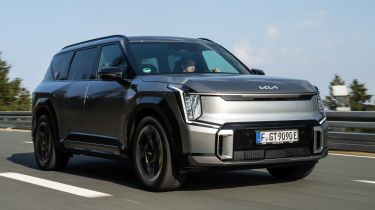
The Kia EV9 GT adds colour to the EV9 range, and we’re not just talking about the splashes of neon green that come with every model. Its appearance appeals, as does its interior, which is just as practical as that of any EV9, while liberal application of technology means it’s quick and capable too, whether you’re dealing with straights or corners. It does feel like a car in search of a buyer, though: one who’ll be prepared to pay more than £80,000 for a Kia (while still notably cheaper than a Volvo EX90 with the same number of seats), is prepared to overlook an overly firm ride on a family SUV, and who doesn’t mind frequent charging on account of combining 501bhp and 2.7 tonnes. It’s fun, but a regular EV9 makes more sense.
Kia’s GT range hasn’t quite had the consistency as sister company Hyundai’s more focused N models, but that’s steadily changing, as the EV9 GT joins the existing EV6 GT – and will soon be accompanied by GT versions of the EV3 supermini, EV4 family hatch and EV5 crossover.
The EV9 GT is, as you’d infer from Kia’s naming strategy, the largest of the GT models, and it’s been a long time coming, having first appeared at the Los Angeles motor show in 2024. It also has the feel of Kia’s engineers being let loose a little. The brand isn’t expecting to sell huge numbers of this £82k performance SUV, but it has the parts and the engineering knowledge, so why not?
Used - available now


What you’re getting then is Kia’s practical five-metre long, six- or seven-seater with a dual-motor drivetrain putting 501bhp and 740Nm of torque to the road. These are pretty mighty outputs for what’s now the most expensive Kia ever (and remember, the firm’s range starts at just under £17k with the Picanto), albeit offset by a similarly mighty 2,718kg kerbweight – or nearly three times the Picanto’s 947kg figure. Load up the EV9 GT with people and stuff and you’re rolling around at nearly 3.3 tonnes.
As such, while Kia claims a 0-62mph time of 4.6 seconds, what is clearly still a very quick car doesn’t have the accelerative slam you expect of 500bhp. That’s despite the all-wheel-drive set-up, with Electronic Dynamic Torque Vectoring Control (eDTVC) and an electronic limited-slip differential (e-LSD) all ensuring the GT has absolutely no trouble putting its power down, even in the damp conditions of our drive near Frankfurt, and on the winter tyres mandated there at this time of year.
The most scrabbling we felt was driving uphill in GT mode – selectable via a bright yellow button on the steering wheel, and one of several driving modes in the GT. It joins Eco, Normal, and Sport, plus three off-road modes and a MyDrive customisable set-up accessed by pressing the GT button twice. GT essentially turns everything to the maximum – motor response, the behaviour of the eDTVC, e-LSD and steering weight, as well as response from the by-wire braking system.
The EV9 GT definitely feels liveliest in GT mode, responding instantly as you squeeze the accelerator. The steering gets quite weighty, but appropriately so for such a heavy car, although you won’t feel any feedback from it. Perhaps most impressive is that on Germany’s sweeping forest roads, slick from rain, the EV9 GT feels genuinely well-balanced, and the sense of power being shuffled to the rear wheels, like a proper sports car, is tangible as you accelerate hard out of corners. The brakes stand up to repeated heavy stops admirably, too, although driven like this, you shouldn’t expect the typical EV long intervals between pad changes…
Another part of the GT mechanical puzzle are electronically controlled dampers, with appropriately firm settings in the sportier driving modes. Again, considering the weight you’re throwing around, and how high you’re sitting, there’s no real body lean or pitch to speak of, which is impressive, even if it never feels exactly nimble.
Less welcome is ride quality that’s even busier than that of the regular EV9. Germany’s roads are, on the whole, pretty well surfaced, but the constant jostle on the handful of rougher sections we found suggests that the GT could border on being annoyingly unsettled in the UK – acceptable in an actual sports car, but possibly enough to deter buyers of a family SUV. Refinement is still impressive, at least, and the GT makes a relaxed motorway cruiser.
Other unique aspects of the GT include Continental SportContact 6 tyres (when not running on winters), and as is also the case on the EV6 GT, a Virtual Gear Shift function. We first saw this on the Hyundai Ioniq 5 N, but it doesn’t quite fit the EV9 GT as well as it does the Hyundai – the gearshift paddles function well enough, with a bit of a kick between as you swap virtual ratios and torque that feels more like a petrol engine than an EV – but in the EV9 it comes across as more of a gimmick. We can’t see many drivers using it regularly, particularly as it unavoidably makes the car feel a bit slower, and the speed is surely what people will be spending the extra for over a standard EV9.
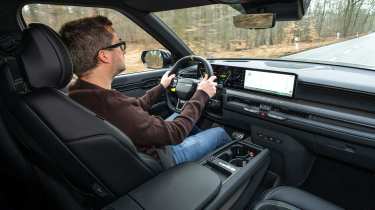
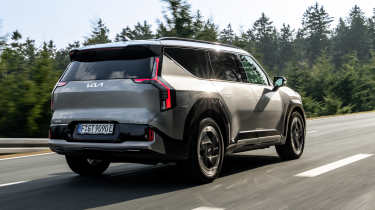
That and the styling, perhaps. As big boxy SUVs go, the EV9’s already a smart-looking option, and the GT’s unique 21-inch alloy wheel design, neon green brake calipers, and restyled front and rear bumpers give it just enough menace to justify the GT billing. You’ll find more neon green inside, for the centre marker and GT button on the sporty three-spoke steering wheel, the stripes down the centre of each seat, the seat stitching and the mood lighting.
The front seats are fabulous, too, with big bolsters and grippy Alcantara trim, and despite the best efforts of the firm ride, they’re also comfortable. Rear seat space and adaptability is as per the regular EV9 – there’s abundant room in the second row (with both the three-seat bench of seven-seat models, or the individual captain’s chairs in the six-seater) and shorter adults will do just fine in the third row. Space with the seats folded (which they do electronically) is vast: 828 litres in four/five-seat format, and 2,318 litres as a two-seater; there’s still 333 litres with all six or seven seats in place.
Day-to-day functionality is much like other EV9s too. Visibility is good, and it won’t take long for most drivers to figure out the dashboard layout. Pairing a phone is easy, and there are just enough physical controls to cover the basics – including proper buttons for heat and fan speed, several buttons on the steering wheel, and haptic buttons below the infotainment screen for accessing the important functions. Cabin storage is excellent, too.
Range, meanwhile, is unaffected by the extra performance, but only on paper. Kia claims 316 miles – a touch more than a GT-Line – from the same 99.8kWh battery (of which 96kWh is usable) as the rest of the EV9 range. Efficiency works out to 2.8 miles per kWh, although we saw a little less, with about 2.5mi/kWh in gentler driving, and only 2.1mi/kWh after exploring the GT’s performance and handling. Make full use of the GT’s 501bhp, and you’re looking at 200 miles or less from absolutely full to absolutely empty.
| Model: | Kia EV9 GT |
| Price: | £82,235 (seven-seater) £83,235 (six-seater) |
| Powertrain: | 99.8kWh battery, 2x electric motors |
| Power/torque: | 501bhp/740Nm |
| Transmission: | Single-speed automatic, four-wheel drive |
| 0-62mph: | 4.6 seconds |
| Top speed: | 136mph |
| Range: | 316 miles |
| Max. charging: | 210kW (10-80% in 24min) |
| Size: | (L/W/H): 5,015/1,980/1,780mm |
| On sale: | March |