Kia EV5 review
The Kia EV5 is an intriguing alternative to the Skoda Enyaq and Tesla Model Y, though it can’t quite beat them

Our opinion on the Kia EV5
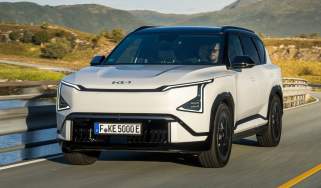
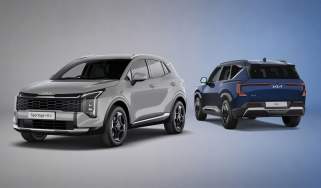
There is little wrong with the Kia EV5 in isolation, yet it struggles to stand out in the increasingly crowded mid-size SUV class. Customers coming from the hybrid-powered Sportage will revel in its familiarity, yet we can’t help but feel that an EV leader such as Kia could have done more to offer something genuinely unique. This is a spacious electric car that’ll take on family duties with ease, but it lacks any true stand-out qualities, such as the tech-fest that is the Tesla Model Y, or the temptingly low pricing of the Citroen e-C5 Aircross.
About the Kia EV5
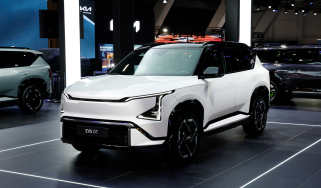
Kia is a brand that’s widely perceived as a leader in electrification, but it’s taken longer than most to stake its claim to the mid-size electric SUV market with the EV5. This car essentially acts as a natural progression for those moving from the big-selling Kia Sportage into an electric car, but the Kia EV5 GT is also attempting to lure in buyers who crave a dose of performance.
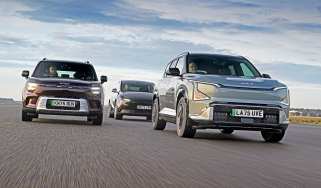
We’ve tested a GT-Line S version of the Kia EV5 against the Smart #5 and Tesla Model Y in a triple test. We’ve also tested this electric SUV on a variety of British roads, and we even travelled to Korea to drive a top-spec, front-wheel-drive model prior to its UK launch.
Performance & driving experience
Pros |
|
Cons |
|
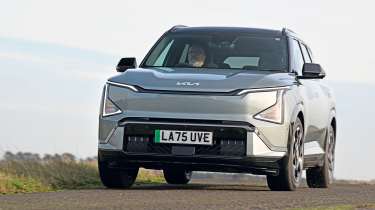
On the road, Kia’s entry into the mid-size electric SUV class is safe, predictable and almost entirely unremarkable. That might sound like we’re damning the car with faint praise, but such traits have never held the similarly sized Kia Sportage back from topping the segment sales chart, and we doubt they’ll do the EV5 any harm either.
Used - available now

2026 KIA
EV5
1,655 milesAutomaticElectric
Cash £38,489If you want a little injection of added performance, the four-wheel drive powertrain ups the power slightly to 261bhp. However, there aren’t any notable changes in terms of the driving characteristics, so while it is quicker, the fun factor is limited.
An honourable mention goes to Kia’s expertly tuned, best-in-the-business regenerative braking system. It varies from a full coast mode to a strong one-pedal drive, plus an intuitively calibrated adaptive setting, and you can flick through the wide-ranging spectrum on the fly, via paddles on the steering wheel. We wonder why all car companies haven’t carbon-copied this feature; much like engine braking, it allows you to slow the car more efficiently, all the while feeding precious power back into the battery.
| Model | Power | 0-62mph | Top speed |
| EV5 Air FWD | 214bhp | 8.4 seconds | 102mph |
| EV5 GT-Line FWD | 214bhp | 8.4 seconds | 102mph |
| EV5 GT-Line AWD | 261bhp | 7.3 seconds | 111mph |
Electric motors, 0-60mph acceleration and top speed
The only powertrain that’s currently on sale in the UK is the Long Range, which consists of a single electric motor mounted to the front axle. Regardless of trim level, this set-up has a 0-62mph time of 8.4 seconds, and a 102mph top speed.
The dual-motor all-wheel drive models cut the 0-62mph time to 7.3 seconds. When the flagship GT arrives, this will push things further with 302bhp and a 0-62mph time of 6.2 seconds. That’s quick, but not as potent as the Skoda Enyaq vRS, which completes the same sprint in just 5.4 seconds.
Town driving, visibility and parking
The EV5’s light steering and generous glasshouse make it one of the easier mid-size SUVs to pilot around town. It inevitably feels large when hitting a narrower street, but it’s still pretty easy to place on the road and thread through traffic. If you need to perform an awkward manoeuvre such as a three-point turn, the gear selector is well placed to the right of the steering column, so moving between drive and reverse can be done quickly, thus preventing any fellow motorists from becoming too frustrated and impatient.
While all-around visibility is decent, the standard suite of sensors and cameras helps to take a lot of potential stress out of parking. The EV5’s width means it does stick out a little bit when parked on the side of the road, so you’ll want to double-check that the mirrors are folded in to help prevent any clipping (this can be set up to happen automatically when you lock the car).
Country road driving and handling
The EV5 handles neatly and predictably, but in a very uneventful way. There’s enough grip, and the compliant suspension means it won’t unwittingly throw you off course mid-corner. It resists body roll just as well as can reasonably be expected from an SUV of this size and weight (2,580kg). The steering is light but precise, striking a decent balance between making the car easy to manoeuvre and reasonably responsive on a country road
Flicking through to Sport mode doesn’t transform the EV5 into a Hyundai Ioniq 5 N-rivalling hot hatch, but it does add a modicum of engagement complete with a subtle sci-fi soundtrack. We’re pleased to say that the sounds it makes aren’t annoying, unlike some, which will have you delving into the menus desperately trying to turn it off again.
Ultimately, we doubt you’re about to emerge from the experience feeling a surge of adrenaline. Instead, this electric SUV simply gets on with the task of getting you to your destination in a controllable and comfortable way, which makes perfect sense in a family-oriented car. Those coming from a petrol or hybrid-powered Kia Sportage should find this EV quite ‘familiar’, which is probably the biggest compliment we can pay it.
Motorway driving and long-distance comfort
Along with its agreeable town-driving manners, the EV5 excels on the motorway. It’s comfortable and particularly refined, while the motor works away in near silence. As with rival EVs, tyre and road noise is a bit more pronounced due to the lack of an engine to drown it out, but the cabin remains pleasantly refined throughout longer journeys.
Kia’s Highway Driving Assist tech is fitted to every EV5, and this takes a huge amount of effort out of motorway cruising. This tech will assist you in maintaining speed, keeping a safe distance from the vehicle in front and staying between the lines. It’ll even change lanes automatically when the appropriate turning indicator is activated. Don’t go thinking that you can take your hands off the steering wheel, though, because the car will give you a loud telling off if you do.
“The Kia EV5 is unexciting and totally predictable to drive, which in our eyes is both its most appealing attribute, as well as what prevents it from standing out in the busy mid-size SUV segment." - Richard Ingram, deputy editor.
Range, charging & running costs
Pros |
|
Cons |
|
In terms of specs, the EV5 matches many of its rivals without really moving the game on in any way. It’s based on Kia’s E-GMP platform, but shares more with the smaller Kia EV3 than it does the hi-tech Kia EV6 or Kia EV9. That means it uses the more affordable 400-volt electrical architecture, missing out on the 200kW-plus peak charging speeds offered on Kia’s top-end EVs.
Electric range, battery life and charge time
The EV5 will still hit 150kW when connected to a compatible charger, and go from 10 to 80 per cent in around 30 minutes – similar to its main rivals but nothing more. Those charging from a typical 7.4kW home wallbox charger will need to wait around 11 hours for a full charge from empty. The sole 81.4kWh battery promises up to 329 miles of range on the WLTP combined cycle.
However, during our own testing, we saw mixed results that bring this official range into question. During the warmer months with outside temperatures of around 22 degrees celcius, we managed an average of around 3.8mi/kWh following very heavy stop-start traffic, high-speed motorway runs and rural roads with significant elevation. This equates to around 309 miles of range, which is a very respectable outcome.
During winter testing with temperatures ranging between 8 and 11 degrees celsius, we saw our test car’s efficiency plummet to 3.1mi/kWh. This drags down the real-world range closer to 252 miles. While this is still a reasonable amount, it falls more than 70 miles short of the official number.
It’s also worth noting that a heat pump is not standard fit on the EV5, and it can only be specified as an option on the priciest GT-Line S trim for an extra £900. We reckon that’s a bit stingy, seeing as you get one as standard on the Renault Scenic and Nissan Ariya, for example.
| Model | Battery size | Range | Insurance group |
| EV5 Air FWD | 81.4kWh | 329 miles | 40 |
| EV5 GT-Line FWD | 81.4kWh | 313 miles | 41 |
| EV5 GT-Line AWD | 81.4kWh | TBC | 43 |
Insurance groups
The Kia EV5 line-up sits between insurance groups 40 and 43 (out of 50), so quotes will be pretty high considering that this isn’t positioned as a premium model. The Skoda Enyaq, meanwhile, sits between group 27 and 37, while even some Tesla Model Y variants undercut the Kia, ranging from groups 37 to 47.
Tax
The GT-Line S AWD variants of EV5 exceed the £50,000 luxury car tax bracket, while one-too-many options on some lower-spec cars will also bring this surcharge into play. This will add an extra £440 onto your annual VED road tax bill between the second and sixth year of ownership. EV owners will also want to bear in mind the plan to introduce an eVED pay-per-mile fee, which may come into force from April 2028 onwards.
Company car drivers can enjoy the usual electric car Benefit-in-Kind (BiK) tax rate of just four per cent in the current ‘26/’27 tax year, rising to five per cent for ‘27/’28, and seven per cent for the ‘28/’29 tax year.
Depreciation
According to our market data, the Kia EV5 will retain around 47 to 49 per cent of its original value over the first three years or 36,000 miles, with the entry-level Air being the best of the bunch.
In comparison, the Renault Scenic is expected to retain 54 per cent of its original value after the same period, while the Skoda Enyaq SUV only manages 43 to 47 per cent (in standard SUV form).
Interior, design & technology
Pros |
|
Cons |
|
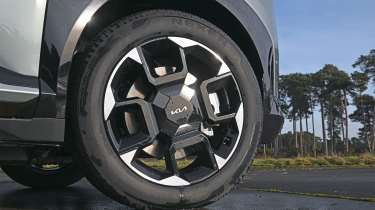
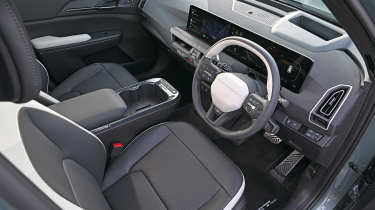
The EV5 comes pretty well equipped, with every version – including the entry-level Air – getting 18-inch wheels, automatic LED lights and privacy glass, while inside there are heated seats, automatic air-conditioning and a triple-screen infotainment system comprising two 12.3-inch read-outs for the instrument cluster and central display, and a five-inch panel for the climate controls.
We'd recommend looking at the mid-range GT-Line because it has:
- Electric front seat adjustment
- Electric tailgate
- Heated rear seats
- Adaptive LED headlights
The range-topping GT-Line S features a lot of extra kit, including front premium relaxation seats with ventilated front seats, a sunroof, a Harmon Kardon sound system, a head-up display, a 360-degree camera system, and a blind-spot view monitor.
Interior and dashboard design
The EV5’s interior follows a very similar design language to the other members of Kia’s ‘EV’ model line-up. In other words, it’s simple, ergonomic and perfectly pleasant to look at, if a bit lacking in the fashion department.
We found the climate control panel to be a bit awkwardly placed because it’s largely obscured by the steering wheel. Fortunately, there’s also a set of chunky, physical switches on the console which allow for easier adjustment of the temperature and fan speed.
Materials and build quality
The EV5 feels built to last, even if it doesn’t set any new standards for perceived quality in the mid-size SUV class. The seats are comfortable, and every surface we interacted with felt plush yet reasonably hard-wearing. There’s no compromise for those in the rear, either, where the fit and finish is on par with the rest of the cabin.
Infotainment, sat-nav and stereo
As mentioned, the infotainment system spans three distinct areas pulled together in one panel stretching behind the steering wheel, right out into the centre of the dash.
The main screen is easy to navigate and has all the functionality you’d expect, including wireless Apple CarPlay and Android Auto, enabling you to project the contents of your phone onto the EV5’s display. The fully digital instrument cluster is another plus point, with clear, easy-to-read fonts and menus that you can flick through on the fly.
While the Tesla Model Y and Ford Explorer have much bigger central screens, we found the Kia’s more modest setup to be a bit less distracting when driving, especially at night.
“Kia’s interior design has largely proved just fine in the EV3 and EV9, so it makes perfect sense to follow the ‘if it isn’t broken, don’t fix it’ approach with the EV5." - Shane Wilkinson, senior content editor.
Boot space & practicality

Pros |
|
Cons |
|
While the EV5 doesn’t scream ‘value’, it is at least pleasingly practical for a car in this class. There’s lots of storage up front, the back seats are impressively spacious both in terms of headroom and legroom, and there’s absolutely no hump in the floor, so you can even sit relatively comfortably in the middle seat. There are Isofix points on the outer rear seats, but some rivals also offer mountings on the front passenger chair; the Kia doesn’t.
Dimensions and size
The Kia EV5 is ever so slightly shorter than a Skoda Enyaq, but longer than a Volkswagen ID.4. A Tesla Model Y dwarfs it in every direction except for height, while a Toyota bZ4X is longer, but narrower and lower than the Kia.
| Dimensions comparison | |||
| Model | Kia EV5 | Skoda Enyaq | Tesla Model Y |
| Length | 4,610mm | 4,658mm | 4,790mm |
| Width | 1,875mm | 2,147mm | 1,982mm |
| Height | 1,675mm | 1,624mm | 1,624mm |
| Wheelbase | 2,750mm | 2,770mm | 2,890mm |
| Boot space | 566 - 1,650 litres | 585 - 1,710 litres | 890 - 2,130 litres (measured to roof) |
Seats & passenger space
The Kia’s bespoke electric platform means there’s loads of space inside the EV5, whether you’re sitting up front or in the rear. There’s a huge area between the front seats to stash stuff, while in the back there’s a completely flat floor, which means even those in the middle will have plenty of room for their feet.
One neat feature in the back is the centre console storage drawer. Pull this out, and there’s a lidded compartment that’s easily accessible from the back seats, and is far more useful than the shallow armrest bin situated above.
As with other Kias, the EV5 features USB-C sockets in the sides of the front seats, while the front headrests double as coat hooks.
Boot space
The Kia’s 566-litre boot only really falls short of the Skoda Enyaq on paper. The reality is that it’s a great shape and size, while the upright rear end means even boxier items should slide in without issue. A clever folding mechanism, whereby the seat bases and backs move in tandem, means that the rear bench goes completely flat – revealing a big, square and uninterrupted load bay. This increases capacity to 1,650 litres, very nearly matching the spacious Skoda Enyaq for load-carrying capacity.
We appreciate that the tonneau cover can be stored neatly out of the way below the boot floor, above an underfloor storage area. But while the Skoda doesn’t offer any space under the nose, the EV5 has 44 litres of storage there, which is modest, but enough for a charging cable, or in our case, a laptop bag.
Towing
The EV5, can tow up to 1,200kg in single-motor form, while the AWD models up this to 1,800kg. This means both powertrains outshine both the Renault Scenic’s 1,100kg capacity and the Skoda Enyaq’s 1,200kg.
“The EV5’s boxy profile and bespoke electric platform reveal a spacious interior and big boot. We found the folding rear seats particularly innovative, as they concertina to create a completely flat load bay.” - Richard Ingram, deputy editor.
Reliability & safety
Pros |
|
Cons |
|
The Kia EV5 didn’t appear in the most recent Driver Power best car to own rankings, but the brand continues to slip downwards on the best manufacturer leaderboard. Following an 18th place finish in the 2025 survey, Kia dropped to 25th (out of 30) in 2026. This is rather disappointing, especially when its sister brand, Hyundai, managed 13th place.
Safety experts Euro NCAP have awarded the Kia EV5 a maximum five-star safety rating, which is higher than the four-star score of the Peugeot E-3008 and Vauxhall Grandland Electric, and a match for the Renault Scenic.
As with every Kia, the EV5 comes with a seven-year, 100,000-mile warranty, which is more than double what many of its European rivals can offer. If you plan to keep your car for longer than most, this kind of cover could pay for itself several times over.
| Euro NCAP safety ratings | |
| Euro NCAP safety rating | Five stars (2025) |
| Adult occupant protection | 83% |
| Child occupant protection | 85% |
| Vulnerable road user protection | 74% |
| Safety assist | 80% |
Buying, prices and deals
Best buy: Kia EV5 GT-Line
With only one powertrain option available, it all comes down to trim choice. The EV5 Air is pretty well equipped with 18-inch wheels, heated seats, a three-screen infotainment system and wireless Apple CarPlay and Android Auto, but the GT-Line adds some luxuries such as artificial leather upholstery, electric driver’s seat adjustment, heated rear seats, a powered tailgate and adaptive LED headlights.
The Kia EV5 starts from around £39,500 and tops out at over £51,000, but you can save thousands by finding your perfect Kia EV5 through the Auto Express Buy A Car service. On top of that, we can also help you to sell your car.
Kia EV5 alternatives
Being a mid-size SUV means that the Kia EV5 is swamped with competitors from all sides. Rivals include everything from the Skoda Enyaq to the Tesla Model Y. Other options include the Audi Q4 e-tron, Citroen e-C5 Aircross, Ford Explorer, Nissan Ariya, as well as the Renault Scenic, Toyota bZ4X and Vauxhall Grandland. That’s a long list, but it isn’t even an exhaustive one.
Key updates of the Kia EV5 review
29 July 2026: Latest depreciation and pricing data
20 February 2026: Fresh driving impressions and pictures from our EV5 triple test.
Frequently Asked Questions
The EV5 gets the same seven-year, 100,000-mile warranty as all Kia cars.
Deals on the EV5 and alternatives