New Jaguar Type 01 is here, at last! British brand’s luxury EV future begins now
Jaguar’s controversial new four-seat GT has finally been revealed in full

Failure is not an option. Two years after Jaguar broke the internet with its derided ‘Copy Nothing’ relaunch video and subsequent Type 00 concept, here is the first production car of the company’s all-new electric era.
The Jaguar Type 01 is a four-door Gran Turismo, a throwback to a romantic past when wealthy motorists crossed continents in big, high-performance petrol coupes. But who buys a big coupe these days, and – more pointedly – who buys a new Jaguar?

No-one since early 2025, when Jaguar euthanised its range and burned down its house. The bold ambition is to rebuild it as the fourth luxury stable in JLR’s house of brands, alongside Range Rover, Defender and – a leap this – Discovery. And that means hugely “elevated” prices, to use Jaguar’s euphemism, with the Type 01 likely to cost from around £120,000.
That kind of money – a little above Porsche, a little below Bentley – underlines the scale of the ambition. And the necessity to do something radically different, underpinned by outrageous design, impeccable engineering and extreme performance. At first glance this overlooked and underestimated British brand has done exactly that.
It’s been unveiled in New York city, “one of the leading centres of culture, creativity and influence” and a big potential market, says Jaguar’s global marketing director Carlee Hardaker. That event kicked off the Type 01’s commercial introduction before first deliveries in summer 2027.
Type 01: how big is it – and what’s the story behind the design?
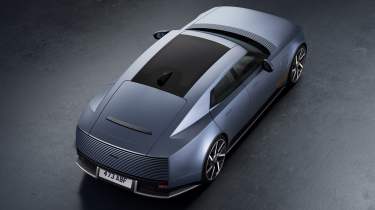
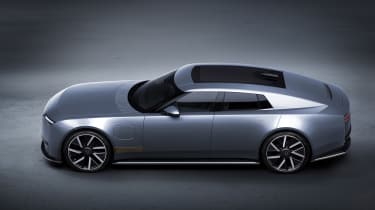
Everything about the Type 01 starts with the design, repeatedly described as “exuberant” and “a copy of nothing” by Jaguar’s creative team. Yet there is a fundamental truth behind that galvanising mission statement: those volumes – preposterously long nose, irrational ‘prestige gap’, set-back cabin – stem from the ‘60s E-Type or ‘70s XJC and XJS, not the amorphous electric crossovers that dominate today’s showrooms.
The Type 01 is 5.2-metres long and 1.4-metres high. Stack its standard 23-inch wheels two high and they would stand taller than the car itself. That low roofline is a colossal achievement when you consider the elevationary pressures triggered by having to stow a large battery – up to 120kWh – in the floorpan. It’s unlocked by smart engineering.
The prestige gap – the length between the front wheel centre and the front door – is 90cm-long, or 17 per cent of the total length (pointedly that’s the same proportion as the E-Type’s). Nearly a metre long, yet it serves no logical purpose other than to convey unconventional proportions and luxury; indeed Jaguar’s designers refer to it as the ‘luxury gap’. It will take some getting used to: combined with the cab-backward stance it causes an unusual dead area, a visual offset from where convention expects the windscreen pillar and forward door.
Despite the long, 3.2m wheelbase, the prestige gap bites into cabin space, restricting the Type 01 to a 2+2-seater, rather than one with bountiful space for four adults. Whether the market will tolerate this wilfulness is one of the new Jaguar’s most intriguing questions.
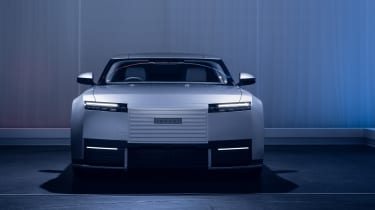
And then there are the details. 2024’s infamous pink Jag – the two-door Type 00 concept car – telegraphed the front end, with its ‘strikethrough grille’, a series of horizontal lines seemingly embossed on sheet metal, and low-set cooling aperture. The flat, clean bonnet extends towards four headlamps – illuminated hyphens in the corners – the smallest units in Jaguar’s history. Any similarity to a Rolls-Royce is probably no coincidence, even for a copy of nothing.
Design in detail: the impossible panel

Exterior designer Alexey Andreev describes the profile view as harbouring “our favourite surfaces on the car, on the impossible panel”. This is a vast, 3m-long pressing containing the roof rail, bodyside and curved shoulder that hints at the coke bottle rear haunch of Jaguars past.
“Why do we call it the impossible panel?” asks architecture chief engineer Jon Darlington. “Our computer modelling and tooling tryout basically said you cannot make this panel out of our chosen material, aluminium.” The metal tends to spring out of its pressed shape, giving the engineers the quandary of splitting the panel, or toning down the dramatic radii which would have impacted aerodynamics. Instead they spent 22 weeks perfecting the tool and process to deliver the panel; typically that would take a month.
“It now exists,” concludes Darlington. “We’re industrialising it in the Solihull factory, and it’s an example of how the team has been unwilling to compromise the aesthetic and the aerodynamic performance.”
The rear is dominated by another strikethrough, which contains the discreet rear light bars, and the absent glass screen. You can only imagine the team’s disappointment when the Polestar 4 beat Jaguar to market with this avant-garde feature, given the design competition that produced the Type 01 dates back to the Covid pandemic.
Tucked away on the rump is a three-stage active spoiler. It climbs to 7˚– the optimum angle to reduce drag – then cranks upwards to 21˚ in its maximum position, to generate 75kg of downforce for high-speed stability.
Jaguar says it’s shown the Type 01 to 2,500 people in clinics, where designs customarily score six or seven out of 10. “We got more nines and 10s than we’d
ever had before – and more ones and twos,” says Ms Hardaker. “That’s fine. We want to evoke an emotion and provoke polarisation of opinion. If you get people saying ‘It’s okay’, you end up creating a car for everybody that no one really wants. We want to drive an emotional connection – and irrational desire.”
Under the skin: the engineering story
To unlock that unique form, Jaguar had to engineer a bespoke platform, JEA (Jaguar Electric Architecture). No Land Rover platform was suitable, and discussions with external partners also proved fruitless. But that failure gave the engineering team a clean canvas on which to paint the new Jaguar generation.
The structure is almost three-quarters aluminium, to drive down weight, complemented with boron steels and composites; Jaguar claims the chassis is incredibly stiff, boosting refinement and handling precision.
A fundamental puzzle was packaging sufficient battery cells to meet Jaguar’s target range of 435 miles on the WLTP cycle, without a monolithic slab pushing the roof higher. The engineers solved this – saving 200mm in height – by segmenting the cells: there’s a void into which the rear occupants can extend their feet, which also houses the front seat mounting. But this meant 32 cells had to be stowed ahead of the front bulkhead, along with the power electronics and battery management system.
The knock-on effect was Jaguar needed to invent new structural parts to house relocated components and manage crash loads. So the high-voltage connections are merged with a structural brace in a novel junction box, while a patented ‘tri apex node’ can take up to 26-tonnes of force and channel it into the longitudinal extrusions and battery casing to protect the passenger cell.
Jaguar Type 01: battery, charging and range
Jaguar says its electric GT will have a battery with around 120kWh of energy; the precise pack size is still being homologated. The NMC prismatic cells are only 150mm tall, with 80 per cent of the volume providing energy: a thin cooling plate and side connectors ensure the pack’s size is minimised.
The 850-volt battery has a maximum DC charging rate of 350kW, restoring 200-miles of range in 13 minutes. On lower power, 400-volt chargers, the battery is effectively divided into two parallel packs charging at 250kW, in a bid to curtail wait times. For AC wallboxes, the on-board charging system is primed for the 7kW UK norm and 22kW if you have a three-phase electricity supply. There are AC charge ports on both flanks, with the one on the right the DC connector.
The Type 01 is the most aerodynamic Jaguar in history, to target a 435-mile range on the WLTP test cycle. At 70mph, the nose accounts for more than 60 per cent of overall drag; optimising this surface unlocked an extra 20 miles on the motorway. And active powertrain and brake cooling – with the lower grille opening only on demand – saves even more miles. Other aerodynamic features include the wheel designs, a flat underbody and four-corner, air suspension which lowers the GT at speed.
Three motors and more than 1,000 horsepower
The battery feeds three permanent magnet motors, good for a mighty 1,015bhp in total. Two rear drive units, united in a single casting, can pump out close to 900bhp, and typically provide 70 per cent of the torque to ensure a rear-drive feel.
Torque vectoring controls the load at each wheel, boosting traction and dynamics, with the inverter switching power on and off in an instant. And the rear unit can be completely deactivated on a highway cruise, with the GT propelled by the front drive unit. The gearing is also optimised for motorway efficiency.
But stamp the accelerator and Jaguar promises the GT will always have “power in reserve” – hardly a surprise given the four figure output. But if a driver is doing a steady 62mph and needs to overtake, the GT will catapult to 112mph in less than four seconds – with plenty more punch remaining to accelerate to the 150mph v-max. The 0-62mph is over in the blink of 3.2-seconds.
How does the new Jaguar feel to drive?
The Type 01’s dynamic feel has been honed by JLR’s ride-and-handling team led by Matt Becker. The ex-Lotus and Aston Martin dynamics guru says the GT is among his top three career highlights, alongside his former employers’ 2009 Evora coupe and DBX SUV.
What were the benchmarks? “I like the Porsche Taycan but it’s not a true GT for impact isolation and refinement,” he tells us. “The other car we looked at was the BMW i7, for refinement and engagement; but it’s a saloon car.”
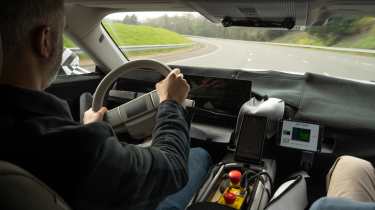
Earlier this year, Auto Express deputy editor, Richard Ingram, was given the chance to experience the Type 01 at Jaguar’s test facility in Gaydon, Warks. The car was “100 per cent accurate for hardware” but only around “70 per cent complete for software.”
Even so, the car felt agile; the innovative rear-wheel steering system made the 5.2m-long electric car “feel like a supermini” according to our man. The GT “did a great job of isolating us from the outside world” with a “cosseting, cocooned feeling.” The car pulled strongly well past 100mph, with what we called an “ability to eat up autobahns for breakfast”.
While developing the Type 01, Jag’s team also drove history’s great Jaguars, in an attempt to capture their dynamic DNA. The lighthouse was the 1974 XJ Coupe, due to its body control, refined ride, controlled roll and its “connected, engaging feeling,” explains Darlington.
The team claims the new Jaguar generation has a dual character, switching from comfortable cruiser to hunkered down GT, thanks to the dual-volume air springs and Bilstein twin-valve active dampers. That rear-wheel steering will help pivot the Type 01 into corners and boost stability at speed. The multi-link rear axle, double wishbone front suspension, low centre of gravity and 50:50 weight distribution ensure “the car rotates around your hips – it’s really good,” says Becker. “You’ll really like the ride comfort and primary control isolation, but it’s engaging as well.”
Four drive modes – altering the steering, one-pedal throttle and suspension – transform the character, with the Type 01 going from Jaguar mode’s comfortable moggy to wild cat in Dynamic mode. Ice and Snow unlocks a more all-wheel drive bias, while Efficiency recalibrates the accelerator to preserve range.
1970s lounge vibes: inside the Type 01
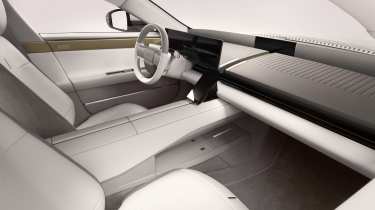
The Type 01’s cockpit is almost as avant-garde as the exterior, segmented into four areas by a chunky central spine. “Jaguar is all about the length,” says chief interior designer Tom Holden, suggesting the front-to-back console “creates a real sense of drama.” Fine in principle but it’s overpowering, even in the Orchid White colour scheme: a dark finish is a claustrophobic prospect indeed. Swivel the lids to reveal cupholders and cubbies lined in bright colours.
The imaginative finishers running along the cabin are inspired by brass, a material too heavy for a car but replicated by aluminium, anodised to bring colour and embossed for tactility. Externally the prestige gap’s Jaguar ‘Leaper’ emblem is made the same way.
Charles Eames would approve of the slimline seats, upholstered in neograin ultrafabric and Kvadrat’s duoweave, 30 per cent wool blended with polyester. Bentley’s rival EV, the Torcal, tops it with 100 per cent wool more sparingly used.
The slim dashboard’s form resembles a part-nibbled macaroon, with a 24-inch driver’s display taking a bite. And a modest central touchpad controls key functions such as climate and audio: not a single switch is visible. The thick carpet spreads onto the lower doors, and with the architecture hemming in occupants, it “creates this incredibly cosseting, driver-focused interior,” says Holden.
The strikethrough reappears on the dashtop, alongside two more novel elements: a full-width soundbar to create a wall of sound and a digital rear view mirror. Called ‘clearsight rear view display’, Jaguar says its positioning requires less focal adjustment than glancing upwards.
It all adds up to a calm and cocooning cockpit trimmed in beautiful materials which, like the exterior design and engineering, indisputably delivers on Jaguar’s mantra to redefine the automotive boundaries. “You have the vision, you deliver on the vision,” exhorts design director Andy Wheel. “Do not let it suffer death by 1000 cuts.”
Conclusion: does death – or glory – beckon?
After six years in secrecy, Project Renaissance’s first production car now faces the white heat of public opinion and Darwinian commercial reality. Can Jaguar carve out a niche alongside Bentley, having doubled its price points, just because JLR wishes it so?
Its last attempt at a relaunch, the 15-year push to break the volume premium market, ultimately failed, despite owners Tata investing billions to build a broad range featuring the ground-breaking iPace EV, charismatic F-Type sports car and popular F-Pace SUV.
“Jaguar was really at a crossroads five years ago: we could have done minor tweaks to that strategy, but that wasn’t going to make the difference,” explains Ms Hardaker. She cites the price war with German premium brands and Chinese brands circling that market, plus the revolution in powertrain and digital technology, as triggers for the strategic overhaul.
“Our customer base was getting older, and it was naturally getting smaller. And we weren’t really attracting a new generation of customers. The only option was to completely transform the brand, the positioning and the product line-up.”
The underlying fear is there’s something about the Jaguar brand that makes it a drag, even on excellent cars. Can it transcend this and emulate Netflix or Apple and successfully reinvent itself? It’s an audacious gamble, doubly so to launch with a four-door GT, when a crossover SUV would have been a safer move. And to launch electric only, without the safety net of a plug-in hybrid.
Jaguar’s vision is uncompromising and puristic, embodied by the Type 01: a spectacular piece of design underpinned by impressive engineering. Whether that’s enough to create the electric luxury four-door GT market is another question entirely. But the ambition must be applauded, and Britain should get behind it: if this fails, it’s hard to see how Tata can revive the once leading car brand.
“We could have done some iterative steps, but if you look back in our history, we’ve never made little steps,” says Ms Hardaker. “We’ve always made bold decisions – and that’s exactly what we’ve done today.”
This radical reinvention of Jaguar may fail. But at least no-one will die wondering.
Did you know you can sell your car through Auto Express? We’ll help you get a great price and find a great deal on a new car, too.