New Hyundai i20 2015 review
Will all-new look and more space help Hyundai i20 supermini stand out in a tough market?


There was a lot of pressure on the new Hyundai i20 to deliver based on the success of its little brother, the i10. In this case, Hyundai hasn’t quite been able to replicate that winning formula. The new car is very spacious and well kitted out, but in such a competitive sector its shortcomings – in terms of ride and performance – are highlighted. Still, the arrival of the new three-cylinder turbo next year could change all of that.
The outgoing Hyundai i20 never really established itself as a firm contender in the competitive supermini sector. We were always aware of its presence but, like the forgotten member of a band, it was never in the limelight. Hyundai is hoping to change that with this all-new second-generation model.
It won’t be easy, with the aggressively priced Vauxhall Corsa and capable VW Polo to compete against, so are a radical redesign and claims of class-leading interior space enough to attract buyers?
Longer, lower and wider than the previous i20, the new model is characterised by a long bonnet, wide grille and slim headlamps with LED daytime running lights. The floating-style C-pillar also helps to mask its bulk, giving it a more coupe-like profile. It’s an intricate design and the makeover finally enables the i20 to stand out among conservatively styled rivals.
The overhaul continues beneath the surface, too. An all-new platform has amplified the i20’s proportions, so not only is it bigger than before, it’s now 63mm longer, 52mm wider and 12mm taller than the spacious Polo. Think of the i20 as a supersized supermini.
Used - available now


What isn’t new, however, is the engine range, which has been carried over from the outgoing model, with efficiency tweaks to make all engines pass Euro VI regs. There are three petrol units and two diesels, with the 1.2-litre petrol likely to be the pick of the bunch.
On paper, the 84bhp four-cylinder 1.2-litre unit that we tested – a 74bhp version is also available – falls short of matching some rivals but trumps others. It’s more efficient than a Corsa, returning just over 55mpg and emitting 119g/km of CO2, but a Polo is cleaner.
This engine isn’t the most inspiring or energetic, either. It feels breathless throughout the rev range, making progress rather sluggish, highlighted by a 0-62mph time of 13.1 seconds. The Polo will do it in 10.8 seconds.
What the i20 is crying out for is a three-cylinder turbo – something all of its closest rivals now offer – but you’ll have to wait until mid-2015 before Hyundai will introduce its version.
Once up to speed, things improve, with positively weighted steering and well suppressed wind noise. With just five speeds as standard, the engine can become a little coarse at higher speeds – you’ll have to opt for a diesel if you want an extra gear.
The ride isn’t the most forgiving. It deals with potholes and rougher surfaces well, but a car full of passengers reveals suspension that doesn’t have enough travel and thuds into larger imperfections.
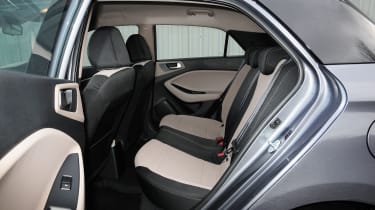
Where the i20 does come into its own, though, is inside. The extra 45mm added to the wheelbase makes it the most spacious car in its class, with rear knee and headroom enabling three adults to sit comfortably in the back. Add the full-length panoramic sunroof – standard on Premium SE models and a first in this sector – and it feels light and airy. There’s more room in the back than you’d find in a Ford Fiesta.
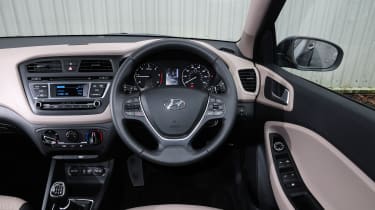
The 326-litre boot is larger than that of a Focus, too. What is a little disappointing is that the touchscreen infotainment and nav system will only be offered as a dealer fit option, even on top-spec Premium SE models, which start from £14,725. The equivalent-spec Ford, VW and Vauxhall all offer some sort of sat-nav as standard.