Future of car safety: smart seatbelts, robotaxis and bringing back buttons
Physical buttons and driverless taxis are on Euro NCAP’s to-do list, as Matthew Avery's crystal ball-gazes all the way to 2035

Grouping car controls on touchscreens has failed. It’s time to “bring back buttons”, according to car safety guru Euro NCAP.
Europe’s vehicle safety testing organisation is sharpening its focus for 2030 and even looking ahead to 2035 and assessing robotaxis. But tackling touchscreen-related driver distraction is a pressing issue, says Matthew Avery, Euro NCAP’s director of strategic development. “One in three crashes has distraction as an element,” he says. There are two principal causes: people illegally scrolling smartphones at the wheel, or drivers taking their eyes off the road to use complicated touchscreens.
Avery admits there’s little scientific data that links touchscreen use to increasing crashes. “Anecdotally, everyone would say they are [linked], because off-road glance time trebles. It might take a second to use a button; it’s three-seconds-plus on average to use a touchscreen.”
Some car makers have already got the message: VW’s latest EVs such as the ID. Polo and ID.3 Neo have reinstated a bank of buttons for key controls, while Volvo’s design boss Thomas Ingenlath says the touchscreen trend has gone too far.
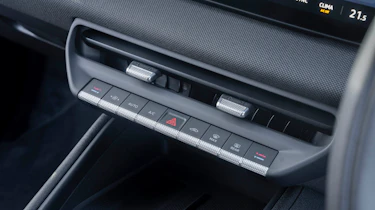
How and when buttons are set to return to our cars
Euro NCAP will become more prescriptive about the type and placement of controls, implementing it for the 2029/30 assessment protocol. Today, general vehicle controls contribute five points to overall ratings: “We will increase that from 2029,” confirms Avery. The directive applies to key functions such as lights, turn signals, windscreen wipers/washer, hazard warning and emergency call. “We will allow a touchscreen for secondary controls such as heating,” he says, “but they must be permanently displayed.” And the switches must be in logical places, dictated by consensus and tradition.
The next passive safety push: smart seatbelts
Although Euro NCAP is very focused on active safety features that avoid crashes, it will continue to promote passive safety advances. One example is Volvo’s intelligent seatbelt, which adapts its load levels according to a person’s physique. “We see [specific] injuries from people with different morphologies,” says Avery. “[Following] Volvo’s innovation, we’re looking for manufacturers to tune the restraints from 2029.”
Volvo’s new EX60 is the world’s first car with a multi-adaptive safety belt. It combines data from exterior sensors to assess the likely crash severity with driver monitoring to understand whether occupants are pregnant, slight, older or other variables. Instead of just three load-limiter settings, the EX60’s restraints have 11, to provide a broader spectrum of more tailored loads that are less likely to cause injury.
Euro NCAP ready as robotaxis hit towns
As well as passive safety, Euro NCAP will step up its scrutiny of driver assistance. Auto Express’s testing found today’s Level 2 assistance to be very limited in urban areas, with the systems struggling with parked cars, which can trigger forward collision warnings and upset conventional lane etiquette. Roundabouts, tight turns and junctions also nullify the systems. But Avery accepts enhanced co-pilots (so called Level 2++) will become increasingly common and must be assessed. “Level 2++ should drive on any road and operate all the controls,” he says, although he stresses responsibility will lie squarely on the driver.
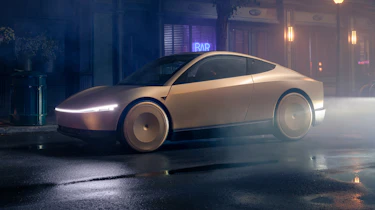
Car makers have generally shied away from Level 3 assistance, a grey area where drivers can in theory be ‘eyes off and hands off’ on certain roads, but ready to take control when liability switches back to them. “We’ve got to look at self-driving, up to Level 4,” says Avery. This is the level of robotaxi operators Waymo and Tesla, where a vehicle can drive itself autonomously within a geofenced area. “We’re also going to have to look at robotaxis; a lot more people are getting ‘mobility as a service’. How can we advise people to use this company, not that company?”
Avery has the energy levels to remain on the frontline of vehicle safety for years to come. “So many crashes – and road deaths – are completely avoidable,” he says. “Why should we put up with, effectively, three to four jumbo jets crashing every year in terms of casualties? Some people may say ‘That’s life’. But to me, it’s absolutely unacceptable.”
More from our ADAS car safety special
- ADAS warning and safety tech tested (pt 1)
- Hands-free self driving systems tested (pt 2)
- Best and worst ADAS 2026/2027: megatest verdict
- What is ADAS? Advanced Driver Assistance Systems explained
- 2027 will be the UK’s year of the self-driving car
- Future of car safety: smart seatbelts, robotaxis and bringing back buttons
Don't miss the best of Auto Express on Google! Make us a preferred source. Click here...