Are Chinese cars really cheaper? True buying and running costs for top models uncovered
Five big-selling Chinese cars go head-to-head with western rivals on fuel, servicing, insurance and depreciation costs, to find out if the disruptors really are as cheap as their lead-in price suggests

Price is the number-one factor when it comes to buying a new car. But where that car is assembled is neither here nor there for British consumers: according to YouGov, more than half of us would consider an emerging Chinese brand – if it offered competitive pricing. As a result, new entrants such as Jaecoo, Omoda, Chery and BYD are exploding in popularity, taking more than 10 per cent of the new-car market in 2026.
Chinese car prices can be around 10 per cent lower than for their European, American, Korean and Japanese rivals, but are the former really cheaper to own? Research by our sister brand Carwow has already revealed Chinese cars can be trickier and more expensive to insure – so how does that translate into other running costs, such as servicing, fuel and depreciation?
We’ve done the maths to investigate whether Chinese cars really are as cheap as they seem. We’ve picked out top-selling models from five of Britain’s most popular Far-East brands and pitted them against rivals, finding out how much they cost to run over the course of three years and 30,000 miles, the average lease or ownership period.
The cost of charging has been determined by using the July Ofgem Energy Price Cap, combined with the ZapMap average cost for rapid charging, at a domestic to public charging ratio of 84:16 – the typical usage pattern for most EV drivers. We’ve also compared the cost of buying with cash or leasing – the former with residuals sourced from industry expert, cap HPI, and the latter using the best ‘Available to Order’ deals we found on the Auto Express Buy A Car service.
And if you’re asking how come Chinese cars are so much cheaper than the competition at face value, state subsidies play a big part. Research from the Center for Strategic and International Studies suggests that Chinese car makers have benefited from more than £170billion in financial aid over the past decade and a half, prompting the European Union to impose tariffs on Chinese models over what it sees as unfair competition.
Yet it’s not just Beijing’s bankrolls that contribute to cheap list prices. David Bailey, professor of business economics at the Birmingham Business School, told Auto Express: “Thanks to heavy investment, Chinese brands have built scale, which helps keep costs down. Employee costs are also much lower, while Chinese energy costs are probably 25 per cent of what they are in the UK.” But across the three-year costs of a vehicle, can western producers fight back?
Plug-in Hybrid comparison: Jaecoo 7 vs Hyundai Tucson vs VW Tiguan
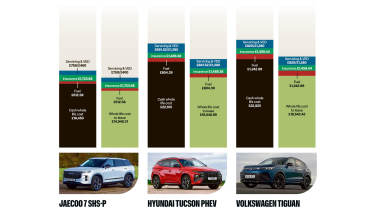
| Model | Cost to buy | Cost to lease |
| Jaecoo 7 SHS-P | £19,845.26 | £18,341.57 |
| Hyundai Tucson PHEV | £26,510.29 | £22,504.18 |
| Volkswagen Tiguan | £27,627.33 | £23,344.75 |
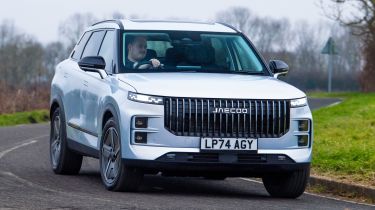
The Jaecoo 7 has become the flagbearer for the Chinese invasion and is currently the UK’s third-best-selling car of 2026. But the Jaecoo is no luxury SUV, instead targeting mainstream family cars with its wannabe Range Rover image. On paper, it appears to offer fantastic value; standard kit is very strong, while the use of plush materials around the cabin offers a perceived sense of quality – even if driving comfort and dynamics aren’t a patch on rivals’.
The model we’ve chosen to compare is the Super Hybrid System (SHS-P) PHEV. Not only is this the best-selling variant – Jaecoo says it accounts for roughly 70 per cent of sales – but it significantly undercuts other plug-in options available, too.
We picked out two big-selling rivals, the Hyundai Tucson and Volkswagen Tiguan, and specified them to match the 7’s generous equipment list.
A roughly £10,000 difference in cash price gives the Jaecoo a huge advantage, not only in terms of up-front savings, but also because the Hyundai and VW are liable for the Government’s £440 annual road-tax surcharge for cars costing £40k or more, between years two and six of ownership. The Jaecoo has strong residual values and maintains its lead when switching to lease pricing, too.
Insurance is where its rivals claw back ground, while the VW undercuts the Jaecoo on servicing costs. All three cars returned an average between 43-50mpg when we drove them. Yet despite the difference in fuel costs being closer in the real world, it isn’t enough to offset the initial cost difference; the Jaecoo will still set you back between £3,000-£6,000 less than the Hyundai or Volkswagen.
We say:
The Jaecoo 7’s rock-bottom price is only made cheaper by competitive running costs – just
watch out for pricey insurance premiums.
- Best to buy: Jaecoo 7 SHS-P
- Best to lease: Jaecoo 7 SHS-P
Hybrid comparison: MG HS vs Nissan Qashqai vs Kia Sportage
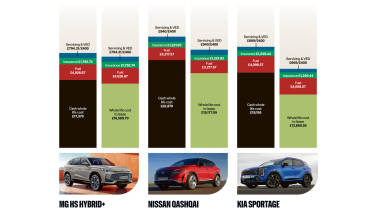
| Model | Cost to buy | Cost to lease |
| MG HS Hybrid+ | £24,383.72 | £23,602.51 |
| Nissan Qashqai | £28,649.50 | £24,957.49 |
| Kia Sportage | £25,612.01 | £20,277.27 |
Proof that not all Chinese cars are attractive only on cost grounds, the MG HS is one of our favourite family cars, and won our plug-in hybrid megatest. Like the Jaecoo, it’s a family SUV that often appears in the top 10 of the UK sales charts.
We’ve pitted the HS against two of its most formidable hybrid rivals: the Nissan Qashqai and Kia Sportage. Once again, when considering the list price, the Chinese SUV looks far cheaper. However, the MG doesn’t hold up quite as well as the Jaecoo when it comes to residual values, meaning the price gap between the HS and its competitors narrows considerably when you come to sell the car after three years – especially in the Qashqai’s case.
The Sportage has the edge when it comes to leasing, highlighting how a good deal can be a game-changer; despite its lower price, the MG is £1,500 more expensive over three years. Insurance premiums for the HS also cost roughly £180 per year more than for the Qashqai and Sportage.
The MG HS Hybrid+ we’re featuring here offers similar fuel economy to most of its rivals, with the exception of the Qashqai; its e-Power system not only delivers an EV-like driving experience, but similar fuel economy to a hybrid supermini.
This means the Qashqai is around £800 cheaper to fuel than the HS over 30,000 miles.
Finally, the MG is more expensive to service – especially compared with the Sportage – meaning it’s actually more expensive to buy outright and run overall. It’s only around £1,000 cheaper than the Qashqai on lease, with a good deal on the Kia making that car the best bargain by far in this match-up.
We say:
Hybrid MG is undercut by the Sportage’s competitive lease deals. Insurance and fuel costs are higher than the HS’s competitors in this head-to-head, too.
- Best to buy: MG HS Hybrid+
- Best to lease: Kia Sportage
Electric SUV comparison: Leapmotor B10 vs Skoda Elroq vs MINI Countryman
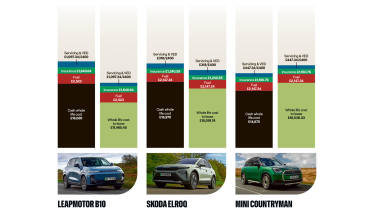
| Model | Cost to buy | Cost to lease |
| Leapmotor B10 | £21,680.98 | £17,126.43 |
| Skoda Elroq | £21,075.83 | £19,125.57 |
| MINI Countryman | £18,830.34 | £20,691.67 |
Leapmotor is the smallest and least well known of our five Chinese challengers, but its sister brands include Vauxhall and Peugeot under the umbrella of the Stellantis group. The £31,495 B10 is its family mid-sized SUV, with a respectable 270-mile range.
We’ve pitted it against two other desirable small-yet-spacious SUVs: the MINI Countryman E and Skoda Elroq. The B10 is only slightly cheaper than these rivals – with the MINI benefitting from the full £3,750 Electric Car Grant. But the Leapmotor’s seemingly endless equipment list can only be matched with high-spec Countryman Exclusive and Elroq Edition 60 models – and even they don’t tick every Leapmotor box.
As you’d expect from a MINI, strong residuals make it the cheapest of the three to buy outright, although China’s offering is by far and away the least expensive option to lease – proving that deals can swing in both directions.
The Leapmotor requires servicing annually, and its £1,097.34 plan over three years is much more costly than rivals – especially when visiting a Skoda dealer once in two years will cost just £318. But the Leapmotor costs around £125 a year more to insure than the Skoda, with the MINI the most expensive.
The B10 is also much less efficient than its two competitors here, meaning drivers will be paying around £400 extra on average for electricity over the course of 30,000 miles.
Ultimately, buy outright and the Leapmotor is the most expensive – largely due to its weaker used value. But it’s the cheapest to lease – highlighting the power of a competitive monthly rental.
We say:
Across the board, the Leapmotor costs more to run than its rivals, but a killer lease deal saves it from total embarrassment.
- Best to buy: MINI Countryman E
- Best to lease: Leapmotor B10
Electric saloon comparison: BYD Seal vs Tesla Model 3 vs Volkswagen ID.7
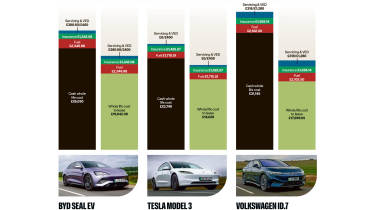
| Model | Cost to buy | Cost to lease |
| BYD Seal EV | £30,499.66 | £24,111.74 |
| Tesla Model 3 | £27,276.08 | £21,564.08 |
| Volkswagen ID.7 | £36,403.64 | £22,957.69 |
BYD is one of the biggest Chinese brands in the UK and one of its key models is the Seal electric saloon, which competes head-on with the Tesla Model 3.
The Seal is unusual because it’s actually £1,000 more expensive than the Model 3 Premium Long Range RWD, and the Tesla beats it on range. Volkswagen’s ID.7 is the most expensive to buy and due to greater depreciation, will be worth roughly the same as the BYD and Tesla in three years’ time.
Nonetheless, a good leasing deal can make a more expensive model the cheaper option in practice; the ID.7 is the cheapest of this trio to lease, costing around £2,000 less over three years than the Seal. The Volkswagen is also slightly cheaper than the BYD to maintain, too, with both cars only needing one service every two years; Tesla tells us that over this mileage and timespan, the Model 3 won’t need servicing at all.
The Volkswagen, though, does creep over the higher £50,000 threshold for electric cars when it comes to the VED supplement for luxury cars and costs around £200 more to insure over the course of three years than the BYD, which is actually the cheapest to cover in this company.
But it’s the Tesla that’s overall the cheapest of the three to run; its 5.9 miles per kilowatt-hour claimed figure makes it by far the most cost-effective to charge up. Full access to the Tesla Supercharger network should make topping up on the go cheaper, too – we haven’t taken that into account for the sake of fairness – with the Tesla costing around £3,000 less than the BYD over the three-year period, regardless of whether you choose to buy or lease.
We say:
One of the few Chinese models to be more expensive than its main competitor, the BYD also bucks another trend by being the cheapest of this trio to insure.
- Best to buy: Tesla Model 3
- Best to lease: Tesla Model 3
Petrol comparison: Omoda 5 vs Ford Puma vs Nissan Juke
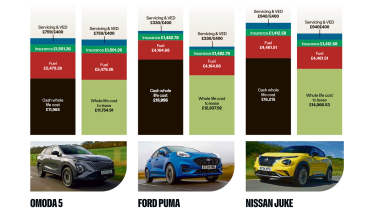
| Model | Cost to buy | Cost to lease |
| Omoda 5 | £20,104.52 | £19,894.43 |
| Ford Puma | £22,372.46 | £19,215.38 |
| Nissan Juke | £23,429.09 | £21,280.62 |
Omoda doesn’t have the same profile as its sister brand Jaecoo, but it’s outperformed Dacia, Citroen and Mazda so far in 2026. The Omoda 5 has even outsold the larger Jaecoo 7 in some months, with buyers tempted by the petrol model’s £24k price.
The 5’s biggest rival is undoubtedly the Ford Puma, which has been the UK’s best-seller for three years. Nissan’s Juke also sells in big numbers and, like the Puma, costs several thousand pounds more than the Omoda when specified like-for-like.
While the Omoda currently has robust residual values, fleet-operator confidence in the Ford and Nissan keeps the cost premium narrow, if still slightly higher. The Puma scores with a £330 servicing package over three years – less than half its rivals’. The Juke is the cheapest to insure by around £30 per year. But the Omoda’s inefficient petrol engine returns around 10mpg less than its rivals here, so costs up to £1,500 more to fuel over 30,000 miles.
The Omoda is the cheapest to buy outright, but the Puma is £680 cheaper to lease over three years.
We say:
Upfront cost savings are diminished by the Omoda’s inefficient petrol engine and expensive servicing costs.
Overall Verdict
Beijing has done well to fabricate a veil of value, but pulling it back highlights how choosing Chinese isn’t necessarily the wisest investment in the long term. Despite almost all of China’s entrants boasting a lower sticker price, higher running costs mean only three of the five models here come out less expensive overall when buying outright. If you plan to lease, however, this drops to just two, with a margin of only a few grand.
But the Jaecoo 7 is much cheaper to buy than its rivals, which negates any higher running costs. Yet the BYD Seal is beaten by the Tesla as a cash or a lease option; it costs more to lease than the larger and, at face value, pricier VW ID.7.
All of this showcases how the real costs of car ownership run much deeper than simply the list price or monthly cost. Once you crunch the numbers, you’ll discover the legacy car makers aren’t all that far behind their Chinese rivals and often offer better value. We recommend doing the maths before you buy, because while saving several thousands of pounds is a valid reason to take the risk with a new marque, a difference of a few hundred quid might not be worth the jiggly ride and in some cases, ‘bootleg’ image.
Did you know you can sell your car through Auto Express? We’ll help you get a great price and find a great deal on a new car, too.