Electric cars vs winter: Audi A6, Mercedes CLA, Tesla Model Y, Kia EV4 and MG IM5 megatest
What does winter do to the capabilities of five long-range EVs? Our brutal 370-mile trip reveals everything - but did they all make it?

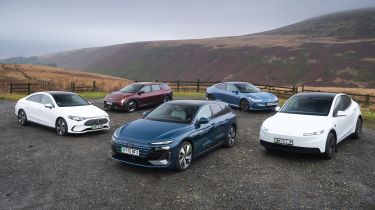
Winter EV range tests are brutal. Here’s the movie trailer for this one: cars limping towards chargers, one with zero miles remaining. Others inexplicably refusing to refuel as they should. A mislaid key card. And Storm Chandra remorselessly hammering us with rain. It’s a blockbuster, right?
Long-range electric cars vs winter: the contenders
Our test logic is simple: range anxiety should have gone the way of DVD players and cassette tapes now that electric cars comfortably exceed 300 or even 400 miles. So, that’s the mileage we’re going to cover. The runt of our litter is the cheapest version of the world’s best-selling EV – the Tesla Model Y – but it still packs an official 314 miles of puff. At the opposite end of the spectrum, we have Mercedes’ CLA 250+ Sport, able to cover a cool 484 miles. On paper.
And while big-range Benzes typically sell for £75,000 or more, this one costs less than £50,000 – like four of our five contenders. It seems that angst-free EV running is no longer reserved for plutocrats in EQS and EQE saloons.
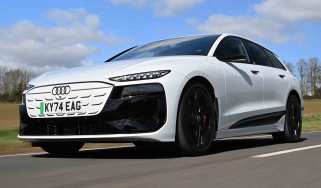
That said, the Audi A6 Avant e-tron remains in that bracket, costing just north of £80,000. With its curvy lines and stubby nose, it looks like an A3 Sportback stretched and slammed by Dr Frankenstein to improve aerodynamics – it’s apparently the slipperiest estate on sale, and has a claimed electric range of 430 miles.
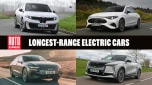
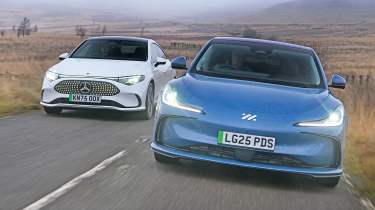
But it still doesn’t scythe through the air as smoothly as the MG IM5 Long Range. Fellow tester Alastair Crooks utters reverently that the Chinese saloon offers “so much car for the money”: it’s a fiver under £45k, yet at 4.9 metres long, is bigger than the Audi. With the most power (401bhp), the biggest battery (96.5kWh) and the most potent DC charging (396kW), the MG could be a dark horse for the win.
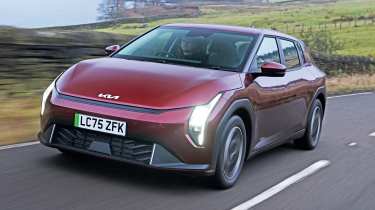
Rounding things off is Kia’s EV4. Like many mid-size hatchbacks, its motor turns the front wheels (the rest of our contenders are rear-wheel drive), and we could imagine it tempting a few VW Golf owners to go electric – especially with the Kia’s price just beneath the £37,000 ceiling to qualify for a £1,500 government grant.
| Model: | Kia EV4 Air | Audi A6 Avant S-Line e-tron Performance | Mercedes-Benz CLA 250+ Sport | Tesla Model Y Rear-Wheel Drive | MG IM5 Long Range |
| Price: | £36,995 | £80,455 | £45,615 | £41,990 | £44,995 |
| On sale: | Now | Now | Now | Now | Now |
| Powertrain: | 81.4kWh battery, 1x e-motor | 94.9kWh battery, 1x e-motor | 85.5kWh battery, 1x e-motor | 60kWh (est) battery, 1x e-motor | 96.5kWh battery, 1x e-motor |
| Power/torque: | 201bhp/283Nm | 362bhp/565Nm | 268bhp/335Nm | 295bhp/420Nm | 401bhp/500Nm |
| Transmission: | Single-speed automatic, front-wheel drive | Single-speed automatic, rear-wheel drive | Two-speed automatic, rear-wheel drive | Single-speed automatic, rear-wheel drive | Single-speed automatic, rear-wheel drive |
| 0-62mph/top speed: | 7.7 seconds/105mph | 5.4 seconds/130mph | 6.7 seconds/130mph | 6.9 seconds/135mph | 4.9 seconds/137mph |
| Efficiency/range: | 4.3 miles per kWh/388 miles | 4.1 miles per kWh/430 miles | 4.7 miles per kWh/484 miles | 4.5 miles per kWh/314 miles | 3.8 miles per kWh/441 miles |
| DC charging: | 127kW (10-80% in 31min 350kW DC) | 270kW (10-80% in 21min) | 320kW (10-80% in 22 mins) | 175kW (10-80% in 24mins est) | 396kW (10-80% in 17 mins) |
| Size (L/W/H): | 4,430/1,860/1,485mm | 4,928/1,923/1,493mm | 4,731/1,855/1,468mm | 4,797/1,920/1,668mm | 4,931/1,960/1,474mm |
| Boot space: | 435 litres | 502 litres (27-litre frunk) | 405 litres (101-litre frunk) | 845 litres (116-litre frunk) | 457 litres (18-litre frunk) |
| Weight: | 1,896kg | 2,185kg | 2,055kg | 1,906kg | 2,210kg |
The first hurdle: a cold charge
As my best mate’s dad always used to say, “you buy cheap, you buy twice” – and the Kia is dicing with a frosty reception from our test team. It’s 2 degrees C at our charge station, Brewpoint near Bedford, and the EV4 is juicing up like it’s on a household socket, not a 300kW ultra-rapid.
The plan is to fuel all batteries to 100 per cent, but the road to hell is paved with good intentions. Good news: the MG is 95 per cent charged, the bad news is it flashes up a warning forbidding DC charging to protect the battery! Max Adams rolls it round to the AC boxes for a little top up, and sets about checking tyre pressures. He coaxes it up to 98 per cent – it’s showing an optimistic range of 413 miles, not far off its 441-mile official max.
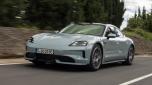
We didn’t precondition any of the batteries, so the fight is on a chilly but level playing field. It’s won by the Tesla, which ingests 11.55kWh in 58 minutes. The Mercedes is the only other car to fully fill, but it takes 72 minutes to absorb 7.73kWh. The Model Y is also teacher’s pet for helping us start on time: one tester was running late having forgotten its key card, but the Tesla app lets us unlock it anyway and drive on to Brewpoint.
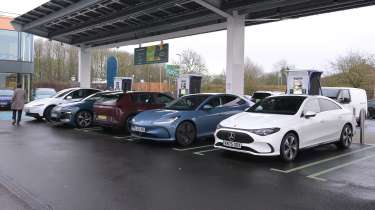
The Audi is refuelling at the same trickle as the Mercedes, so we abort that on 95 per cent, and the Kia on 91 per cent after 95 minutes on the charger. It’s quaffed a similar amount to the Tesla, but admittedly from a lower base. When EVs are almost full, clever software restricts charging power to protect batteries from damage, which is why car makers advise owners not to habitually charge cars past 80 per cent. Factor in the cold temperature and we’ve been reminded of two electric lifestyle lessons before we’ve even set off. More will unfurl in the next 36 hours…
It’s go, go, go Audi – at the speed limit
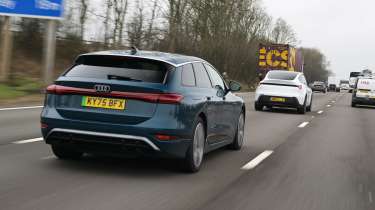
For the first leg, I’m in the Audi. The e-tron feels modern thanks to its white leather sports seats and dashboard highlights in grey fabric and embossed aluminium – worlds apart from the Germanic sobriety of a three-year-old A6 Avant, though anyone trading up would be reassured by Audi’s familiar quality feel and digital displays on a subtly curved touchscreen that oozes class.
Our convoy heads cross-country to the M1 motorway north. All the cars have air-con at 21C, seat heaters are banned, and normal mode is mandatory. That means no exaggerated ‘one pedal’ braking to harvest extra battery juice or draining Sport performance – and no speeding! We’re riding two-up and the Avant’s so-so, 502-litre boot is filled with our gear, but these loads will be spread around as we go to keep things fair.
I’m immediately struck by the Audi’s steering. It has a lovely immediacy off the dead-ahead, and a silky effortlessness at urban speeds as we U-turn in villages and dart off down side roads.
As the limit rises, so does the weighting, with a precise granularity helping measure every input, until we catch a DS3 dawdling up ahead on the A422, with plenty of space to overtake.
This e-tron Performance model may have only one 362bhp motor but it summons 565Nm of torque: more force than any other car here. I squeeze the springy accelerator and – wow – am slightly taken aback by the speed with which we sail past the little hatch. The odd overtake shouldn’t do too much damage to the Audi’s huge 95kWh battery (second only to the MG’s), although with projected range dipping below 280 miles, we are way off the official maximum of 430. Such is the debilitating effect of cold weather on EVs.
First impressions suggest smooth-riding comfort suspension (though so far I’ve only driven the notoriously firm Tesla as a reference point), and there’s some noticeable patter on a smooth new road near Cranfield. Then we’re onto the M1 – and under laser fire from Star Wars stormtroopers! Or perhaps that’s the Head-Up Display’s incredibly overbearing forward distance monitor, which animates massive red arrows and fizzes them towards you. I’m no tailgater but if you hustle into a motorway space the Audi deems insufficient, you’ll very quickly know about it.
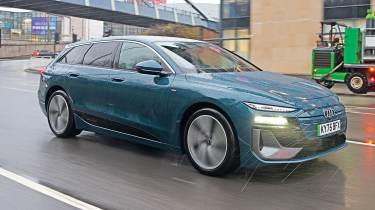
The 20-inch Falken tyres grumble quietly underfoot, and wind noise feels a touch more exaggerated than in the Tesla: we reckon the e-tron’s driving position being closer to that swept-back windscreen pillar is a factor. But this is still a supremely civilised car to while away the miles to Watford Gap services and our first stop.
The baton passes from Audi to Mercedes
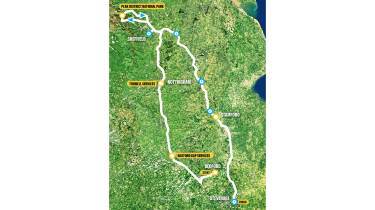
Our two-day test loop will take in fast, hilly roads in the beautiful Peak District National Park, urban driving in Sheffield and then a run back south on the A1(M.) Our final destination is Gridserve at Stevenage, where we’ll put our EVs against the clock to see how fast they recharge to 80 per cent.
My man-maths/winter testing experience discounts 30 per cent from the 484-mile official range, but if we do achieve 350-odd miles the CLA 250+ will make the entire loop to Stevenage; maybe the MG too. The Merc’s secret sauce is its efficiency: on the official cycle it averages 4.7 miles per kWh. Of our five, the MG ranks bottom with a 3.8-mile figure, so perhaps my optimism is misplaced.
This CLA is an entry-level Sport model (£45,615), and in flat Polar White looks a bit gawky. The snub nose droops apologetically, while the slitty glasshouse to bodyside ratio makes for a portly midriff. And what be these sticky-out things? The Sport has old-school door handles, unlike every other CLA trim and all its range test rivals. They won’t help the efficiency figure, but will aid sales in the world’s biggest car market, given that China is banning flush door handles on safety grounds.
Chinese consumer influence extends inside: there’s a built-in camera for making selfies and TikToks. Not my bag, but I am a sucker for synthesised soundtracks and Mercedes’ EV is spoiling me with five choices. Silver Waves and Granular Fuzz sound like options at a hairdresser, and another sounds like a Ring doorbell, so I opt for Fractal Fusion, which makes an urgent tinkling noise. “Like standing outside a Greek restaurant’s plate-smashing night” I mutter, and Mercedes’ voice assistant pipes up with a list of Leicester’s finest Hellenic eateries. Time to focus on driving.
The CLA rolls on long-travel soft suspension: it toils like an obsequious housekeeper pandering to your every move, pumping up the sofa cushions, fetching the foot stool, with the single-minded goal of occupants’ supreme comfort. There’s a flutter of muted wind noise and featherlight steering: the Merc is even more relaxing than the A6 e-tron.
But don’t dismiss it as a soft touch. The elastic throttle has a nice tactile feel, and mid-range acceleration feels relentless, with the digital speedometer crackling like a Van De Graaff generator and sharing its purple-pink colour scheme. The CLA might have mid-ranking power outputs – 268bhp and 335Nm – but it surges from standstill to 62mph in just 6.7-seconds.
Lane-keep assist, however, is making the steering sticky, so I reach for the towering central touchscreen, more upright than soldiers saluting the King. In all honesty, there’s not much more to the Merc’s cockpit than the piano-black screens in a Spitfire wing-shaped housing, with a couple of air vents at either end. If your passenger isn’t distracted by all the dazzling stars, they might notice the cheap-feeling centre console or armrest inserts, or the bland vegan leather seats. The Audi monsters it for flair – but at a £30k price premium.
Thankfully the glass roof is standard, helping elevate the rear ambience. The driver’s seat drops nice and low, but at the expense of my winter boots beneath it. I’m a six-footer and have just a couple of inches of headroom and legroom: wait for the EQB if you want this technology with a roomier body. Access to the boot is narrow, but it’s deep and swallows 405 litres – plus there’s a decent frunk.
The temperature is up to 4C, efficiency is 3.9 miles per kWh (0.7 better than the Audi) and our sugar levels are beginning to crash, so we pull into Trowell services in Nottinghamshire for lunch, coffee – and my chance to drive the Kia.
Kia to the mountain top
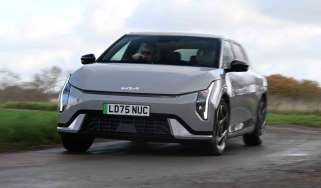
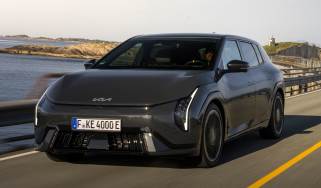
The EV4 is the baby of the pack: with 201bhp and 283Nm, it has the least power, and at 4,430mm-long, it’s 300mm shorter than the Mercedes. No matter: nestle inside the Kia and it has lots of big-car appeal. It’s airy, thanks to those deep windows, and impressively spacious. There’s triple the Merc’s kneeroom behind my driving position, decent under-thigh support and a reclined backrest that appears to be inspired by a dentist’s chair. The rectangular boot is the smallest, but still holds 435 litres of cargo.
Admittedly, the base ‘Air’ cockpit is greyer than today’s weather, where even a Highways Agency SUV is barely visible through the gloom. But the ribbed seats are squishy like hammocks, and the aquamarine flashes – in the seat backs and dash – make a lovely contrast. Thankfully, Kia has exorcised my long-held bugbear: dual-use controls for air-con and functions such as media and nav.
The asymmetric wheel looks oddly squished and doesn’t quite reach far enough for my T-Rex physique. The steering feels weighty and stately as we roll through the services and on to the motorway, with the body happy to sway gently on its relaxed suspension. The problem is the steering rack is completely one-note, with much the same gearing and response whether around town, cruising the motorway or clinging on for dear life in the Peaks.
We’re closing in on 100 miles and this EV4 – packing the bigger of two batteries, with around 80kWh of usable capacity – is estimating 182 miles remaining, and a motorway consumption of 3.6 miles per kWh is reassuring, but it’s the driver-assistance systems making me a nervous wreck.
Glance away from the windscreen – to not unreasonably look at the driver’s display – and it illuminates a red eye symbol. Throw in an intermittent speed-limit warning for a 1mph violation, flashing green lane-departure warnings and a cacophony of bongs, and the Kia’s nannying makes me – unusually – reach for the system’s kill-switch. If you’ve got a wandering eye for passers-by, the EV4 could land you in hot water.
The rolling refinement is impressive for the most affordable car here. The Air only generates a rustle of air, the tyres’ bassy rumble is well suppressed and the suspension keeps noise out of the cockpit.
We turn off the M1 and begin the climb along the A616. It’s steady behind the lorries, so I take in the scenery: hand-laid stone walls to corral sheep, small cottages, spindly branches stripped of every leaf, peaty brown hillsides. An ice warning pops up at a modest-sounding 4C. Hustling through some roundabouts, our convoy gets strung out – apart from Max Adams on my tail in the Tesla.
“Have you got enough to make it back to Sheffield?” I ask over the radios. “The Tesla is predicting 31 per cent at the summit – where I hope someone else takes it,” wisecracks Max.
Our lowest-range duo are the EV hot potatoes. We turn into the Peak District National Park and, briefly, we’re shrouded in fog but climb through it. The road zig-zags over Salters Brook, and there’s an ID.3 – the Kia’s Volkswagen rival – marooned on a corner. Not clocking any damage, I wonder if he’s out of battery: let’s hope that’s not our fate.
At the Woodhead Reservoir, we turn off, leaving the cross-Pennine traffic behind. I floor the accelerator and the Kia’s response differs markedly from its travel companions: instead of a light-switch flick of meaty power, the EV4 pauses, then builds speed incrementally. It’s not slow – 0-62mph in 7.7secs is usefully quicker than regular combustion Golfs – but it’s an outlier in this company.
The Kia’s suspension continues to impress, isolating noise and soaking up some serious whacks as camber changes deflect the wheels left and right. There’s decent front-end grip, so you can really lean on the nose to haul you around corners, like you’d drive a hot hatch. Not that the steering is giving any more feedback, but its heft works well on these faster roads. This pace is spinning the range projection like a slot machine: perhaps it’s time to park up and try some other contenders.
EVs make a Holme run
The pedigree of the rare passing cars – Audi RS6 and Ford Focus RS, plus a particulate-belching VW Eos cabriolet that illustrates our EVs’ air quality benefit – rubber-stamps Hole Moss as a great destination. The road climbs and falls, there are fast sweepers and tight corners – and plenty of bumps.
Our Audi is the nicest to drive, with its fluent steering making it easy to place, plentiful grip and supple suspension to surf the topography, with heaps of performance keeping the pace up. At almost 2.2 tonnes, the e-tron’s the second heaviest car here, but it doesn’t feel it.
The Mercedes is cut from a similar, compliant cloth, but its front end isn’t quite as tied down or true in some demanding turns. It’s still plenty quick enough, and the responsive brake pedal is deeply reassuring – especially when the Armco disappears and you get a sobering look into the valley below.
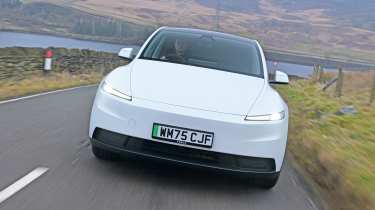
And then there’s the Tesla. This is the less-is-less Model Y (briefly labelled the Standard), with a suite of technical changes to reduce the price to a tantalising £41,990. It swaps out the higher-performance versions’ NMC battery for cheaper, less energy-dense lithium iron phosphate (LFP) cells, the frequency-dependent shocks are switched for a more conventional passive spring and damper set-up and a detuned motor slows the 0-62mph time from 5.4 to 6.9 seconds. There are equipment changes too, but now is not the time for detail when there’s a mountain to fall off.
Out of the lay-by, I clomp the throttle. Acceleration remains mighty and just keeps on building, so we’re at the tight turns in an instant. The tiny steering wheel – manually adjustable (thank you cost-cutters) – is as darty as ever from the 12 o’clock position, but overly sharp movements can provoke body roll: extra movement is not needed with this road’s craters and cambers.
Sadly, the new shocks do little to pacify the Model Y’s notoriously unyielding suspension. The body is jostled left and right, my hips shaking like Shakira’s in my seat, and the 19-inch wheels seem to scuttle and skip along the road rather than feel keyed into it. Bumps can also upset the steering.
Thankfully, the stiff brake pedal feels like a racing car’s, aggressively wiping off speed the instant I touch the top end, with the Tesla stable as it slows. And the Hankook tyres are generating tonnes of grip: on a calmer, sweeping section I feed in the power and it just keeps clinging on as speeds build.
Overall, the tempestuous Y isn’t made for these roads; its virtues will become clearer later. And though I could do with a lie-down, there’s an MG to drive back to Sheffield in.
IM5: dark horse or lame nag?
Before then is the summit-to-reservoir run in this IM premium spin-off brand. It’s a big tech statement wrapped up in a big saloon, with a design that looks like an Aston Martin DBX has rear-ended a Tesla Model S at high speed, reckons Max.
Oh-my-gosh, what is this steering? Vague and sloppy around the straight-ahead, the Light setting doesn’t provide enough reassurance and stability, especially in fast corners, while Steady is like stirring concrete. And you can feel the suspension struggling to contain the MG’s mass – it’s the only car here to weigh over 2.2 tonnes.
The rear-wheel steering assistance feels well judged at speed: it doesn’t make the IM feel flighty tipping into bends. And it’s a huge relief when turning around on these tight roads, shrinking the car to seemingly supermini proportions during tight three-point manoeuvres.
The ride is generally pretty comfortable but it can belly flop into dips and trigger a touch of hip shake. I also rather like the brakes, which build progressively to a serious bite, or trigger a natural-feeling deceleration when you lift your foot off the throttle. It’s a stark contrast in engineering terms to the rather lifeless and indirect steering.
One by one we peel off the summit, with the Tesla on 20 per cent and heading for a charge, and the Audi and Merc bound for our central Sheffield hotel. Allie Crooks is behind me in the Kia: well, I think he’s behind me. The posh MG’s slitty rear visibility is an absolute joke – all I can see are the EV4’s bonnet badge and vine-like lamps.
Visibility is not much better ahead. Our headlights strobe through the fog like the torch-wielding Feds hunting down E.T. The IM5 is as vexed as that alien, ticking off numerous driver-assistance systems that can’t function in the gloom. Thankfully we have the B-roads to ourselves and soon pick up the far more suitable main road.
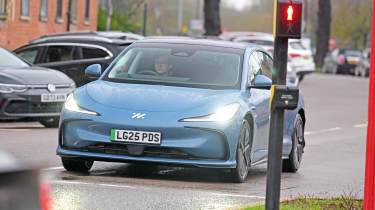
The woolly steering is best, but still rubbery, in Moderate mode. Acceleration is ferocious, the rear motor surging in the mid-range, pushing the nose upwards like a speedboat’s prow. The Performance version, with 741bhp, must be total overkill.
Now that I’m settling into the IM5 (as best I can on the flat driver’s seat), I’m beginning to spot its flaws. There’s a persistent drone, like the underlying combustion moan of 2,500rpm at motorway speed. It’s not an electric motor whine and it comes and goes, but it’s audible over the well contained tyre and wind noise. It’s inexplicable and totally undermines what’s otherwise a pretty refined car: I just cannot unhear it, or identify the source.
And the operating system is an Inhumane-Machine Interface. The second screen, set at knee-height and peppered with unfathomable app tiles and sub-menus, drags your eyes off the road. The wireless charger repeatedly triggers Apple Pay, and when the side mirror drops in reverse, it doesn’t revert to its original position. Not only is this infuriating, it’s a real hazard when we leave the retail park chargers later and have to join multi-lane 50mph traffic with practically zero rearward vision.
The MG doesn’t need a top-up, but the Tesla and Kia are – unsurprisingly – the first horses to drop. Martyn Collins rolls into Sheffield’s Parkway Central shopping site with 22 miles remaining on the Tesla, while the EV4 has a claimed 34 miles to go.
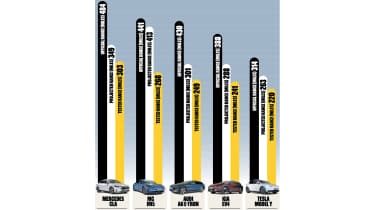
We retreat to Starbucks for just over an hour while the EVs refuel to 100 per cent, and crunch the numbers. If we generously add the remaining miles to those covered, the Model Y’s winter range was 220 miles, the Kia 242. And their resting rivals? The Audi reckons it has another 89 miles to give, the MG 109 versus the Merc’s 124. Can any of them make it to the finish line – especially given tomorrow’s ominous forecast?
Storm Chandra sweeps us home
The Audi’s wipers swish hyperactively back and forth, but can’t properly deal with the epic rain. Sheffield is in a yellow warning area but it’s nowhere near Storm Chandra’s epicentre, which deluges Devon with over 115mm.
It’s first light and I’m leading our EV convoy north-east, to pick up the A1(M) south. On the opposite side of the parkway, nose-to-tail traffic queues to enter the city, while grey and black clouds hang over the Peaks. The dot-matrix signs are lit up with surface water warnings and passing an HGV is like participating in a car factory monsoon test.
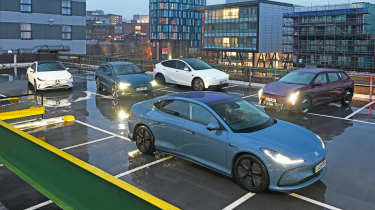
Today, we want to assess our cars’ electric route planners, a secret weapon for simplifying long-distance EV driving. We all love Google Maps but, outside of Volvos and Renaults, which use Google’s automotive operating system, it’s a blunt instrument compared with an in-built nav system, which can tap vehicle diagnostics to continuously calculate your route based on the car’s real-time efficiency and range. It’ll also warm up (or cool) EV batteries to the optimum temperature for fast charging, to glide you through services in the EV equivalent of a Formula 1 pit stop.
The Audi plots a charge at Blyth services, with 10 per cent remaining. As we near, Martyn – who has previous A6 e-tron experience – is on the radio to tell me its lightbar has deactivated. Shades of our basic Model Y, though its front and rear lightbars were removed on cost grounds.
This going dark is not the Audi’s only power-saving move: the digital display’s info has been shrunk into a porthole with the rest of the screen blanked off, a virtual doorstop wedged under the throttle (though it’s easy to push through it to accelerate) and B-mode activated for punchier braking to boost battery regen.
It’s been a pleasure to be reacquainted with the Audi, although its ride doesn’t feel quite as cossetting today. The cockpit is a civilised sanctuary though – especially compared with the 4C temperature and wild rain outside. Why is it that petrol stations get a massive canopy, but Blyth’s Stonehenge ring of Gridserve and Tesla chargers provides absolutely no protection from the weather? And obviously I’ve forgotten my log-in for the app, prolonging the agony.
Which is the opposite to the actual charge: the battery chomps through 51kWh in just 14 minutes, barely time for the loo and a coffee, before I pull the plug. The Audi covered a slightly underwhelming 220 miles, or 249 with remaining range added.
The final blast: Tesla and Mercedes
Grrrr, the quirks of Tesla! Having no external boot release sees me fumbling for the app to stow my bags in the huge boot: it’s of little consolation to me that owners can set up smartphone nearfield communication to automatically trigger it.
Then there’s the indicator stalk that refuses to click on (like the MG’s), or the steering wheel wiper button that triggers secondary speed inputs on the touchscreen. Tesla has ushered in many advances – such as electric route planning – but these idiosyncrasies are not progress. They’re irritations.
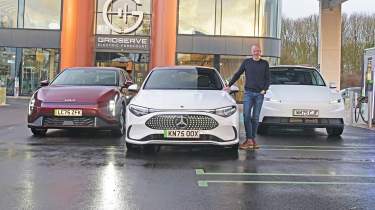
This model may be the entry point to Tesla’s range, but inside it doesn’t feel cheap. I’ve always liked the minimalist dashboard, now trimmed in fabric, and the cloth seats are comfy and supportive. The glass roof may be gone, but the big windows make for an airy cabin, and build quality is reaching new highs.
Given that many kids bring their own devices into a car, deleting the rear touchscreen is no biggie. The high-set driver’s seat means rear passengers can stretch out in the back with great under-thigh support. By contrast, the MG – devoid of rear footwells – puts the long-legged into a stress position with knees up by their shoulders.
The Model Y is far more at home on the A1(M)than yesterday. Acoustic glazing ensures the cockpit is nicely hushed, and brake regen is well judged, wiping off speed around town or maximising motorway coasting. But the body is still as lashed down as my hotel bedspread last night, and while all the cars require crosswind correction today, the darty Tesla rack is particularly needy.
But it comes into its own when the convoy peels off near Newark to charge the MG, leaving unobservant me to double back cross-country to find them. On these smooth, sweeping country roads, the Tesla’s quick steering, vice-like grip and punchy performance make it hugely enjoyable.
The fun is cut short by reuniting with the crew at a Starbucks where the MG is charging. It covered 256 miles, or 268 when boosted by the remaining range. Only the Mercedes is yet to refuel.
But we all know the CLA’s race is run – and before our planned lunch stop in beautiful Stamford. Allie soldiers on for another 35 miles before pulling onto the Instavolt chargers at Colsterworth Services. The CLA has lived up to its billing as the longest- range car – by completing 291 miles. Throw in its 12-mile reserve and the Mercedes is the only car to break the 300-mile barrier – by a whisker.
But we still have another 75 miles to run before the big shoot-out of preconditioned batteries to establish our fast-charging champion. We detour through Stamford, where we thread our software-dominated electric cars through narrow streets of limestone townhouses, built in the era of horse and cart. Then – finally – we all set the navigation for Gridserve Stevenage to precondition our batteries.
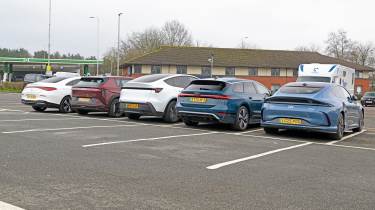
The Kia has a nice shortcut, with an ‘Activate’ button in a charging sub-menu to eliminate any doubt. In the Mercedes, I select the forecourt as a charging destination to lock in warming, then our convoy swings onto the A1 (M) for the final leg.
And sure enough, 25 miles out there’s a touchscreen message: “HV battery will now be brought to optimum temperature, for better performance during charging stop.” As we approach the Stevenage junction, there’s no signage promoting the Gridserve hub on the roundabout. It’s due to strict rules preventing advertising on the strategic road network; a curious double standard considering the big blue signs promoting the previous two service stations.
Thankfully electric route maps know it’s there, but the government needs to promote these amenities better. The CLA peels off – and a mecca of 24 high-power charging bays appears.
But not the Audi – or the MG. Worried that the 10-minute delay will cool down the preconditioned battery cells, I phone Max in the A6 e-tron to give him the hurry up. And that’s when I discover that Allie’s MG is limping along under the speed limit, with zero range remaining on the dashboard and still five miles left to travel. We hold our breath, cross our fingers and toes – and five minutes later the IM5 rolls into the charging station.
For the first time in 32 hours, we charge these EVs like owners would – as rapidly as possible. We select 80 per cent, but drivers might typically draw just enough to return to their home wallboxes where they pay five – not 20 – per cent VAT on the power that they use to recharge. Another unsupportive move from a government that talks up supporting the electric transition.
Given their varying states of charge – the MG on zero, the Kia on 18 per cent and everything else in between – we’re judging them on sustained peak charge and their kWh per minute average charging speed to get an evaluation of their real-world performance at a high-speed charger.
True to form, the Kia performs worst, taking 30 minutes to replenish 62 per cent, at 1.71kWh per minute. The Tesla comes next, ingesting 1.77kWh per minute. LFP batteries typically fast-charge less rapidly than NMC ones, and the Tesla’s – the only one in the test – performs to type.
Unsurprisingly the Audi – with its lower 270kW DC charging peak – takes the bronze, averaging 2.40kWh every 60 seconds. So which is the charging king? The MG may have a theoretical 396kW DC max but these Gridserve boxes top out at 360. Nonetheless it charges at an impressive 2.54kWh per minute. Yet the Mercedes, gulping down a mighty 2.90kWh per 60 seconds and returning to 80 per cent in just 23 minutes, gets the charging gold. But which is the best EV overall?
EV winter range megatest: verdict
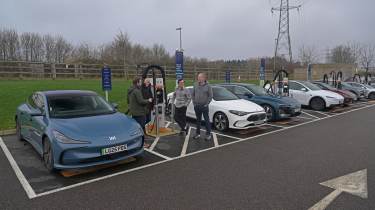
It’s been six years since my first winter range assignment in an EV. Then, one panicked writer phoned to ask if his test car – which was predicting a 105-mile range on a charge, just half the car’s official rating – was broken. How far we’ve come.
This latest breed of EVs all surpass 200 miles in tough weather conditions, with blissful refinement, punchy performance and lots of clever, software-enabled capabilities. Plus the days of having to queue for a lone 50kW charger – then the apex of charging speeds – are thankfully history.
That said, it’s our job to rank these EVs. And, despite its ferocious performance, rapid charging and eye-catching price, the MG IM5 finishes in last spot. It might be impressively big and have a practical hatchback, but its rear seats are claustrophobic and uncomfortable.
And the user experience is riddled with irritating niggles, topped by the car’s so-so efficiency and hopeless optimism: the IM5 covered a mere 268 miles, just 65 per cent of its projection, and was the only one of these cars to trigger nail-biting range anxiety.
Next up is the Audi. In isolation, it’s a lovely car, with the poshest cockpit, nicest steering and plenty of pace. But its ride quality is a bit patchy, the boot capacity average and its efficiency hopeless. With a range of 249 miles, the A6 Avant e-tron travelled only eight miles further than the Kia, and the German car’s 2.6 miles per kWh (compared with the EV4’s 3.1) made it the class dunce.
The Tesla sits on the podium’s bottom step. Elon Musk always said his mission was to accelerate electric vehicle technology, and the Model Y established the modern e-SUV template with fast charging, strong efficiency – 3.4 miles per kWh in our test – and frequently updated connected features.
Using your phone as a key and watching YouTube videos while you charge are great tricks, but they – like a frunk – are now widespread. What we desperately want is an all-new Model Y with calmer steering and a comfortable ride; what we’ve got is a cheaper version of a six-year-old car. And that, increasingly, won’t be enough.
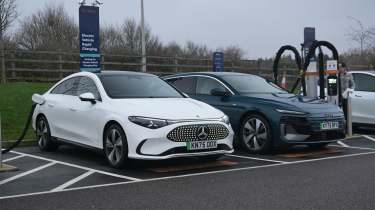
The EV4, the most affordable car here, ranks second. Everything about the Kia impresses, apart from its lacklustre charging and one-dimensional steering. Considering its compact footprint, the electric hatch has bountiful space inside, along with refinement and comfort levels that can shame far more expensive cars. It charmed all our testers, especially Max Adams, who was largely desperate to avoid driving anything else.
But the winner is the Mercedes-Benz CLA 250+. It was the only car to pass 300 miles thanks to its top-notch 3.6 miles per kWh economy. Not that it’s all efficiency, no fun: the Merc is bang in the sweet spot for performance and there’s a sweet tactility to its controls. The cockpit may be a bit cramped and needs elevating with AMG Line spec, but the comfort and refinement levels feel Mercedes through and through. Whether judged on rational or emotional grounds, the CLA is a worthy winter-range test champion.
The charging battle: which car won?
| Car | Charge | average charge | kWh per minute | Cost |
| Mercedes CLA | 67.22kWh | 326kW/118kW | 2.90kWh/min | £55.12 |
| MG IM5 | 79.70kWh | 179kW/171kW | 2.54kWh/ min | £65.35 |
| Audi A6 e-tron | 72.116kWh | 178kW/144kW | 2.40kWh/min | £59.13 |
| Tesla Model Y | 48.01kWh | 185kW/111kW | 1.77kWh/min | £39.36 |
| Kia EV4 | 51.98kWh | 122kW/74kW | 1.71kWh/min | £42.62 |
How far did they go?
| Car | State of charge | Official range (miles) | Projected range (miles) | Real-world range on test (miles) |
| Mercedes CLA | 100% | 484 | 349 | 303 |
| MG IM5 | 98% | 441 | 413 | 268 |
| Audi A6 e-tron | 95% | 430 | 301 | 249 |
| Kia EV4 | 91% | 388 | 288 | 241 |
| Tesla Model Y | 100% | 314 | 263 | 220 |
Tester’s notes
Our road-test team deliver their thoughts on the five contenders...
Audi A6 e-tron
I was expecting the A6 to be an interesting counterpoint to over 5,000 miles I spent in an entry-level e-tron last year. The Performance offers more power and range, yet the driving experience feels otherwise the same. It certainly suffers from the same efficiency issues – Audi claims up to 4.2 miles per kWh for the e-tron, and 4.4 miles/kWh for the ‘Performance.’
The closest I got to that figure with my car was 4.0 miles/kWh on a trip to Devon last summer. We might be in full winter mode here, but the Performance was similarly affected, with 3.2 miles/kWh seen at the start, before dropping as low as 2.2 miles/kWh after a wet and windy trip back to base. Still, the A6 remains a high-quality, comfortable, and refined EV – despite a couple of call-outs on my long-termer last year to fix some charging faults.
Latest Audi A6 Avant e-tron deals
Mercedes CLA
It’s been an automotive cause célèbre: why did Mercedes fit only 800-volt charging capability on the CLA, when many of the UK’s chargers are 400-volt? Yet after plugging in at Gridserve, Instavolt and Osprey chargepoints, we reckon the CLA isn’t quite the charging dunce we feared.
Two of our three stops revealed no issues whatsoever; at both, the CLA was among the fastest-charging cars and had no issue connecting with the chargepoints. Stopping off at the 120kW, 400-volt Instavolt charger at Colsterworth, however, the Merc topped out at just 45kW, with the touchscreen lighting up with warnings. We hadn’t pre-conditioned the battery, but it should still be better than that.
Kia EV4
Even though the Kia EV4 is the least expensive car in this test, I came away from it mightily impressed. It does everything you would need from a car and it just happens to be electric. Its ride is the most compliant, it has enough performance to handle most situations, and it’s remarkably quiet. I also found it highly practical, with plenty of room in the back and a good-sized boot.
If there’s one flaw, it’s that the entry-level Air model doesn’t have a heat pump; that’s reserved as an option on the range-topping trim. Not having this energy-saving feature impacted the EV4’s motorway range during our cold-weather test; warmer summer temperatures would have shown it in a better light. However, after the test and on the cross-country blat where I was able to make full use of its adjustable regen braking, I eked out a more impressive efficiency figure of 4.1 mi/kWh.
MG IM5
A nice, relaxing 49-mile home stretch down the A1 (M) then – or so I thought. With a 20-mile buffer in hand, the IM5 should get to Gridserve with a few miles left, so long as I don’t push it too heavily. At around halfway I feel the first gnaw of range anxiety. After sitting in battery-saving Eco mode for a while, I turn off the air con – adding a whole mile to my range.
The MG doesn’t seem flustered by its lack of charge, there’s just an amber battery symbol on the driver’s display warning of my impending doom - quite the opposite to the Mercedes CLA which, even at a higher state of charge, still brandished several low battery warnings. About 15 minutes after everyone else, I limp onto the charging forecourt. A bit of maths suggests I’d been pottering around with less than 1kWh of battery capacity left. Too close for comfort.
Tesla Model Y
In some ways, it’s hard to keep up with Tesla: this car arrived as the ‘Standard’ model, but by the time I’d finished the story, that suffix had been dropped. It looks like Tesla got cold feet on an adjective with a rudimentary feel. And for good reason: launching a lookalike budget version runs the risk of devaluing the rest of the range – or hurting revenues if too many people migrate down to an EV which has almost all the core Tesla virtues. What’s the thinking?
This is Tesla’s quick and dirty way to fight low-cost rivals from China, while still making a decent buck on tooling it would have long ago amortised. It probably won’t be enough to keep increasingly good European rivals – such as the CLA and the forthcoming GLB Electric and BMW iX3 – at bay. But the car formerly known as the ‘Standard’ should do okay in the US, where competition is hampered by tariffs – to the point of exclusion in the case of Chinese EVs.
Did you know you can sell your car through Auto Express? We’ll help you get a great price and find a great deal on a new car, too.