New Dacia Spring: Renault Twingo’s £15k sister car name confirmed
The Renault Twingo’s more pragmatic Dacia cousin is set to be revealed this autumn

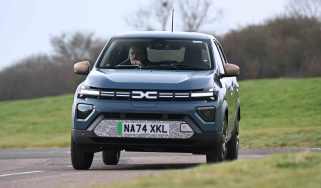
After much speculation about what the successor to the no-nonsense Dacia Spring EV and the more pragmatic sister car to the irresistible Renault Twingo might be called, the brand has announced the name: it’s the new Dacia Spring.
Sure, it’s not the most imaginative choice, but it makes sense considering that Dacia has sold nearly 210,000 examples of the original Spring since the cut-price electric car was introduced in 2021. But as well as being recognisable, the brand believes the car’s success has made the Spring name “a symbol of renewal and positive energy”.

The latest teaser image doesn’t reveal much about the car’s design, except the shape of tail-lights, but we already know it will be a sub-four-metre SUV with rather chunky proportions. Despite its diminutive size, Dacia promises the new Spring will have seating for four people and a “proper boot”.
The new Spring is due to be revealed in the autumn, potentially at the 2026 Paris Motor Show where the brand will have a big presence. We’re not expecting it to arrive in the UK until 2027, but when it does, prices could start from as low as £15,000, ensuring it retains the title of the UK’s cheapest electric car that the current model has held since coming here.
We don’t expect the old and new Spring will be in showrooms together, but the current model has recently been updated so it can hang on until its successor arrives. Importantly, however, the new one will be made in Europe, whereas the outgoing model is built in China, meaning it’s at the mercy of European tariffs that could raise its price by as much as 35 per cent.
While the new Spring will use the Twingo’s bespoke EV platform, and probably its 27.5kWh battery too, it’s unlikely to offer much of an improvement on the current model’s 140-mile range. Patrice Lévy-Bencheton, Dacia’s VP for product performance told Auto Express: “We do essential cars; we do only what the customer really needs.
“We define our product according to what we get from the customer survey, what insights we get in terms of real needs and real usages. And this is, for us, the better way to stay where we are on the market; position [the new Spring] as the most affordable EV on the market by far. You can count on us to continue to defend, let's say, this position on the market”.
What will the new Dacia city car look like?
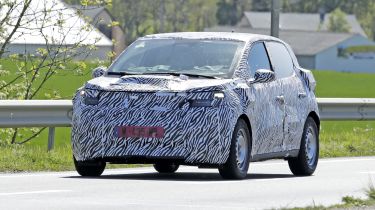
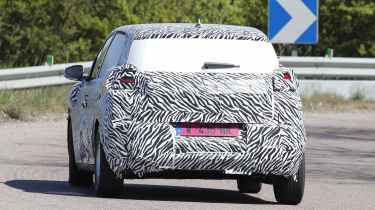
Looking at the prototypes in our spy images, it’s clear that this car will share its fundamental structure with the Twingo, but designers have been able to separate the two visually by using plenty of clever tricks. The first is the Dacia’s taller and more defined bonnet, which gives it a more conventional two-box silhouette.
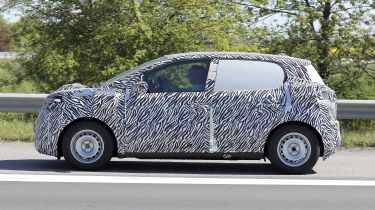
Beneath the new bonnet are a pair of boxy LED headlights that’ll probably be joined by a large grille-like graphic as seen on other Dacia models. However, while the nose will be quite different in design, the side windows look to be carried straight over from the Renault, including the pop-out openings for the rear glass. At the back, expect similarly high placements of the rear lights, but these will be squarer and more conventional than the Twingo’s clever LED hoops.
Inside, we expect the pair to share their dashboard layout and general design, however Dacia will utilise its less colourful palette of recycled materials. The digital interfaces are also to be shared and should include a digital driver’s display paired with a Google-based 10-inch touchscreen. One of the Twingo’s iconic elements, the movable twin rear seats, could be reverted to a more traditional bench in order to help keep a cap on the Dacia’s costs.
What battery and motors will be fitted?
As well as the shared basic structure, Dacia’s plan to keep costs low will include the direct carry-over of the Twingo’s electric motor and battery layout. This means we’re expecting to see a 27.5kWh battery pack combined with an 80bhp electric motor mounted on the front axle. It’s far too early to be specific about range or performance, but it should match the Twingo’s 163-mile electric range, and 50kW DC charging speed.
Compared to key rivals, the Dacia will have a longer range and better charging capabilities than the entry-level BYD Dolphin Surf, while also substantially undercutting it in price. This also means it’ll usurp Dacia’s own Spring, however the Leapmotor T03 will still probably offer more range for your buck with 175 miles at around £16,000.
As with the Twingo, this Dacia has had a fast-tracked development that will bring it to market very quickly, but it will also mean we’ll have to wait a little longer than our friends in continental Europe for it to arrive. Right-hand drive production of the Twingo doesn’t commence until the beginning of 2027, so expect the Dacia to follow after that date, even if we see the completed car in the next few months.
Will this new model replace the Dacia Spring?
The model is likely to be sold, at least in the short term, alongside the existing Dacia Spring EV – itself only having been recently updated. But because the Spring is built in China, it’s at the mercy of European tariffs on Chinese EVs, which could raise its price by as much as 35 per cent. In time, the new model will probably replace the Spring in the UK and Europe.
However as we’ve established, it’s unlikely to offer a generous improvement on the current Spring’s 140-mile range, as Patrice Lévy-Bencheton, Dacia’s VP for product performance told us: “We do essential cars; we do only what the customer really needs.
“We define our product according to what we get from the customer survey, what insights we get in terms of real needs and real usages. And this is, for us, the better way to stay where we are on the market; position [the Spring replacement] as the most affordable EV on the market by far. You can count on us to continue to defend, let's say, this position on the market”.
Why build a second small EV at all?
Speaking on the media call discussing Dacia’s 2025 H1 financial results, Frank Marotte told Auto Express: “[Dacia is] committed to increasing our BEV share, our BEV volumes, and our contribution to the Renault Group’s CAFE (Corporate Average Fuel Economy).
“So we keep developing the model that was announced earlier this year by (ex-Renault CEO) Luca de Meo, and we will bring more news to you in the coming months about this. You will not wait for too long,” Marotte told us.
Is this more rapid-fire development from Renault and Dacia?
De Meo claimed the car will be developed in just 16 months, beating the 21 months that it’s taken the Twingo to go from green light to production. “I defy any competitor in the world to do that, including the Chinese when they come to Europe,” de Meo said at Renault’s annual results conference back in January.
A proven toolkit is key to the new Dacia’s rapid development, as Philippe Brunet, SVP Powertrain and EV Engineering for the firm’s Ampere sub-brand hinted, while discussing the new Twingo. “When we say that we are going to [develop the car] in two years, it means that it's only possible after the vehicle is already existing,” he said.
It means Dacia’s next EV will use a plethora of proven parts from the Renault 5 and Twingo, to ensure it can be developed so quickly. Given Dacia originally announced the new city car at the year, the Spring successor is now less than two months away, with a launch planned for summer 2026.
De Meo pledged that the new car will cost less than 18,000 Euros (around £15,000), and that it will “always be a true Dacia, and true value for money”, as well as “making money in the way Dacia is used to”
The existing Dacia Spring is one of the very cheapest EVs money can buy. However, you could save even more via the Auto Express Buy a Car service...
Great Dacia leasing deals
Dacia Spring
Dacia Duster
Dacia Jogger