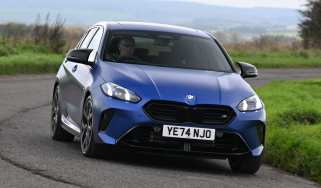
BMW M135 review
BMW’s hot hatch trades a little fun for massive all-wheel-drive capability and overall, the compromise makes sense

Our opinion on the BMW M135
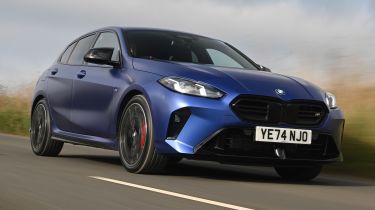
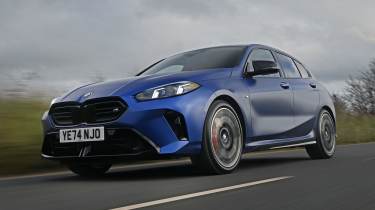
While BMW is famous for its rear-wheel-drive M division cars, four-wheel drive is now much more common across the line-up than it used to be. Most of the xDrive-equipped M models still have a bias towards the back axle, but the M135 (which is now shorn of its ‘i’ suffix to help differentiate it from BMW’s electric offerings) has a character that’s markedly different from the rest of the range. That’s not to say it’s no fun, though, because it’s still one of the most engaging hot hatchbacks around.
Enough revisions have been made to the updated car for BMW to give it a new model code – changing from F40 to F70 – and the tweaks are largely positive. The styling is less awkward, although it can look a little anonymous when configured in some specifications. Enhancements to the chassis and powertrain when compared with the outgoing car help the M135 to battle it out with the best four-wheel-drive hot hatchbacks currently available.
About the BMW M135
Given that it’s the flagship of the 1 Series range, the BMW M135 is pricey, However, if you’re willing to pay out, you’ll find yourself behind the wheel of a great-handling four-wheel-drive hot hatch. You don’t necessarily have to spend any more on it to improve things, either.
Used - available now

2024 BMW
1 Series
19,083 milesAutomaticPetrol1.5L
Cash £23,995
2020 BMW
1 Series
28,882 milesManualPetrol1.5L
Cash £14,197
2021 BMW
1 Series
45,882 milesAutomaticPetrol1.5L
Cash £16,997
2020 BMW
1 Series
61,923 milesAutomaticPetrol1.5L
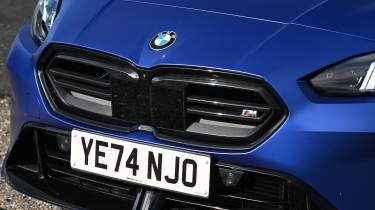
Cash £14,697A lot of people welcomed the return of a less challenging grille at the front of the 1 Series, but if you want your M135 to stand out from the crowd, we’d recommend speccing bigger 19-inch wheels and one of the more distinctive paint options.
To see if the M135 is truly a worthy contender in this small yet fiercely competitive sector, we lined it up against the Audi S3 in a twin test. The BMW was victorious, being just that bit more enjoyable to drive.
This review focuses exclusively on the M135, but we also have an in-depth review of the regular BMW 1 Series if you prefer a slightly more subtle hatchback.
Performance & driving experience
Pros |
|
Cons |
|
The BMW M135 is powered by a 2.0-litre turbocharged four-cylinder engine. However, BMW was forced to tweak this unit in order to meet the latest emissions legislation, so it has less power and torque than you’ll find in the pre-facelift car. The current model is down from 302bhp/420Nm to 296bhp/400Nm.
To make up for this, the old car’s eight-speed automatic has been swapped for a seven-speed twin-clutch semi-auto that’s designed to deliver faster shifts and quicker responses.
The last car’s UKL2 platform is retained, too, but BMW has given it an overhaul to improve the M135’s handling. One major update is that adaptive dampers are now fitted as standard, while the chassis has been stiffened and the suspension geometry has been revised to deliver an even more engaging drive.
| Model | Power | 0-62mph | Top speed |
| BMW M135 xDrive | 296bhp | 4.9 seconds | 155mph (electronically limited) |
Performance, 0-60mph acceleration and top speed
Although the engine is slightly down on power, BMW’s tweaks to the transmission mean 0-62mph takes another 0.1 seconds compared to the pre-facelift car, at 4.9 seconds. As is usually the case with German performance cars, the M135’s top speed is electronically limited to 155mph.
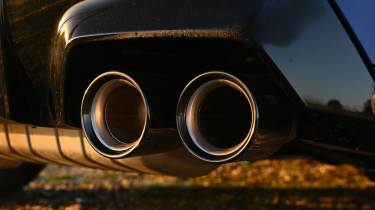
If only the engine sounded as sporty as the M135 feels overall. There’s a bland, droning note from the exhaust, and while artificial sounds are piped into the cabin, they don’t do the car many favours – at least they’re easy enough to switch off.
When it’s time to slow things down, the brakes deliver strong performance. BMW also offers the M Dynamic Pack that adds the larger drilled discs from the M3, and these deliver consistent stopping power that should stand up to the rigours of track use.
Town driving, visibility and parking
While the standard-fit adaptive dampers mean you can dial back the intensity of the M135’s ride, it’s still a relatively firm car at low speeds. The stiff chassis tends to thump into potholes, although the quick steering rack means it’s easy to avoid them in the first place.
Standard-fit parking sensors and a reversing camera are on offer to help with low-speed manoeuvres, while the engine’s docile nature at low revs means it’s just as easy to manage as a less powerful 1 Series.
Country road driving and handling
At higher speeds, the M135’s ride improves, although the car still tends to follow the road surface rather than absorbing smaller lumps and bumps. The Comfort setting is soft enough that passengers won’t complain about the harsh ride, while switching to Sport mode offers a sharper focus when you’re attacking a twisting road.
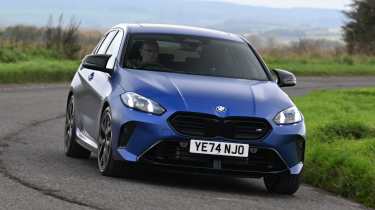
There’s little body roll in corners, and chassis grip is strong. There’s a front-end bias to the four-wheel drive system, with the sharp steering and keen turn-in encouraging you to lean on the car’s nose when heading into bends, while a more neutral bias on corner exit sees the car fire down the next straight with the minimum of fuss.
And fire away it does, with strong acceleration through the rev range, while the gearbox delivers quick shifts. Manual mode is responsive, while the Sport setting for the automatic gearbox sees the shifts thump home when changing up while keeping your foot on the throttle.
Motorway driving and long-distance comfort
While the M135 is stiff, it’s reasonably settled at motorway speeds. There’s some road noise from the wide tyres, but overall it’s a competent cruiser that offers decent comfort. There’s a bit of a shudder from the body when the gearbox kicks down, but the wide torque spread means this doesn’t happen that often on the motorway.
“BMW’s new twin-clutch gearbox gives you a distinct thump in the back each time a cog is changed in Sport mode.” - Dean Gibson, senior road test editor.
MPG & running costs
Pros |
|
Cons |
|
One advantage that the M135 has over rivals such as the Audi S3 and Mercedes-AMG A 35 is that it starts at a lower price. It’s thousands less than these two rivals, and while the M135 still commands its fair share of cash, there aren’t many cars at this price point that can deliver the same kind of driving thrills.
As well as being famous for building cars that are entertaining to drive, BMW has also made a reputation for itself as a maker of efficient machines. And while the M135 majors on the former rather than the latter, it still delivers reasonable returns for a performance car. We saw fuel economy of 33.4mpg during our time with the car, which compares favourably with the official figure of 37.2mpg. Achieve our numbers, and the M135 offers a range of up to 360 miles, but this will quickly fall if you regularly use the car’s full potential.
| Model | MPG | CO2 | Insurance group |
| BMW M135 xDrive | 37.2mpg | 154g/km | 29 |
Insurance groups
It's naive to expect a BMW hot hatch to come with low insurance costs, but the M135 might not be as horrifically expensive to cover as you first feared. Sitting in group 29 out of 50 means the hot 1 Series is cheaper to insure than both the Audi S3 in group 33 and the Mercedes-AMG A 35 in group 34.
Tax
A list price well in excess of £40,000 means that the M135 is subject to the luxury car tax premium, so you can expect an additional £440 on top of your annual VED road tax bill from years two to six of ownership.
You’d have to be an incredibly fortunate company car driver to even have the M135 as an option in the first place, but choosing this car for business use isn’t recommended as its high emissions result in an equally high tax bill. With an increasing number of electric hot hatchbacks on sale, these are the best option for the lowest company car tax bills. Options include the Alpine A290, Cupra Born and MINI JCW Electric.
Depreciation
Our market data indicates that the BMW M135 will retain between 43 and 46 per cent of its original value after three years or 36,000 miles. This places the BMW a little bit behind the Audi S3, as that manages 47 to 49 per cent. The Mercedes-AMG A 35 is on part with the BMW, though, at 44 to 45 per cent.
Interior, design & technology
Pros |
|
Cons |
|
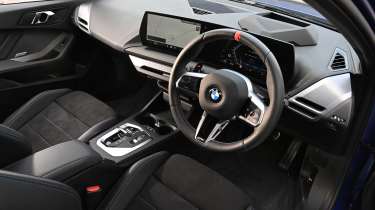
The M135’s facelift saw several changes applied both inside and outside in order to bring the ageing BMW 1 Series into line with the brand’s younger models. For the most part, the interior is the high-quality affair that we’d expect from BMW, but we couldn't help but notice one or two apparent cost-saving measures.
Interior and dashboard design
The refreshed cabin saw the infotainment screen and driver’s display combined into a single curved unit, while the older car’s traditional air vents were replaced by slots with the controls to one side. There are backlit grilles on either side of the dashboard and across the centre console, too.
Unlike some rivals that make the starter button a focal point, the M135 locates its on the centre console ahead of the drive selector. It seems modest to the point of being hard to find, if you’re not familiar with the cabin’s layout.
BMW��s M division stripes make an appearance as three lines of stitching running diagonally across the passenger side of the dashboard, but this feels like the in-cabin equivalent of the colours that some owners add to their car’s grilles.
Materials and build quality
The cleaner look is matched by decent materials, although the little joystick-style air vent controls that BMW now uses on its cars don’t feel quite as positive as the old vents when you're adjusting them. As is typical in most BMWs, there’s a thick, squishy steering wheel rim to hold, while the synthetic leather and Alcantara-trimmed seats are figure hugging and comfortable.
Infotainment, sat-nav and stereo
The curved, twin-screen dash display comprises a 10.7-inch central touchscreen and a 10.25-inch instrument cluster, both featuring pin-sharp graphics. The revamped model does away with the old car’s iDrive rotary controller, so you’re left with touch inputs or voice control, which is a bit of a shame because neither system is as intuitive as the click wheel and shortcut buttons.
Simple on-screen shortcuts let you switch between functions, though, while the My Modes option changes the cabin ambience to varying degrees. Rather than have a Sport button, it’s the Sport Mode that adjusts the car’s responses, which seems a little more involved than just having a button or switch to do the same thing.
The mapping and live traffic info is quick and effective, though, while the tile layout can be set to show media or car-related applications to help you find them faster. There are four USB-C sockets inside – two up front, two in the back – but wireless phone charging is part of a pack that costs around £1,500. Apple CarPlay and Android Auto feature as standard and are wireless.
“What makes my eye twitch is the different point sizes used for the M135 badge. It’s a good car in itself, it doesn’t need a nod back to the M1 supercar in its name.” - Dean Gibson, senior road test editor.
Boot space & practicality
Pros |
|
Cons |
|
One part of the M135 that stays the same with the arrival of the revamped model is interior space. Because the current 1 Series uses the same platform as the car it replaced, cabin space is largely unchanged. That means there’s decent room inside for a compact hatchback.
Dimensions and size
The M135 is narrower than the Audi S3 and shorter than the Mercedes-AMG A 35, but it still boasts more luggage space than both of its competitors.
| Dimensions comparison | |||
| Model | BMW M135 | Audi S3 | Mercedes-AMG A 35 |
| Length | 4,361mm | 4,354mm | 4,447mm |
| Width | 1,800mm | 1,816mm | 1,797mm |
| Height | 1,459mm | 1,431mm | 1,407mm |
| Wheelbase | 2,670mm | 2,630mm | 2,730mm |
| Boot space | 380 litres | 325 litres | 370 litres |
Seats & passenger space
There’s a wide range of wheel and seat adjustment to get comfortable and get a clear view out, although the over-large door mirrors do block your forward view a little.
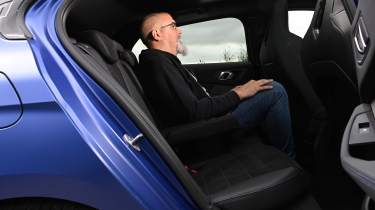
You sit low in the back of the 1 Series, but there’s decent space, even when the car is fitted with an optional panoramic sunroof. The front sports seats that are fitted to the M135 eat into rear legroom a little, and while the cabin isn’t as wide as in some rivals, it should be fine for shorter journeys.
Boot space
Storage space is reasonable, with the highlights being the central armrest bin, plus twin cup-holders and a tray further ahead. The door bins are a little short and narrow, while glovebox storage is built into the door, so it’s not as roomy as in some rivals.
A typical hot hatch combines performance with practicality, and with a 380-litre boot, the M135 has one of the larger cargo bays in the class. In comparison, the Audi S3 only offers 325 litres, although the Mercedes-AMG A 35 is closer to the BMW at 370.
The M135’s wide load area also has under-floor storage, while the back seats fold flat to create 1,200 litres of space. 40/20/40 rear seats are an option, but seeing as they cost less than £200, we think they’re worth having.
“The Audi S3 has a slightly wider cabin to boost shoulder space across the back, but this is offset by a relative shortage of legroom, due to the large sports seats up front.” - Dean Gibson, senior road test editor.
Reliability & safety
Pros |
|
Cons |
|
When the BMW 1 Series was tested by safety experts Euro NCAP in 2025, it bagged a full five stars. The M135 shares this score as it features the same advanced safety tech such as lane-keeping assist and speed-limit warning technology. A shortcut button on the centre console accesses the infotainment menu where the safety systems can be set up. However, some of the very fanciest systems, such as Parking Assistant Plus and adaptive LED headlights, require additional outlay.
If you’re using the M135 as a particularly zesty family car, there are three Isofix child seat mounts inside, with one on the front passenger seat and two in the rear.
The previous generation BMW 1 Series was declared the sixth best car to own in the most recent Driver Power owner satisfaction survey. This bodes very well for the latest model seeing as the two share plenty of components. The BMW brand is winning its fair share of hearts, too, as it ranked fifth out of 30 on the best manufacturer scoreboard.
| Euro NCAP safety ratings | |
| Euro NCAP safety rating | Five stars (2025) |
| Adult occupant protection | 78% |
| Child occupant protection | 84% |
| Vulnerable road user protection | 85% |
| Safety assist | 80% |
Buying, prices and deals
- Best buy: BMW M135
The only variations available to BMW M135 buyers are the packs and options, but we think that the core model is fine as it is. For maximum comfort and practicality, we’d add lumbar adjustment with the £415 Active Seat option, along with the £175 split folding rear seat to get the more versatile 40/20/40 set-up. The £175 heated steering wheel is also worth having seeing as it isn't too expensive by BMW standards, and it’ll quickly pay dividends when the weather takes a turn.
BMW M135 alternatives
The M135 is a contender in the four-wheel-drive hot hatch class, and its main rivals are the Audi S3 and Mercedes-AMG A 35. These two cars are four-wheel drive and pack 2.0-litre turbocharged petrol engines like the M135, but both are more expensive and in our experience aren’t quite as engaging to drive.
Beyond these two, the Volkswagen Golf R follows the same formula, and if you want to get rally car-inspired thrills (and save a bit of cash in the process) the smaller, manual-equipped Toyota GR Yaris could also fit the bill if you’re happy to sacrifice some practicality.
BMW M135 pictures
Key updates of the BMW M135 review
22 September: Latest driving impressions and pricing data.
Frequently Asked Questions
A three-year, unlimited-mileage warranty matches that offered by Audi and Mercedes, while roadside assistance covers the same period. Extended warranties are available at extra cost.
Deals on the M135 and alternatives