What is a staggered crossing?
Find out what a staggered crossing is and how to use one.

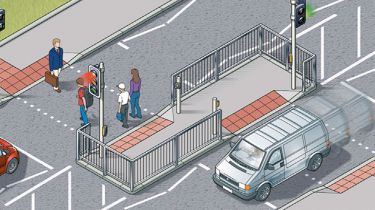
Staggered crossings use a pedestrian refuge - also known as an ‘island’ - to make it safer for pedestrians to cross wider roads. A staggered setup also allows the road to be cleared in much less time and helps to prevent tailbacks. These crossings are most commonly found on dual carriageways.
Two sets of Pelican, Toucan or Puffin crossings will be in operation, with one covering each side of the road. After using the first crossing, pedestrians can then stand safely in the middle of the road while waiting for the next set of lights.
Although the crossings are in very close proximity, they operate independently, so you’ll need to press two separate WAIT buttons - one for each crossing.
Staggered crossing rules and how to use one
Pedestrians
As with any traffic light-operated crossing, push the button and wait for a green signal. Once you reach the large ‘island’ in the centre of the road, press the button for the second set of lights and wait again for another green man.
It is important to note that the two sets of lights may not be synchronised, so they should always be treated as two separate crossings.
Drivers
Staggered crossings can combine Pelican, Puffin or Toucan setups, so the type of crossings in use will determine which rules apply. If a Pelican crossing is in use, you may proceed on a flashing amber light if you are sure that all pedestrians are well clear.
If the staggered crossing is located on a high-speed stretch of road, warning signs should indicate that you are approaching traffic lights. Ensure you have reasonable stopping distance and watch your speed as you would with any other traffic light.
Pedestrian crossings explained
- Zebra crossing
- Pelican crossing
- Puffin crossing
- Toucan crossing
- Pegasus crossing
- Staggered crossing
- School crossing