BYD Sealion 7 review
A big electric family SUV that’s strong on space and kit but doesn’t drive as sweetly as its main rivals

Our opinion on the BYD Sealion 7
There’s a lot going for the BYD Sealion 7, with a long list of standard equipment and one of the best warranty and breakdown packages anywhere on the market. It’s a spacious SUV for passengers, with lots of rear legroom, although headroom could be better.
But it’s not all good news, because the Sealion 7 isn’t as good as its rivals to drive. The ride and handling balance isn’t great, and the overly sensitive safety systems will frustrate many. And despite the promise of strong performance, the top-spec cars don’t deliver the kind of punch we expect from an electric car – they’re expensive, too. It’s a decent first attempt by BYD, but there’s plenty to work on for the facelift.
About the BYD Sealion 7
The compact electric SUV market is a busy one, but the BYD Sealion 7 has arrived to attempt to make an impact in the class. It’s the largest electric SUV yet to be offered by BYD in the UK, measuring slightly longer and wider than the BYD Seal U PHEV, and its five-door, five-seat SUV shape should hold appeal for many electric family car buyers.
There are Comfort, Design and Excellence models on offer. The Comfort version features an 82.5kWh battery and rear-wheel drive, while the Design version upgrades to four-wheel drive and has more power. It has the same battery, however, so offers a slightly shorter range as a result of the extra capability. The top-spec Excellence has the same 4x4 powertrain as the Design model but with a 91.3kWh battery, helping to deliver the longest range in the line-up.
Used - available now

2025 BYD
Sealion 7
11,298 milesAutomaticElectric
Cash £28,828
2025 BYD
Sealion 7
1,074 milesAutomaticElectric
Cash £35,995
2025 BYD
Sealion 7
8,369 milesAutomaticElectric
Cash £35,495
2025 BYD
Sealion 7
6,482 milesAutomaticElectric
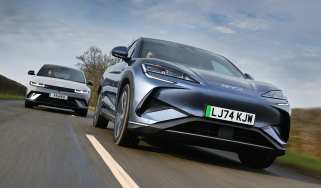
Cash £39,999Our news editor, Jordan Katsianis, lived with a BYD Sealion 7 Comfort as part of our long-term test fleet, and we tested a Design trim BYD Sealion 7 against a Hyundai Ioniq 5 in a twin test.
Performance & driving experience
Pros |
|
Cons |
|
Sealion 7 drivers get a choice of two battery capacities and two motor configurations spread across three models. The range starts with the Comfort, which is the only single-motor option. It sends its 308bhp and 380Nm of torque to the rear wheels.
The Comfort and the Design AWD models both feature an 82.5kWh battery. As the name suggests, the Design AWD gains four-wheel drive, courtesy of a twin-motor set-up. This extra motor driving the front wheels bumps the Design’s overall output to 523bhp and 690Nm of torque, while this model benefits from a range of chassis, braking, and other performance upgrades to handle the increased power. The Excellence version has the same power output, but comes with a larger 91.3kWh battery.
| Model | Power | 0-62mph | Top speed |
| Sealion 7 Comfort | 308bhp | 6.7 seconds | 133mph |
| Sealion 7 Design AWD | 523bhp | 4.5 seconds | 133mph |
| Sealion 7 Excellence AWD | 523bhp | 4.5 seconds | 133mph |
Electric motors, 0-60mph acceleration and top speed
The single-motor Comfort model manages 0-62mph in 6.7 seconds. All versions of the Sealion 7 have a top speed of 134mph, which is surprisingly quick for an electric SUV, because most rivals are limited to lower maximum speeds to help maximise range.
The more powerful Design AWD slashes the 0-62mph time to a very potent 4.5 seconds. That’s not as quick as a Tesla Model Y Performance or a Hyundai Ioniq 5 N but still very lively for a family SUV. Despite the extra 95kg that the larger-capacity battery pack adds to the Excellence model, BYD claims identical performance figures to the Design version.
As with the BYD Seal saloon, we found that the Sealion’s performance didn’t feel staggeringly quick in the real world – it’s by no means short of power, but it’s not mind-blowing when you put your foot down. A laggy throttle response and long pedal travel are partly to blame, as inputs are met with a slight delay before anything happens. The long travel helps the car drive smoothly at low speeds, but sluggish responses undermine the experience.
Town driving, visibility and parking
Limited visibility to the rear of the Sealion further emphasises the size of what is already a bulky car, and the superbly sharp surround-view cameras can’t quite overcome the fact that low-speed manoeuvrability is behind the best alternatives in the class. There are easier cars of this size to drive in town.
There are two levels of brake regeneration to pick from. The toggle switch on the centre console isn’t as intuitive to use as the steering wheel-mounted paddles some rivals offer, but it still beats diving into an on-screen menu to adjust the braking force. It’s better than the Tesla Model Y, where the regenerative braking system can’t be adjusted at all.
Country road driving and handling
The Sealion 7’s suspension offers neither class-leading comfort nor a reasonable level of control. The body tends to wallow a little clumsily through corners as it struggles to cope with the car’s significant mass – and that’s even by the standards of an electric SUV class where very few vehicles handle with much agility anyway.
Yet on straighter sections, the soft suspension still doesn’t cosset its occupants as well as a Hyundai Ioniq 5. A Ford Capri is much keener to drive through the turns, yet is also more compliant over bumps.
Motorway driving and long-distance comfort
These are the roads where the Sealion 7 feels most at home, although the ride still feels a little fidgety, even at higher speeds. The steering is a little too responsive yet lacks accuracy, which means more corrections are needed to keep the BYD on line when driving at a quicker pace than rivals.
“The BYD’s brake pedal is grabby and over-sharp at low speeds, yet lacks consistency and feel at high speeds. When we’re talking about a car with more than 500bhp, competent brakes really are a must.” - Jordan Katsianis, news editor.
Range, charging & running costs
Pros |
|
Cons |
|
Although it’s pricier than some competitors, the BYD Sealion 7 still benefits from the usual savings that are associated with running an electric car. The brand has also been rather generous when fitting the standard kit. In fact, there’s nothing on the options list aside from paint, so you won’t rack up too many additional costs here.
Electric range, battery life and charge time
The single-motor Comfort model, with a 82.5kWh battery, can officially cover 300 miles on a charge, while the flagship dual-motor Excellence has a 91.3kWh unit for a claimed 312-mile range. The four-wheel drive Design model, with its dual motors and smaller battery, has the shortest claimed range in the Sealion line-up at 283 miles.
When driving our 82.5kWh long-term test car on a number of shorter urban journeys in colder conditions, we saw an average efficiency of 2.9kWh. This only equates to a real-world range of 239 miles, which is some way short of BYD’s official claim of 300 miles. Following some longer journeys in warmer conditions, our car’s efficiency did rise but only to 3.02 miles per kWh, which works out at around 250 miles.
We also tested a Design model in cold conditions as part of a twin test, and it too achieved a slightly underwhelming efficiency of 2.6mi/kWh or a real-world range of 215 miles.
It’s worth noting that during our initial test drives in Germany, we found that Autobahn running harmed the Sealion 7’s range. Even at 70mph, many of the alternatives to this car – particularly the Tesla Model Y and rivals from the VW Group – use less energy, so we’d look to those cars if you plan on doing lots of motorway journeys.
The range-topping Excellence trim has a peak charging speed of 230kW, which allows it to get from 10 to 80 per cent state of charge in 18 minutes. That’s six minutes faster than the Comfort and Design can manage to charge their smaller 82.5kWh battery unit. Utilise a 7kW home wallbox charger, and it’ll take 13.5 hours to fully recharge a Comfort or Design trim Sealion 7 from flat, while the larger capacity battery in the Excellence trim will take around 15 hours to charge.
| Model | Battery size | Range | Insurance group |
| Sealion 7 Comfort | 82.5kWh | 300 miles | 45 |
| Sealion 7 Design AWD | 82.5kWh | 283 miles | 47 |
| Sealion 7 Excellence AWD | 91.3kWh | 312 miles | 49 |
Insurance groups
With at least 300bhp in every model, the base BYD Sealion Comfort is in insurance group 45 (out of 50), while the fancier Design and Excellence models are in groups 48 and 49 respectively. Opt for the lower-spec Tesla Model Y, and you’ll save a few pounds, because this car resides in groups 34 to 47. The Volkswagen ID.5 boasts the least horrifying quotes, though, because it sits between groups 25 and 41.
Tax
All electric cars qualify for the standard rate of VED road tax, and the BYD Sealion 7’s pricing structure means all but the base Comfort spec incur the luxury car tax. In addition to this, EVs are lined up for a potential eVED pay-per-mile tax that’s planned for 2028.
There’s good news for business buyers at least, as the Sealion 7 carries the low Benefit-in-Kind company car tax rates that are associated with fully electric cars.
Depreciation
Our market data show that the Sealion 7 is a bit behind some of the competition in terms of residual values. After a period of three years or 36,000 miles, this electric SUV is set to retain between 41 and 45 per cent of its original value. The ever-popular Tesla Model Y, meanwhile, is expected to retain 51 to 60 per cent of its original value, while the Volkswagen ID.5 will only maintain 37 to 44 per cent of its value over the same period.
To get an accurate valuation on a specific model check out our free car valuation tool...
Interior, design & technology
Pros |
|
Cons |
|
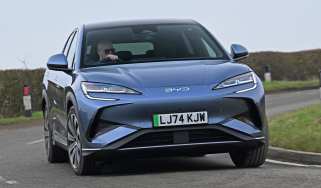
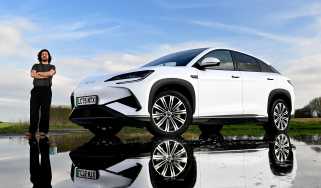
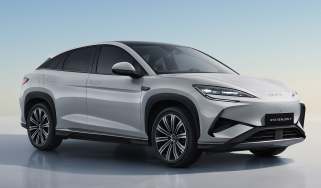
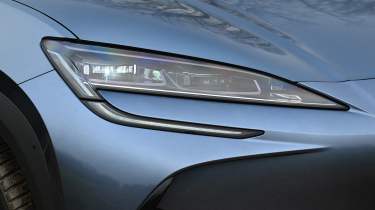
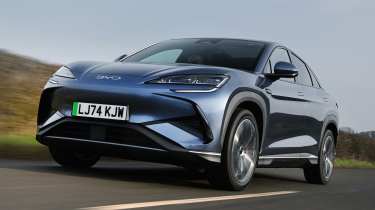
From the outside, the BYD Sealion 7 certainly has an expressive design by BYD’s standards, and it takes lots of cues from the BYD Seal saloon and integrates them with a fastback SUV body. However, this is a particularly busy part of the market, so it looks a little generic among more sharply styled Korean or European rivals.
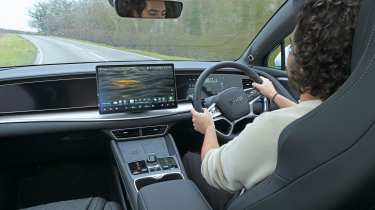
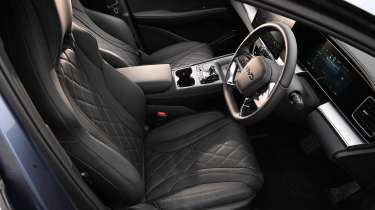
Initial impressions of the Sealion 7’s interior are good, with a sleeker and more restrained cabin design than other BYD models, although the massive touchscreen does draw a lot of attention.
Interior and dashboard design
The interior is dominated by a 15.6-inch infotainment touchscreen, but look elsewhere, and the cabin looks fairly smart. The flow of the dashboard into the door panels creates pleasing organic curves, and the blacklit dash panel ahead of the passenger lends the cabin a generally modern feel.
Materials and build quality
The use of leather and leather-effect materials on much of the door trim and dash points to a sense of expense at first glance. But some of the parts of the cabin that are touched most often, such as the internal door handles, feel a bit flimsy. When we tested the Sealion 7, our car’s head-up display rattled and vibrated while driving.
Infotainment, sat-nav and stereo
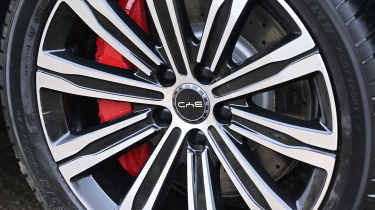
Regardless of the price point, BYD gives all its cars heaps of standard kit, and the Sealion 7 gets 20-inch alloy wheels, LED headlights, a huge 15.6-inch touchscreen display and even ultra-fast 50-watt wireless smartphone charging – including a cooling fan to prevent the device from overheating – as standard.
The 15.6-inch display with BYD’s party-piece ability to rotate 90 degrees from landscape to portrait means that the Sealion’s screen certainly looks impressive. But try to live with it, and there are things which soon start to irritate.
There are some baffling ergonomic choices here: a physical button for the front window demister and a second one included as a permanent fixture on the bottom of the touchscreen. But if you want to clear the rear window, the button is buried in the touchscreen’s climate sub-menu.
Another irritation with the touchscreen is that when Apple CarPlay or Android Auto are connected, they completely take over the display. To return to the native system – something you must do to adjust the temperature, because all the climate controls are on-screen only – you need to fully exit your smartphone app. Most other models leave some of their built-in functions permanently displayed on the screen to avoid this frustration.
“Connectivity has its highs and lows. The screen is relatively fast to react and has no problem maintaining a solid wireless connection for Apple CarPlay. But simple tasks are buried in multiple menus, and while you can also rotate the screen in a typical BYD way, I find this utterly pointless.” - Jordan Katsianis, news editor.
Boot space & practicality
Pros |
|
Cons |
|
The Sealion 7 is a large car, so it’s not cramped inside. But given the size, we’d have hoped for a little more room. It comes in a conventional five-door, five-seat configuration, with only one body style offered.
Dimensions and size
At more than 4.8 metres, the Sealion 7 is longer than both the Volkswagen ID.5 and Tesla Model Y. While the Tesla appears to have a much larger boot than both of its competitors, it’s important to note that this is measured to the roof, rather than the window line.
| Dimensions comparison | |||
| Model | BYD Sealion 7 | Tesla Model Y | Volkswagen ID.5 |
| Length | 4,830mm | 4,797mm | 4,599mm |
| Width | 1,925mm | 1,982mm | 1,925mm |
| Height | 1,620mm | 1,624mm | 1,620mm |
| Wheelbase | 2,930mm | 2,890mm | 2,930mm |
| Boot space | 520 litres | 845 litres (to roof) | 520 litres |
Seats & passenger space
Both the front seats and steering wheel in the Sealion 7 have plenty of adjustment, so it’s fairly easy to get comfortable, but as with other BYD products, the fixed headrest is too far forward. This led to many of our testers being forced into either a hunched driving position, or reclining the seat further than usual to avoid bending their necks. This, of course, means that the seat is no longer supporting the shoulders adequately, so either way, it’s not particularly comfortable.
Among the front storage spaces are a pair of cup-holders in the centre console. Their bases can be pressed down to accommodate cups and bottles of varying heights. The deep central cubby and glovebox are lined with material to stop items from rattling around on the move.
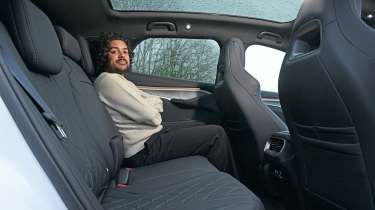
Kneeroom for back-seat passengers is excellent, with the Sealion 7 offering more space than its rivals, with the exception of the Kia EV6.
As with the Kia, headroom is more of an issue. The sloping roofline towards the rear of the car compromises space a little, so taller passengers could find themselves brushing against the headlining with the seats in their standard position. But the backrests can slightly recline, so those who are happy to slouch a little more can generate extra space - as long as the boot isn’t full.
There’s extra storage in the back, thanks to a central armrest with a small cubby and two pop-out cup holders.
Boot space
The main boot area is a generous 520 litres, and there’s a 58-litre cubby under the bonnet – perfect for storing the charging cables. Fold the back seats and the volume grows to 1,789 litres, which is 79 litres more than in a Skoda Enyaq and 209 litres more than the Hyundai Ioniq 5 in the same configuration. The folded seats leave a completely level space with the main boot floor – ideal if you need to load bulky items. Beneath the main floor area, there’s a very deep underfloor storage space.
Towing
Both all-wheel drive variants of the BYD Sealion 7 are rated to tow a braked trailer or caravan of up to 1,500kg, but this drops to 750kg for the rear-wheel drive Comfort model. Those who need more capacity may wish to look towards the Kia EV6 or Volkswagen ID.5 GTX, because both can manage up to 1,800kg.
“If there’s one element that makes it clear the Sealion 7 has been designed for the Chinese market, it’s the inclusion of lots of rear legroom. It would be even lovelier to spend time there if there weren’t issues with both ride quality and refinement, which are even more noticeable in the second row.” - Jordan Katsianis, news editor.
Reliability & safety
Pros |
|
Cons |
|
Euro NCAP has awarded the Sealion 7 its maximum five-star rating, scoring well in all areas. It comes with plenty of safety technology as standard, including nine airbags, a 360-degree parking camera, adaptive cruise control, blind spot detection, lane-keeping assist and traffic sign recognition.
While there’s lots of standard tech, we’re not convinced that any of it works that well. While it might tick Euro NCAP’s boxes, we found that some of these systems, most notably the lane-keep assist tech, are far too intrusive. On narrower B-roads, the car will constantly tug at the wheel, sometimes jabbing the steering wheel rather crudely towards the nearest hedgerow. Turning off these systems is much more of a faff than it is in, for example, Renault or Skoda products.
None of BYD’s models appeared in the most recent Driver Power best cars to own results, but the brand wound up in the middle of the best manufacturer table in 16th place out of 30. Owners were particularly pleased with their cars’ affordable running costs, but BYD’s touchscreens and overzealous safety tech were cause for complaint.
| Euro NCAP safety ratings | |
| Euro NCAP safety rating | 5 stars (2025) |
| Adult occupant protection | 87% |
| Child occupant protection | 93% |
| Vulnerable road user protection | 76% |
| Safety assist | 79% |
Buying, prices and deals
Best buy: BYD Sealion 7 Comfort
Starting from around £47,000, the entry-level Sealion 7 is fast enough, and it offers an official 300-mile range that should be acceptable for most needs. Comfort trim comes with lots of standard kit, so you don’t feel short-changed when compared with more expensive versions. We’d avoid forking out an additional £1,100 for a different colour from the standard Atlantis Grey, as this is a huge extra cost for a purely cosmetic change. This is also the only trim level to avoid the luxury car tax surcharge.
Moving up to the mid-range Sealion 7 Design pushes its price up to just over £52,000, while the fanciest Excellence model commands more than £59,000. Of course, you can save plenty if you build your new BYD Sealion 7 through the Auto Express Buy A Car service. You can also find the best Sealion 7 leasing deals from our network of dealers.
BYD Sealion 7 alternatives
There is a broad selection of electric family SUVs to choose from, with the two key rivals for the Sealion 7 to face being the Tesla Model Y and Volkswagen ID.5. There’s also the Skoda Enyaq and Cupra Tavascan, which are closely related to the VW, in much the same way that the Hyundai Ioniq 5, Kia EV6 and Genesis GV60 all share the same platform.
BYD Sealion 7 pictures
Key updates of the BYD Sealion 7 review
26 August 2026: Latest line-up and depreciation data.
Frequently Asked Questions
The Sealion 7 comes with a six-year warranty that has a 93,000-mile limit. On top of that, roadside assistance is offered for four years.
Deals on the Sealion 7 and alternatives