BYD Flash Charging: the mega-fast EV chargers heading for the UK
BYD’s Flash Charging points allow for a 10 to 97 per cent top-up in just nine minutes, and they’re coming to the UK
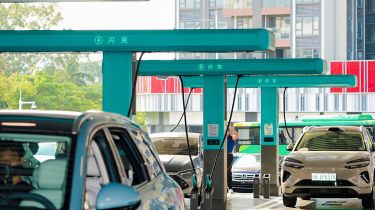
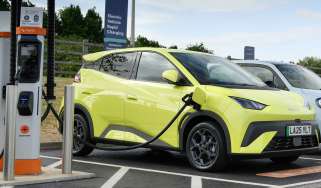
Waiting around for a full charge is often cited as one of the key turn-offs for potential EV buyers, but BYD Flash Charging has been created to quash this concern. While a number of the best electric cars can already complete a 10 to 80 per cent top-up in fewer than 30 minutes, Flash Charging has the potential to slash the time by so much that it’s more comparable to filling a car up with petrol.
The Flash Charging network is already up and running in China and is more than 4,000 units strong, so it’s already a very real game-changer as opposed to wishful thinking. It won’t be long before these stations appear in the UK, either, because they’re officially set to arrive in 2026.
So what is Flash Charging and how is it so fast? Keep reading our dedicated guide to find out everything you need to know.
How fast is BYD Flash Charging?
Generally speaking, the fastest public rapid chargers in the UK operate at a peak of 350kW or 450kW. However, BYD’s Flash Chargers pump out an almighty 1,500kW.
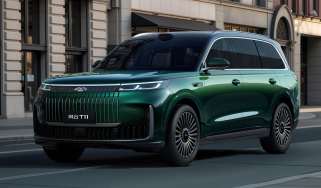
The whole set-up follows BYD’s ‘Ready in 5, Full in 9, Cold Add 3’ mantra, whereby a 10 to 70 per cent charge of the premium Denza Z9GT flagship is possible in five minutes, while filling to 97 per cent takes only nine minutes.
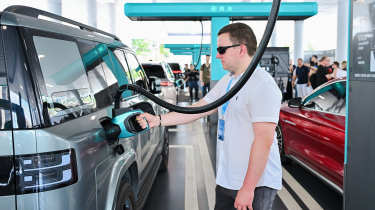
Models fitted with BYD’s Blade Battery 2.0 are compatible with Flash Chargers, but the Denza will be the only one available in the UK until this tech trickles down into BYD’s standard UK line-up.
BYD claims its chargers will even perform in sub-zero conditions; a 20 to 97 per cent charge at minus 30 degrees Celsius is apparently possible in just 12 minutes. For comparison, the BMW iX3 – one of the fastest-charging EVs currently on the market – takes around 21 minutes to top up from 10 to 80 per cent.
When and where will I be able to Flash Charge in the UK?
BYD already has more than 4,000 of its Flash Charging stations in China, but is aiming to have 20,000 up and running by the end of the year. Executive vice president Stella Li has also told us that at least 200 to 300 will be installed in the UK by the end of 2026.
The first stations should be operable in line with the Denza Z9GT’s arrival, and July 2026 has been hinted at as the most likely date. BYD intends to initially have its chargers located at Denza dealerships before the network quickly expands further afield.
We expect one of the very first stations to be located around the firm’s UK HQ in Uxbridge, West London.
Interestingly, the chargers won’t be branded as BYD or Denza, as with rival Tesla’s Superchargers; instead it’s simply going to be called the Flash Charging network.
In an exclusive interview with Auto Express last year, BYD’s UK country manager Bono Ge revealed how the company would build its network of cutting-edge chargers so rapidly: batteries.
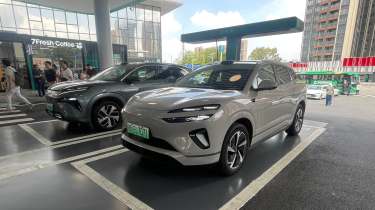
That’s hardly surprising considering BYD has been making batteries for 30 years, but the latest packs will help make its rapid chargers quicker and less expensive to install. “The challenge is upgrading your power supply, because we need to deliver one megawatt,” Ge explained.
“For example, our office here only comes with a 250 kilowatt power supply. If you want to deliver one megawatt, you have to upgrade the power grid, which probably would take us at least 12 months. Very likely 18 months to 24 months. That’s something we don't want.
“I think our solution will be to get batteries in between to store the energy needed. That way you don’t need to upgrade your power supply and can install the charger much more swiftly. That will also make the cost reasonable.”
Ge added that for Flash Chargers “you only need to give us a space for a parking bay that’s already good for the charger and energy storage together. We’ll have a low input, but you'll get a megawatt output”.
How much does Flash Charging cost?
We’re still waiting for the official UK pricing structure for Flash Charging. However, Bono Ge has informed us that being able to install its chargers faster and at a lower price than the competition will enable BYD to charge customers less to use them. “If we set up these things, we don’t need to charge them 89p per kWh, we’ll probably only charge them 60p,” he said.
Can other car brands use Flash Charging?
Flash Charging will be reserved for BYD and its sub-brand Denza to begin with. However, other manufacturers’ cars will be able to use the technology in time, provided they can handle it.
A BYD representative has told us that ideas are currently being discussed around how to prevent non-compatible EVs from taking up Flash Charger spaces. Time restrictions are rumoured to be a possible option, but the official solution is yet to be confirmed.
Making the switch to the EV world? Our dealer network has 1,000s of great value new cars in stock and available now right across the UK. Find your new car…