New BMW i3 revealed: 559-mile range, 400kW charging and bold looks
Forget Tesla, Polestar, Audi and Mercedes, thew BMW i3 blows the opposition away with a huge range

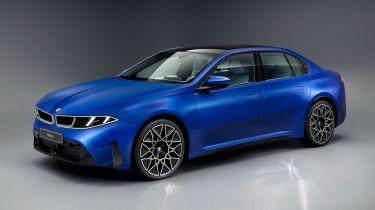
This is the new BMW i3, the first all-electric 3 Series in the company’s history, and one that will form a centrepoint for the whole BMW range moving forward. It’s not to be confused with the old i3 – that carbon-chassis city car won’t be directly replaced – but its name and legacy certainly haven’t gone to waste.
The new i3 is the second new model from BMW’s Neue Klasse era, following the iX3 SUV that’s already caused a stir. But to electrify a compact executive saloon – BMW’s bread-and-butter – is akin to Porsche electrifying the 911 – something the company hasn’t been brave enough to execute for fear of tarnishing its reputation.
BMW is coming out fighting, though, because the new iX3 impressed us when we drove it late last year in Spain, and again when we put it to the test in the UK for the first time.
A new petrol-powered 3 Series will also be along in a few months’ time, and just as MINI did with the Cooper hatch, it’ll share the basic design language and technology with its electric counterpart, but with a heavily modified version of the existing car’s platform underneath. Yet unlike the MINI, the i3 is BMW from the ground up: no joint ventures or Chinese partnerships, only BMW flexing its engineering might from right at home in Munich.
The i3 is expected to reach the UK in the Autumn of 2026, with more powertrain options and that combustion-powered variant due soon after. Pricing is still yet to be confirmed, but on the evidence of the new iX3, we suspect this launch model – the i3 50 xDrive M Sport – to cost from between £52,000 and £58,000.
If you can't wait for the BMW i3, you can buy a new BMW i4 with over £8,000 off through the Auto Express Buy a Car service.
New BMW i3 Touring estate and i4 coupe to follow
Just like the current 3 Series, the new i3 will be diversified into a range of variants with different powertrain layouts over time. Only one body and powertrain has so far been confirmed, but an i3 estate and i4 Coupè are planned.
The one powertrain we do know about is already raising eyebrows with some truly groundbreaking figures, though. The high-spec 50 xDrive set-up is already found in the larger and heavier iX3, and features dual electric motors capable of producing 462bhp and 645Nm of torque.
Its projected range on the WLTP cycle is 559 miles, and it’ll top up at as much as 400kW on a suitable high-speed charger. This makes the i3 capable of adding 248 miles of range in 10 minutes. These figures aren’t just slightly ahead of the competition, but leagues ahead.
Beyond this, we can infer lots of other as-yet unconfirmed information from the iX3 with which it shares much of its key technology. That 559-mile range will come courtesy of the same 112kWh (gross, 108kWh usable) lithium ion battery pack, with BMW’s own cylindrical cell design. This will be mounted cell-to-case style under the floor, with a pair of asymmetrical motors on the axles.
The numbers game: how BMW has smashed its competition
Take a look at the competition and it becomes clear just how much of a leap the new i3 has made when it comes to the metrics people consider when purchasing an electric car.
The Tesla Model 3 remains one of the most compelling in the C-segment based on pure numbers. Thanks to a recent set of updates, the latest Model 3 Long Range Dual Motor posts a 410-mile WLTP range figure and offers 250kW DC charging at a price of around £50,000 – impressive by today’s standards. Yet the gap between it and the i3 isn’t small, with BMW capable of nearly 150 extra miles from a single charge, and 150kW higher charging speeds.
The Polestar 2 is another popular option that’s been constantly refined over the years to offer its own £50,000 Long Range Dual Motor variant, and comes with a 369-mile range and 205kW charging. This is even more off the pace, but Polestar is working on a new generation, which might close the gap when it arrives in 2027. What about the Tesla? Elon seems more interested in making humanoid robots and autonomous taxis than cars in 2026, so don’t count on a new Model 3 any time soon.
BMW’s traditional rivals are a mixed bag. Mercedes will soon reveal its all-electric C-Class saloon, and just like the i3, it’ll be a ground-up reimagination as well. This also pairs its underpinnings with an SUV – in this case the new GLC with EQ Technology – and based on some of that car’s key metrics, Mercedes will still probably be behind BMW with 320kW DC charging and a sub 500-mile range figure.
What about Audi and Volvo? Neither have C-segment saloons or estates due in the short term. Volvo is instead focusing on SUVs such as the new EX60, and Audi’s forthcoming A4 e-tron is still a few years away, coming in late 2027 at the very earliest. Reports from Audi indicate this is actually due to slip to 2028, and when it does arrive it’ll have a mountain to climb in order to wrestle back customers that have already made the switch to BMW and Mercedes-Benz.
Finally, among the Chinese brands, the most obvious rival for the BMW i3 currently available in the UK is the BYD Seal. When fitted with a dual-motor layout in Excellence trim, the BYD is miles behind the curve, with a mere 323 miles of range, 150kW charging, and a price tag that’s still close to £50,000.
In fact, the only brand that could put BMW on the back foot at this stage is Zeekr, a new Geely-owned company that will arrive in the UK around the same time as the BMW i3. One of its first models will be the sleek 007GT, a compact executive estate that claims a 501-mile EV range, and even faster 480kW charging.
What other powertrains can we expect from the new BMW i3?
This high-spec dual-motor launch layout will be just the first of many powertrains, with single-motor variants and smaller battery packs also due to be available. The 50 xDrive is destined to be the top non-BMW M variant, but the step-up will be a big one, because the new iM3 will have much higher levels of power and performance.
The next BMW iM3 will have four electric motors, rather than just two, and feature a unique high-performance battery pack developed specifically by BMW M. A peak power figure of around 1,000bhp is expected, as are elements including a drift mode, a virtual gearbox and a wider body. What’s less certain is the offer of a middling M Performance model, although there’s plenty of space between the 462bhp 50 xDrive and the 1,000bhp iM3.
How has BMW achieved such impressive figures?
The i3’s bespoke architecture has a few tricks up its sleeve to help produce its amazing efficiency figures. Unlike the current i4, which in effect took the existing 3 Series platform and adapted it for an electric powertrain, the i3’s architecture is made-to-measure. This means that all the compromises required to fit an electric powertrain into a platform designed for a combustion model no longer apply.
This same notion applies to the car’s electronic brain, because there’s nothing adapted, only elements designed from scratch. BMW calls its system the ‘Heart of Joy’, and ignoring the rather unflattering name, it streamlines all the i3’s electronics into one tech-stack. This means the car’s elements, from the powertrain to the brakes, infotainment system, automatic lights and autonomous driving features, all speak as one.
An example of a direct benefit of this new system are the brakes. These don’t just have the hardware to use the electric motors for regenerative braking, but also the software to deftly bring the car to a complete stop without using any friction braking at all. This helps make the most of the i3’s kinetic energy, rather than wasting it on friction braking.
What about the BMW i3's design and interior?
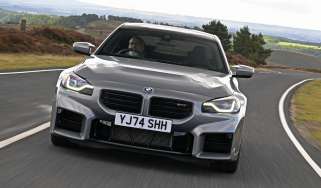
As is befitting of such a comprehensive technical overhaul, the i3’s exterior and interior design has also had a dramatic change, previewed by the BMW i Vision Dee in 2023. Designers have transferred that concept’s new-age design language into a relatively compact, production-friendly three-box saloon that also squeezes in 112kWh worth of battery inside.
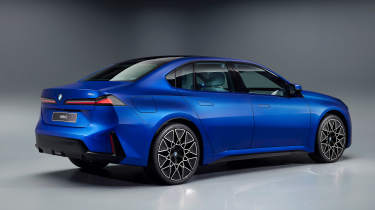
At 4,714mm long, the new i3 is 49mm longer than the current 3 Series, but it’s also 38mm wider and 42mm taller, visually hiding some of that extra mass. In fact, when you realise that the car in these pictures is wearing a set of 21-inch wheels, the stubby proportions actually reveal themselves as being quite bloated in reality.
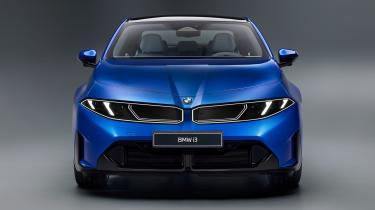
The nose is dominated by the same new-age face as the concept, and features a more streamlined design than the iX3. Its two black ‘grilles’ are illuminated all the way around, and sit above a clean lower opening with active shutters and functional air curtains.
Down the side, BMW’s designers have looked to previous 3 Series models for inspiration, and the first that comes to mind is the boxy E36 from the early nineties. Fundamentally, the body is generally much cleaner and more solid-looking than current BMWs, and although there’s an even wider iM3 on the way, each of the four wheelarches has been swollen quite considerably, giving it an aggressive stance.
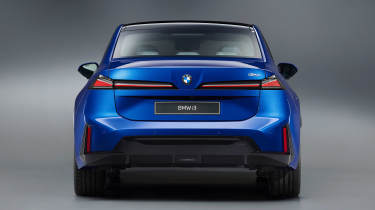
The rear is more conservative, with simple rear lights that sit either side of the BMW badge. What helps the i3 look properly ‘new’, though, are some of the elements that don’t immediately jump out. As on the iX3, the door skins now meet the glass without any plastic trims, the flush door handles clean up the profile, and the integration of the headlights into the front ‘grilles’ keeps shutlines and awkward junctions of plastic and metal to a minimum.
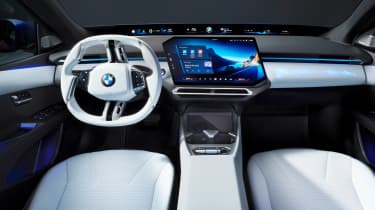
Inside, BMW’s fresh cabin layout is centred around BMW’s Panoramic iDrive system and new touchscreen interface. The Panoramic iDrive is the big mover and shaker in this arrangement, because it replaces a traditional dial pack in front of the driver in favour of a full-width head-up display shown in a black area at the base of the windscreen.
As well as showing your speed, range and other key driving information, it can also be customised to show bite-sized pieces of all sorts of information, from G-meters and power displays in Sport mode, to a virtual assistant and driving tips in Eco. Another nice element is turn-by-turn instructions when the embedded navigation is active.
The 17.9-inch angled touchscreen then takes care of the majority of functions, because there’s no longer a physical iDrive controller. BMW has taken care to make sure often-used features, such as switching off the driver assists or changing the temperature, are easy to access, and key elements including front and rear demisters, the volume control and hazard lights still have physical controls by the small gear selector.
Get the latest and best car news and reviews, first! Follow Auto Express on Google today.