BMW 2 Series Active Tourer review
The BMW 2 Series Active Tourer is a spacious, efficient and upmarket option in the MPV sector

Our opinion on the BMW 2 Series Active Tourer
As a mid-size premium MPV, BMW 2 Series Active Tourer remains a rare alternative for families who want a spacious car that isn’t an SUV in today’s market. Not only are we impressed with the amount of space within the Active Tourer, but we also greatly approve of its build quality.
However, BMW’s decision to downsize the latest iteration of this car to a five-seater is a bit of a disappointing one. We also can’t help but feel that usability has been compromised by the loss of many physical controls.
About the BMW 2 Series Active Tourer
While BMW might not be the first name that comes to mind when you’re thinking about a sensible family car that’s realistically priced, the BMW 2 Series Active Tourer may take you by surprise. In order to keep this car within the realms of affordability, it shares the same platform as several other models, including the BMW 1 Series, BMW X1 and MINI Countryman.
Not only does parts-sharing mean reduced costs, but here it also opens up the opportunity for numerous powertrains. Petrol mild-hybrid and plug-in hybrid power are both available, which helps to highlight that this BMW is far more focused on being sensible rather than sporty.
Used - available now

2026 BMW
2 Series
14,041 milesAutomaticPetrol2.0L
Cash £26,360
2020 BMW
2 Series
61,951 milesManualPetrol1.5L
Cash £12,897
2015 BMW
2 Series
74,291 milesManualPetrol3.0L
Cash £13,991
2017 BMW
2 Series
93,000 milesAutomaticPetrol1.5L
Cash £7,749We’ve tested many variants of the BMW 2 Series Active Tourer during its lifetime, but don’t forget that the 2 Series name also spreads to other (very different) models. If you’re considering one of these other cars, be sure to check out our dedicated in-depth reviews of the BMW 2 Series Coupe, BMW 2 Series Gran Coupe and BMW M2.
Performance & driving experience
Pros |
|
Cons |
|
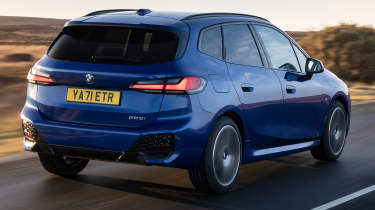
The BMW 2 Series Active Tourer powertrain line-up consists of two petrol and two plug-in hybrid powertrain options.
Kicking things off is the base 220i. Despite its name, this is actually a turbocharged 1.5-litre, three-cylinder petrol engine that can be found in several BMW and MINI models. It comes with 48v mild-hybrid technology in the 2 Series Active Tourer, and produces a total output of 168bhp and 280Nm of torque.
Despite its somewhat modest proportions, this engine is able to get the 2 Series Active Tourer moving in a reasonably eager fashion. It’s also our preferred engine because it has enough muscle to overtake slower-moving traffic on a B-road while maintaining a healthy rate of fuel economy.
The alternative petrol is the 223i. This engine also uses mild-hybrid tech, but this time it’s a larger, turbocharged 2.0-litre four-cylinder that pumps out 215bhp and 320Nm. This variant feels pretty spritely for an MPV and, in all honesty, it’s more than fast enough for a car like this. However, we’d still suggest sticking with the lesser 220i, as this already has enough performance for family car duties.
If you move towards the plug-in hybrid models, things start off with the 225e. This has enough get-up-and-go to take on a number of hot hatches with 241bhp and 477Nm on tap. However, if you really are desperate to complete the school run in record time, the range-topping 230e bumps the power up to 322bhp while providing the same 477Nm of torque.
All engines come with a seven-speed dual-clutch gearbox that delivers smooth and refined shifts. BMW has also fettled with the engine and gearbox mounts to be highly effective at isolating vibration. It results in a car that moves away smoothly at low speeds and remains hushed at higher speeds.
Both of the petrol cars are front-wheel drive, but the PHEVs are four-wheel drive (known as XDrive) due to the electric motor being fitted to the rear axle.
| Model | Power | 0-62mph | Top speed |
| 220i Active Tourer Sport | 168bhp | 8.1 seconds | 137mph |
| 223i Active Tourer Sport | 215bhp | 7.0 seconds | 150mph |
| 225e Active Tourer xDrive Sport | 241bhp | 6.7 seconds | 121mph |
Performance, 0-60mph acceleration and top speed
It’s never going to keep up with a BMW M2, not that we imagine any prospective 2 Series Active Tourer owner would want to do that, but this MPV won’t hang around if you decide to plant your right foot.
Even though it’s the slowest model, the 220i will accelerate from 0-62mph in an admirable 8.1 seconds, while the 223i trims this down to seven seconds. With the introduction of the electric motor, the PHEVs are even quicker with the 225e managing the same sprint in exactly seven seconds. The 230e is the quickest of the bunch at an almost ridiculous 5.5 seconds.
Town driving, visibility and parking
The steering quickly proves that this BMW hasn’t been designed with driving dynamics at the top of the priorities list, but it comes into its own in the city streets. It’s still direct and sharp enough, but what matters most in a car like this is that it’s exceptionally light. This makes it great for tight parking manoeuvres, as do the standard-fit front and rear parking sensors and reversing camera to improve visibility. The optional Technology Plus pack upgrades this camera to a full 360-degree system with a top-down view.
Country road driving and handling
It’s no sports car, but the Active Tourer handles more sharply than you’d expect from looking at it. Body control is composed, it turns into corners keenly and there’s plenty of grip, but that aforementioned light steering means the fun factor is lacking. If you want a family car that’s a bit more entertaining, you might want to look towards the BMW X1 SUV instead.
Motorway driving and long-distance comfort
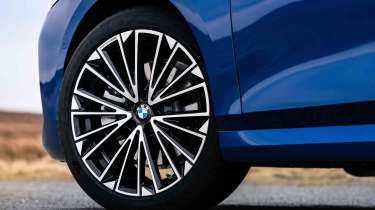
Aim BMW’s MPV towards a motorway and the ride remains reasonably smooth, provided you stick with a Sport or Luxury trim on standard suspension and 17-inch wheels. However, go for the M Sport with its larger 19-inch ‘Individual’ wheels and firm sports suspension, and things won’t feel quite so settled.
MPG & running costs
Pros |
|
Cons |
|
While the PHEVs are naturally the headline grabbers in terms of running costs, the petrol cars really aren’t exactly thirsty. In fact, the 220i and 223i mild-hybrids are almost as economical as each other, with WLTP combined averages of up to 49.6mpg and 48.7mpg, respectively. Emissions are understandably similar, too, at up to 135g/km for the 220i and 140g/km for the 223i.
| Model | MPG | CO2 | Insurance group |
| 220i Active Tourer Sport | 49.6mpg | 131g/km | 24 |
| 220i Active Tourer Luxury | 49.6mpg | 131g/km | 24 |
| 223i Active Tourer Sport | 47.9mpg | 135g/km | 29 |
Electric range, battery life and charge time
Both of the PHEVs use the same size engine and a 16.3kWh (14.2kWh usable) battery pack that powers a single, rear-mounted motor. BMW claims that these models can travel up to 53 miles on electric power alone, and they come with an official weighted combined fuel economy figure of up to 104.6mpg. These cars also have the ability to maintain electric-only running up to motorway speeds, so you could go about your daily driving without burning a single drop of petrol.
When it’s time to recharge, the battery pack will take around 2.5 hours to recharge using a typical 7.4kW home wallbox charger. DC fast charging is not supported, though.
| Model | Battery size | Range | Insurance group |
| 225e Active Tourer xDrive Sport | 16.3kWh (14.2kWh usable) | 52 miles | 27 |
| 225e Active Tourer xDrive Luxury | 16.3kWh (14.2kWh usable) | 52 miles | 27 |
| 230e Active Tourer xDrive Luxury | 16.3kWh (14.2kWh usable) | 53 miles | 31 |
Insurance groups
Unfortunately, a consequence of the sporty and premium connotations associated with the BMW badge is rather pricey insurance premiums. Even in its least-powerful 220i form, the entry-level Sport trim, is in group 27 (out of 50), while at the top of the scale is the 230e PHEV, which lives in group 31.
Even when compared with some of BMW’s SUVs, this is rather steep. The BMW X1, for example, starts from group 25. If you want an MPV that’s much cheaper to insure (and buy), you’ll need to look towards the likes of the humble Dacia Jogger, as this dips as low as group 13.
Tax
If you opt for the petrol-powered 2 Series Active Tourer, you’ll need to tread lightly when configuring it because a large proportion of the line-up crosses the £40,000 luxury car tax threshold. If you go for the PHEV, you won’t have any choice but to endure this additional £440 annual surcharge on top of your VED road tax bill. This surcharge will apply annually from the second time the vehicle is taxed until it is six years old.
While the plug-in hybrid attracts a moderate company car tax reduction, it still doesn’t come close to the savings offered by fully electric cars.
Depreciation
Our market data indicates that after three years or 36,000 miles, the BMW 2 Series Active Tourer will retain between 38 and 46 per cent of its original value. This isn’t as strong as its closely related BMW X1 sibling, which maintains 47 to 52 per cent. The far cheaper Dacia Jogger also retains its value better, holding on to between 47 and 50 per cent of its original value over the same period.
Interior, design & technology
Pros |
|
Cons |
|
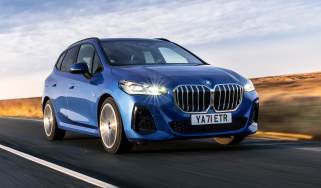
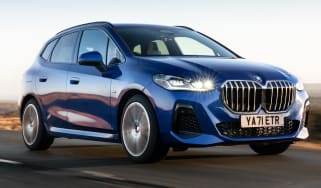
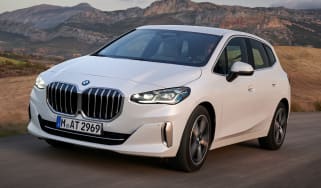
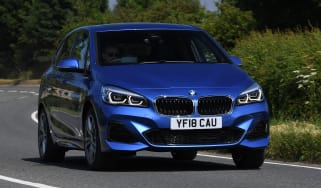
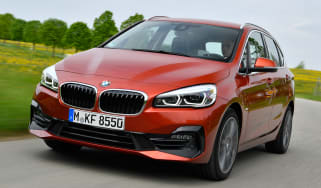
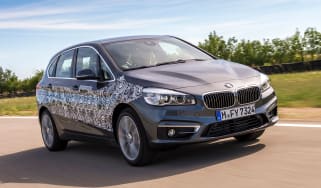
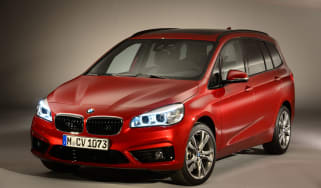
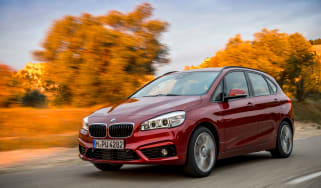
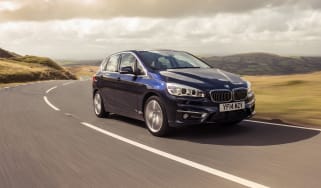
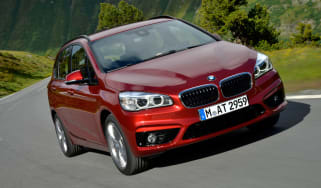
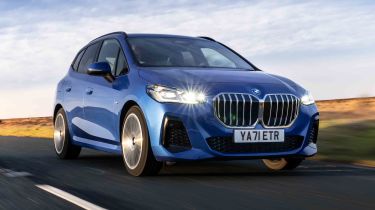
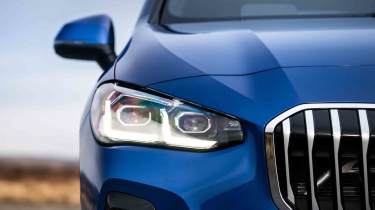
The 2 Series Active Tourer follows the same design language as most other BMWs of the pre-Neue Klasse era. Two massive kidney grilles take up centre stage at the front of the car, but barring that, it’s a pretty conservative design with an element of class about it. There won’t be any mistaking this MPV for one that’s based on a van, that’s for sure.
Interior and dashboard design
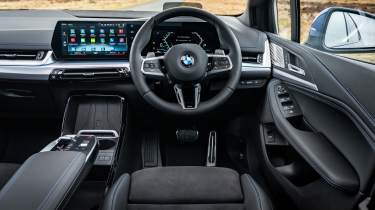
The BMW 2 Series Active Tourer gets the same curved infotainment display that you’ll find in several other models ranging from the BMW 3 Series up to the BMW X7. There’s a 10.25-inch digital instrument cluster in front of the driver and a 10.7-inch display for the infotainment and climate control functions. Both butt up to one another in a seamless design that looks tidy. With the reduced button count, it all helps give the interior a minimalist look.
There’s a clean sweep of air vents sitting below those screens, and a floating centre console which houses many of the drive functions. The shelf below this, which is designed for storage, is exposed, so you can’t hide things from prying eyes.
Materials and build quality
The build quality feels as solid as we’ve come to expect from BMW. M Sport cars come with racy touches around the cabin, but Luxury spec is well suited to the Active Tourer’s comfortable and practical nature.
Infotainment, sat-nav and stereo
As always, BMW’s iDrive software provides crisp graphics plus easy-to-understand menus and widgets. Apple CarPlay and Android Auto phone connectivity are also provided as standard.
However, what we like about the system in pricier models like the BMW i5 is that it’s backed up by the traditional iDrive click wheel and surrounding shortcut buttons. This element has been entirely removed from less expensive models, such as the 2 Series Active Tourer. It makes the user experience much trickier on the move as you have to stab away at a screen instead of being able to utilise a rotary dial within easy reach. This physical interface would have made an excellent system pretty much perfect.
Adding the Technology Plus Pack gives the driver a head-up display that projects useful information, such as sat-nav instructions (including which lane you need to be in), your speed, and the current speed limit, onto a small perspex screen within the driver’s line of sight. It’s not the most elegant application of a head-up display, though.
Boot space & practicality
Pros |
|
Cons |
|
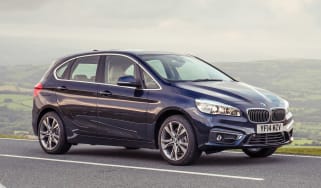
The latest 2 Series Active Tourer doesn’t look vastly different from the old model. Sure, it has flush-fitting door handles from the BMW 4 Series and BMW i4 and some sharper features, but there’s only so much you can do with a one-box MPV design that’s supposed to maximise interior space. As is the tradition in modern BMW design, the brand’s kidney grilles at the front take up a large amount of real estate, and they are flanked by a pair of relatively slim LED headlights.
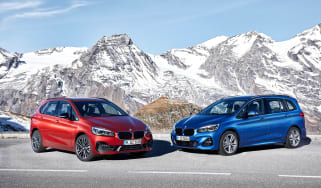
The overall proportions seem chunkier than before, even if they’ve only grown slightly in all directions. It’s also more aerodynamically efficient, with a low drag coefficient of 0.26cd for some models and the potential to benefit fuel economy and refinement.
Dimensions and size
With the demise of rivals like the Mercedes B-Class and Volkswagen Touran, the BMW 2 Series Active Tourer is one of the smallest members of the MPV class and, in fact, a touch more compact than the BMW X1 SUV.
| Dimensions comparison | |||
| Model | BMW 2 Series Active Tourer | BMW X1 | Kia PV5 Passenger |
| Length | 4,386mm | 4,500mm | 4,695mm |
| Width | 1,824mm | 2,104mm | 1,895mm |
| Height | 1,576mm | 1,642mm | 1,923mm |
| Wheelbase | 2,670mm | 2,692mm | 2,995mm |
| Boot space |
415 litres (petrol) 406 litres (PHEV) |
500 litres (petrol 490 litres (PHEV) | 1,320 litres |
Seats & passenger space
Interior and boot-space flexibility will be the main concerns of buyers of this car. Up front, the ‘cut-away’ centre console makes the front feel airy and spacious. That produces a pleasant environment, but it also means that anything large you’d typically store in the central bin will be in plain sight. And don’t expect to utilise the hidden storage area under the armrest, because it’s only suitable for small items.
A pair of cup holders sits behind another central storage area designed to keep smartphones in place; it also doubles as a wireless charging pad if you go for the Technology Pack or pick the range-topping M Sport trim.
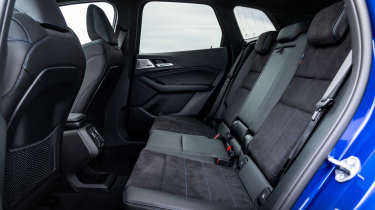
Those in the back will find plenty of space. Passengers sit on an elevated bench to look over the front seats with good leg, knee and foot room. The backrest reclines, so it should be a relaxing place to spend time on longer journeys. The seats on mild-hybrid petrol models can be made to slide forwards and backwards with the £330 sliding rear seat option, while the seats in plug-in models are fixed in place due to the battery pack's location.
A pair of Isofix child seat mounting points is provided on the rear bench's outer positions and are easy to reach behind some folding plastic clips.
Boot space
All versions get a 40:20:40 split-folding seat design to maximise versatility. The boot offers a useful 415 litres of space in petrol models, dropping slightly to 406 litres in the PHEV models. However, these are both a lot smaller than the 490 to 500 litres that you’ll find in the BMW X1.
The amount of space in the 2 Series Active Tourer can expand a little if you go for the £330 sliding rear seat option, or if you need to tackle a weekend tip run, fold the rear seats down to reveal up to 1,455 litres of space.
Towing
The weakest 2 Series Active Tourer for towing is the petrol-powered 220i, but this still manages a reasonable 1,200kg. Moving up to the 223i means you’ll have the strongest towing capacity of the range at up to 1,500kg. Both PHEVs, meanwhile, sit in between at 1,400kg.
If you have a particularly hefty trailer or caravan, you’ll be better served by the BMW X1 xDrive23i or xDrive23d, because these can both take on up to 2,000kg.
Reliability & safety
Pros |
|
Cons |
|
The Active Tourer didn’t appear in the most recent Driver Power owner satisfaction survey. The BMW brand landed in fifth place out of 30 in the best manufacturer rankings. These results should go some way towards providing peace of mind with your prospective BMW ownership experience.
The 2 Series Active Tourer is also a safe car, because it was awarded the maximum five-star rating by the experts at Euro NCAP in 2022.
You get plenty of safety technology as standard with the 2 Series Active Tourer, including autonomous emergency braking (AEB), which works at low speeds to help mitigate or prevent collisions with other vehicles and vulnerable road users. There’s also a lane departure warning and lane-keeping assist system in order to help keep you within your lane on the motorway. It’ll even recognise road signs, displaying the speed limit of the road you're on either in the digital instrument cluster, or in the head-up display that’s part of the Technology Plus Pack.
If you want the very fanciest ‘professional’ tech packages, though, you’ll need to fork out extra cash regardless of your chosen spec. These include additional assistance systems like active navigation guidance and emergency stop assistance.
| Euro NCAP safety ratings | |
| Euro NCAP safety rating | Five stars (2022) |
| Adult occupant protection | 88% |
| Child occupant protection | 81% |
| Vulnerable road user protection | 79% |
| Safety assist | 92% |
Buying, prices and deals
- Best buy: BMW 220i Active Tourer Sport
Prices for the 2 Series Active Tourer start at just over £36,000, with the mid-range Luxury trim costing over £37,000. You’ll need to spend around £40,000 to get into an M Sport model. Those interested in buying the plug-in hybrid will have to fork out closer to £40,500 for the 225e xDrive, or around £45,000 for the more powerful 230e xDrive.
We reckon it’s best to go for the BMW 2 Series Active Tourer in its entry-level 220i Sport specification to avoid the luxury car tax, with some wiggle room if you want to add metallic paint and the handy sliding rear seat option.
You can save money by building your new BMW 2 Series Active Tourer using our Auto Express Buy A Car service. We also have a number of 2 Series Active Tourer leasing deals, along with a range of used 2 Series Active Tourer models in stock.
BMW 2 Series Active Tourer alternatives
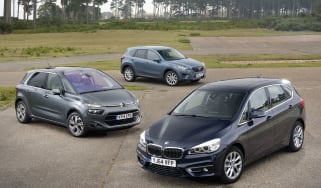
The MPV market has shrunk considerably since the BMW 2 Series Active Tourer first arrived. Today, you’ll have to look towards van-based options like the Citroen Berlingo, Ford Tourneo Connect, Peugeot Rifter, or Vauxhall Combo Life if you want to stick with a traditional people carrier. There’s also the Dacia Jogger, which is a solid family car but a more budget-oriented choice than the plush BMW.
Alternatively, a few pure-electric options are starting to appear, but most of these are much larger and pricier than the BMW. One car that is a bit more modestly sized and priced, though, is the Kia PV5 Passenger; a car that’s highly rated by our expert road testers.
Of course, if you’re not fully committed to an MPV, there’s no shortage of SUVs to take your fancy. The BMW X1 and MINI Countryman are closely related to the 2 Series Active Tourer, while the Audi Q3, Cupra Terramar, and Mercedes GLA are three good alternative SUV models of a similar size.
BMW 2 Series Active Tourer pictures

Key updates of the BMW 2 Series Active Tourer review
3 July 2026: Latest driving impressions and pricing data.
Frequently Asked Questions
The standard BMW manufacturer’s warranty is three years with unlimited mileage. The battery pack for plug-in hybrid models is also covered for six years or 62,500 miles.
Deals on the 2 Series Active Tourer and alternatives
More reviews
Road tests
Which Is Best