Future of Aston Martin: next generation sports car and SUV secrets revealed
Exclusive details of the new Aston Martin generation: new platform, hybrid and electric power, on the road in three-to-four years

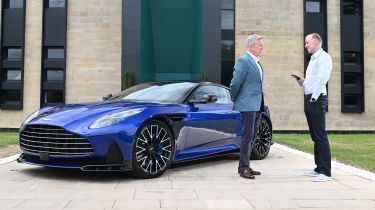
Aston Martin is developing a “revolutionary” new generation of cars – from sports cars to SUVs – powered by mild-hybrid petrol power and blasting onto the road before the end of the decade.
“We’re developing the new generation of cars and their platform, with a new level of incredible technology: powertrain, electronic architecture, air-conditioning, seats, everything,” Aston CEO Adrian Hallmark told Auto Express in an exclusive interview.

Aston’s engineering team is developing a clean-sheet modular architecture, which will be able to share componentry far more broadly across the brand’s varied product portfolio. It will mean sports cars and SUVs can go down the same line, as well as driving out costly complexity.
What engines will the new Aston Martins run?
The platform is being future-proofed for pure electric power. Battery Electric Vehicles (BEVs) have been pushed back in the plan, with the luxury electric car market yet to take off, though they will be introduced in the 2030s.
More clarity is emerging on the combustion powertrain line-up, which Aston would like to simplify. But the V12 engine could – in theory – live on until Europe bans sales of new combustion engines.
“We’ve done some work to make the V12 compliant to European and US [regulations],” explains Hallmark. “If we keep our V12 sales under 1,000 per year, then we’re exempt from legislation until 2035 at least.” That means a series-production V12 flagship GT such as today’s Vanquish, along with ultra-exclusive, multi-million pound V12 specials such as the Valiant or One 77, can continue to crown the range.
“We also looked at how much electrification is needed to remain compliant – and we don’t need plug-in hybrids (PHEVs).” Hallmark’s rationale? With Brussels downgrading emissions credits due to driving data revealing PHEVs are driven more frequently on polluting petrol, the cost, complexity and weight penalty just doesn’t add up for Aston. “We’re not delusional, we’re pragmatic,” he says.
Instead, the intention is to add mild hybrid support for the combustion engines, with the 48-volt electrical system powering the air-con and turbos. This should provide a slight power bump and boost economy, enabling Astons to occasionally coast engine-off on motorways and potentially crawl silently in traffic.
Aston uses Mercedes engines and electronics. Will that continue?

The British brand has been sailing solo since Ford cut it loose in 2007, whereas Bentley rests in the safe harbour of the Volkswagen Group, tapping into jointly-funded powertrains, vehicle platforms and electronics. Where does Aston need help – and what can it do on its own?
“We’ve done an engine, and that will continue,” shoots back the boss, referring to the 5.2-litre twin-turbo V12. “We’ve bought in engines, and that will probably continue. We’ve bought an electronic architecture and we’ll buy another one.”
That led to some initial niggles: Hallmark’s diagnosis is that Aston erred by overlaying its own infotainment system on top of the Mercedes one. “For the next-generation we have a mantra not to touch these core systems. Instead we’ll put all the money into the hardware and the interface: the functionality is fine, but our look-and-feel and switchgear must be totally different.”
Hallmark calculates one-third of today’s Aston components are sourced from Mercedes, a figure that will rise with the new generation. “But more than 50 per cent will be down to us. There’s no penalty for being independent, so long as there are players out there willing to provide credible technologies at a competitive cost.”
What advances will the new architecture bring?
The boss is incredibly fired up by the new architecture’s potential. “We’ve got a mathematical description of how every Aston will be in the future: in terms of vehicle [performance], this will be a revolution.” Teams have gone through 52 systems – ”from air-conditioning to steering to braking” – benchmarking today’s Astons and their rivals to drive the new cars to the next level.
As with the current sports cars, the body-in-white will consist of bonded and extruded aluminium sections. New engineering methods should deliver a stepchange in torsional rigidity with only a minor weight penalty, providing stiffer suspension mounting points to enhance dynamics and refinement. Rear-wheel steering will also sharpen the GTs’ turn-in.
The future portfolio will maintain today’s breadth: from the sports cars to the DBX SUV to a mid-engined supercar such as Valhalla, plus the specials. But there will be far more commonality between core models. Could Aston put them down the same line? “Today, no. In the future, yes.”
Better economies of scale will ”save a game-changing percentage cost of the vehicle”, and streamline the supply chain. In theory, some sports cars could even be assembled at the DBX’s factory at St Athan in Wales: today, sports car bodies are shipped there from Gaydon for painting, then returned for final assembly. This merry-go-round perfectly encapsulates another one of Hallmark’s mantras: “We are blessed with inefficiency – and opportunity.”
Did you know you can sell your car through Auto Express? We’ll help you get a great price and find a great deal on a new car, too.