New Alpine A110 teased again, and it looks more aggressive than ever
The new A110 is set to be fully revealed late next year, but Alpine’s design boss has given Auto Express a peak behind the curtain

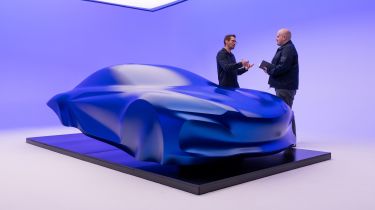
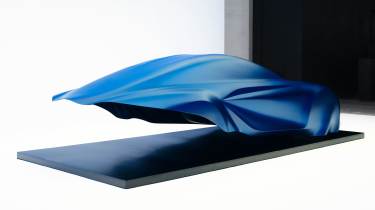
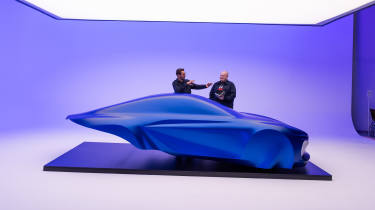
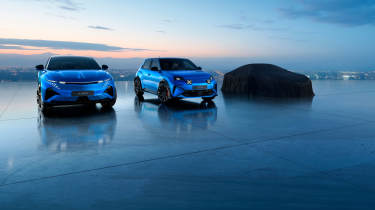
Alpine has given us our best look yet at the long-awaited next-generation A110 sports car ahead of its reveal late next year – in a dramatic sculpture previewing what will be a more spectacular, more aggressive-looking machine than the last.
The previous Alpine A110 was designed to bring the French brand into the modern era, acting as a bridge from its past to today. However, Alpine’s head of design Antony Villain told Auto Express with the new all-electric one “we have much more freedom to explore what will be the future.”
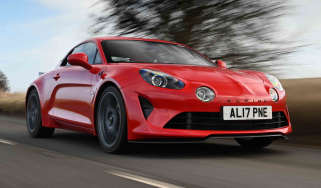
Line up the silhouettes of all three generations of A110, you can clearly see the subtle progression over the decades. The clean, pure and elegant shape of the sports car and its slender figure has not been lost to huge scoops, vents and spoilers. But at the same time, “it looks like it’s going faster and faster", Villain highlights.
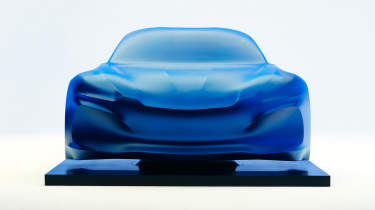
Many of the French icon’s other unmistakable design elements will return for the next evolution. The four lights across a V-shaped nose, for instance, the car’s compact size and footprint on the road, and a character line running from the tip to the tail that gives it a sense of tension.
The A110 has always had distinctive heavily sculpted flanks too, however the new one dials up the sense of drama with a unique, more extravagant design inspired by the sonic boom created by a plane blasting past the sound barrier, putting even more emphasis on the rear and the energy back there, as Villain put it.
“It was a way to have a good combination of sharp lines and very soft surfaces,” the design boss explained as he walked us around the sculpture. “We really want this car to be fully emotional. It's really a kind of art in motion.”
Meanwhile, the A110’s signature four lights on the front, which were round on the first two generations, have now adopted a sharper, hexagonal design, while the bonnet is moulded to accentuate them better.
The reason for the change is Villain believes the old circular lights made the last A110 look a little too “cute” and “froggy”. He explained: “I think this was very successful in France, but when you come to the UK or even more in Germany, it was not serious enough.”
Ensuring the new A110 was just as low as those that came before – below 1.3 metres – was imperative to the designers as well, Villain told us, with the engineers having to figure out how to achieve this on an electric car. They did so by cleverly splitting the battery into two units rather than simply running plonking it under the floor.
As we can see, the classic, tapered, teardrop shape has also carried forward, with the new car’s glasshouse naturally curving downward toward the rear, which should create a compact cabin that tightly cocoons the driver. It will be more pronounced this time around though due to the wider track and more muscular, dynamic surfacing below.
Of course, being an EV means range and efficiency needed to be considered when honing the aerodynamics, with the designers finding the right balance between drag, downforce and their desire to create something dramatic.
There’s still about a year to go until the new Alpine A110 is fully revealed, but we’ve learned plenty of more details already. As we said, it’s going to be electric, feature a bespoke, all-aluminium platform, should tip the scales at 1,450kg (close to a Porsche Cayman GT4 RS’s weight), and pack two innovative in-wheel motors that generate “more than enough power – I can guarantee”, Alpine CEO and ex-Ferrari director of engineering Philippe Krief promised us.
What do we know about the interior?
The last A110’s interior was functional and driver-focused, but felt rather dated by the time production came to end this summer. Especially the tech onboard, such as the seven-inch touchscreen that was plucked from the Renault parts bin and wasn’t upgraded during the car’s nine-year run.
Villain willingly admitted that the previous car’s cabin was not perfect, saying it was “a kind of compromise, in terms of storage, in terms of off-the-shelf parts”.
This time, the A110 will feature a “true new interior”, with a better driving position that will see the seats and steering wheel tilted back more for a more cockpit-esque feeling. Plus, there will be more scope for personalisation, according to Villain, with the new cabin being designed from the start with this in mind after seeing what customers wanted with the last model.
Alpine has also experimented with a sound symposer on the Alpine A390 sport fastback, emitting a lower, bassier frequencies in Sport than in regular Daily mode. The soundtrack is generated in real time, based on throttle position, motor speed and other variables, and this thinking is sure to influence the A110 driving experience.
More variants already in the works
There were several variations of the previous A110 introduced throughout its life, from the more focused S and GTS models to the even lighter, track-honed R model. It looks like it’ll be the same story with the new model, because Villain told us the team is already plotting the additional variants.
“Most of the time with the team, the moment we sketch the first car, we have all the line-up in mind,” he said. “You can’t even imagine how far we go!”
He also told us, with the previous A110, the designs for the S and R models were finished years before the first model was even revealed. “It’s important to understand everything you can do with a car, and this one we already have a full line-up in mind.
“And I don’t need to ask the designers or the team. They are pushing like hell already to project the potential of the car in a lot of dimensions.”
There’s also going to be a convertible A110 Spyder for the first time, which is something Villain and others at Alpine have wanted to do for a long time. The design boss even has a model of a drop-top version of the previous A110 in his office, which he claims was almost ready to go but the company decided not to. Spoilsports.
Why is this new A110 program so ambitious?
Underpinning the next A110 will be a brand-new, modular, extruded-aluminium architecture designed specifically for lightweight sports cars called the Alpine Performance Platform (APP). Developing a completely bespoke platform like this is an expensive and resource-sapping process in 2026, and it’s one that even some of the world’s biggest brands are having to think twice about investing in.
However, Alpine’s new architecture will unlock some unique elements that the French marque hopes will make its future sports cars even more engaging to drive than the petrol-powered A110 that came before.
This begins with the fundamental layout. While the battery in other electric cars runs underneath the floor, the A110 will divide its powerpack into two units – one situated behind the driver, like the motor in a classic mid-engined sports car, and the other smaller battery located in the nose. This is to achieve the ideal weight distribution, keep the roofline as low as on today’s combustion model, and allow the driving position to be lower, too.
Splitting up the battery this way isn’t the most cost effective, Alpine’s CEO admitted to Auto Express, however, he added: “This is something we can afford because we don't want to trade off on the project: the new A110 has to be a real A110.”
Elsewhere, the A110 will finesse the in-wheel motor technology powering the Frankenstein’s monster version of the Renault 5, the Turbo 3E. Alpine’s engineers made this outrageous, £135,000 superhatch rear-wheel drive, with rotors attached to the wheels to spin them. That negates the need for reduction gears and half-shafts, saving weight, and gives huge opportunity to manage torque delivery to individual wheels. While the Turbo 3E will be a drift machine, the new A110 will be set up to carve through corners.
“There will be two motors [on the rear],” said Krief. “We’ll also have an all-wheel-drive version with two [rear] and one different [front motor] – smaller, lighter.”
And how much combined power will there be, in excess of 500 horsepower? “A lot!” he said. “And we are thinking of evolution also (to give a range of outputs and models). There will be enough power, I can guarantee!”
The motors will be fed by “very high energy density” batteries and an 800-volt electrical architecture, boosting charging capability and enabling thinner wiring and componentry to again reduce weight.
“In terms of motors, you optimise them. Integrate all the functions – motor, transmission, inverter, the DC/DC charger – everything in one box. Then in terms of vehicle integration, you fight for every millimeter you can reduce, every kilo on each single part. I'm not saying that it's easy!” vowed Krief.
Alpine’s quest for lightness will continue
The APP is a dedicated sports car platform, made from extruded aluminium sections. It will be manufactured in Renault’s Dieppe factory (previously home to Renaultsport), where workers are used to crafting the lightweight alloy.
The material is critical for paring back weight. “We think we can do an electric car that is lighter than a comparable combustion-engine car,” boasted former Renault Group CEO Luca de Meo – who has now left to head up the Kering fashion empire. “That will change everything. We’ve invested in the electronic engine architecture, putting the engines in the wheel, which lowers the car’s centre of gravity.”
“The weight target of the new A110 is below the best combustion car, a Porsche 718 Cayman,” according to Krief. “It’s 1.45 tonnes to be precise.” Today’s entry-level A110 is extremely petite, stretching to just 4,181mm long and weighing 1,102kg. That means a relatively modest 249bhp four-cylinder engine can fire the coupe from standstill to 62mph in 4.5 seconds.
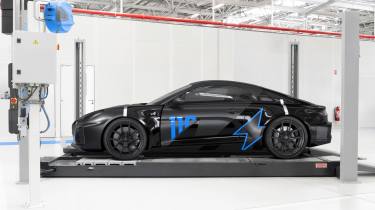
Alpine says the electric A110 will have a 40:60 front/rear weight distribution. It also confirmed that the A110 will be powered by a three-in-one e-axle, which will package dual in-wheel motors with a silicon carbide inverter, a crucial component that manages the motors’ performance delivery and regenerative ability, and is critical for thermal management. Alpine claims the result is “exceptional torque and performance with ultrafast control”.
Is it still going to feel like an Alpine behind the wheel?
In addition, Alpine Active Torque Vectoring will manage power to each rear wheel, altering torque loads left and right every 10 milliseconds to deliver the best blend of performance and traction. Insiders say this results in a car that can compete at the Nurburgring while feeling true to Alpine’s lightweight DNA, experienced from a low-slung seating position behind a vertical steering wheel.
Krief reckons the electric A110 should be good for a range of 600km (373 miles) – customers won’t accept the “easy” trade-off of a small battery compromising usability. And he believes the switch to electric, with its precise tunability and instant response, will make for an agile-feeling sports car.
“If you give the car a sense of the benefit of being electric – quickness in steering and responding, quickness in braking, quickness in recovering from understeer, oversteer – then you have the lightweight feeling. In this, electric has a huge advantage, because in terms of response an electric machine is 10 times faster than a mechanical one.”
“It’s a real sports car, it’s a real A110,” Villain assured us. “There’s even a benefit of being an EV because with the torque vectoring, the instant torque you have, you can reach another dimension, respecting the A110 without having thousands of horsepower. That’s not the purpose, it uses the EV-ness to enhance agility and driving pleasure.”
Will there be a petrol-powered version?
Even though Alpine remains committed to being a pure-electric brand and the A110 potentially being the blueprint or perhaps the benchmark, for all electric sports cars from here on, it unsurprisingly wants to keep its options open, depending on customer demand and changing regulations.
Alpine CEO Philippe Krief has confirmed its EV-dedicated architecture can also accommodate old-fashioned internal-combustion power, and Villain revealed to us that the future A110 was designed from the early stages to fit a petrol engine, if need be. Specifically, the car was made even wider than the chief designer planned.
“That doesn’t mean we will do it, but we are ready for it,” Krief told us. “The most important thing is to offer an excellent product. People don’t buy sports cars because they need them, but because they want them. So we need to create something exceptional; it doesn’t matter if it’s EV or combustion.” He added that the option of an ICE would open up markets outside Europe, such as America perhaps.
Porsche has made similar moves with its new 718 Boxster and Cayman. The financially-troubled brand made a huge song and dance about its entry-level sports car going electric for their next-generation, pumping billions into them and their own bespoke architecture, only to later decide top-spec models such as a new GT4 or Spyder would now feature petrol power. The rest of the line-up will still go without any fossil fuel though.
Alpine’s bold model plan: A110 and beyond
The A110 will be the cornerstone of the Renault Group’s attempt to take Alpine’s track pedigree – racing in Formula 1 and the World Endurance Championship – and turn the brand into a desirable premium car maker at the cutting edge of new technology.
“The Alpine A110 is the foundation of our brand,” said Krief. “Showcasing our commitment to delivering high-technology products, we will offer the first true EV sports car to the market. It will be true to Alpine’s DNA and outperform the best of today’s combustion sports cars, thanks to the Alpine Performance Platform.” More on that later.
Before leaving, De Meo’s vision was to create France’s answer to Porsche. “The A110 is our iconic product, the Porsche 911 of Alpine,” he said. Coincidentally the first A110 coupe – powered by an in-line Renault four-cylinder engine – made its debut in 1963, the same year the 911 was born.
Alpine boss Krief says that APP will underpin the two-seat coupé and the roadster version, plus a 2+2-seater that will be an even more direct rival to the 911. He revealed to Auto Express that the platform is able to accommodate hybrid powertrains as well as an all-wheel drive EV set-up and is leaving options open should Alpine need to respond to market demand in the future.
Beyond that, there is a clear desire within Alpine to follow up on the A110 R Ultime, which is based on the current A110. This high-performance track-focused edition could be the blueprint for future special series versions of the new A110 that would rival Porsche’s GT range.
It’s an ambitious plan, which may eventually add a 1,000bhp hybrid supercar and a bigger SUV on top, if Alpine eventually decides to attack the US market. But why will it work, given that French car makers have typically failed to crack the premium market?
Luca de Meo believed the electric transition is a great leveller. “More or less, we are on a par with the others. Everybody's learning, everybody's investing in battery technology and e-motors,” he said. “It’s not that we have a 100-year gap to close, so maybe it’s an opportunity for us.
“In the first generation, electric cars have been, in the main, appliances like washing machines – kind of ugly and unemotional. Maybe we can prove that electric-car technology can actually be fun, that we can put in a soul. Alpine’s original position was doing more with less, the use of materials, of lightness instead of a big thing with big batteries. That’s the window I see again.”
If you can’t wait for the new, all-electric Alpine A110, check out our Find a Car service. There you’ll be able to find great deals on a new Alpine A110 or top offers on a used Alpine A110 model. Alternatively, we also also have a wide variety of competitive leasing deals.