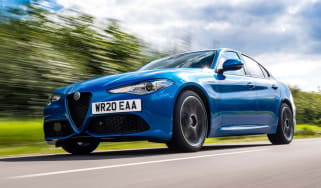
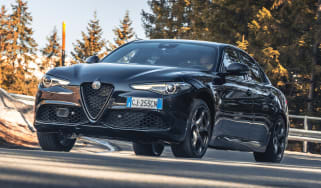
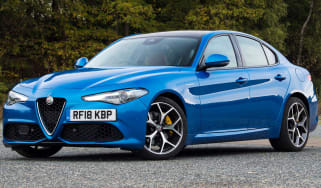
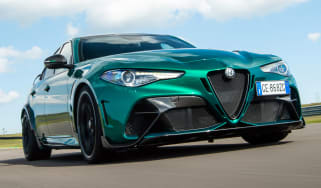
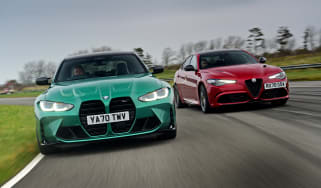
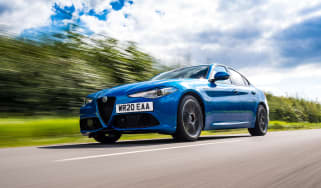
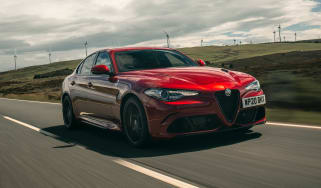
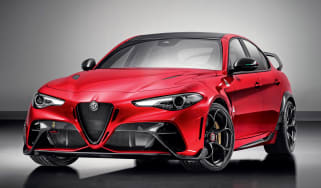
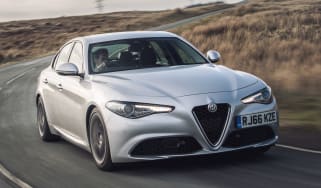
Alfa Romeo Giulia review
The Alfa Romeo Giulia still offers a huge amount of Italian charm, but it is getting on in years
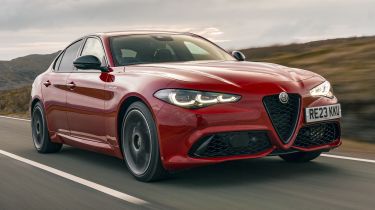

Our opinion on the Alfa Romeo Giulia
The Alfa Romeo Giulia stands proudly as a left-field option in the executive saloon market. While it feels a bit long in the tooth, this car still has its strong points. The hot Quadrifoglio gets tonnes of credit for its performance, but the standard car still provides a healthy amount of shove along with enjoyable handling, and with much more sensible running costs.
The Giulia's 2.0-litre petrol engine is excellent, and while it’s a shame we don’t get a manual option here in the UK, the eight-speed automatic gearbox is still a very good one. Fans of Mercedes and Audi interiors might find the Giulia's cabin isn't quite up to the same standards, but there’s so much to like about this car that you’ll probably be willing to forgive it.
About the Alfa Romeo Giulia
The Alfa Romeo Giulia provided a breath of fresh air when it originally arrived in 2015, as it offered an attractive alternative to the mainstream executive norm. Many years have passed since that time, though, and while this car was supposed to have been replaced by now, it has since been resurrected instead.
A new Giulia is expected to arrive eventually, and we're expecting this to be available with hybrid and electric powertrains. In the meantime, though, the current model is soldiering on as one of the most engaging executive cars to drive. However, while a smattering of updates have been applied to keep this car’s advancing age at bay, the Giulia’s interior and tech are now very much part of the last generation.
Used - available now

2019 Alfa Romeo
Giulia
38,500 milesAutomaticPetrol2.0L
Cash £18,995
2021 Alfa Romeo
Giulia
25,465 milesAutomaticPetrol2.0L
Cash £25,390
2019 Alfa Romeo
Giulia
54,000 milesAutomaticPetrol2.0L
Cash £19,995
2021 Alfa Romeo
Giulia
26,200 milesAutomaticPetrol2.0L
Cash £26,495This review is for the regular Alfa Romeo Giulia, but be sure to check out our dedicated Alfa Romeo Giulia Quadrifoglio review if that’s the model that takes your fancy.
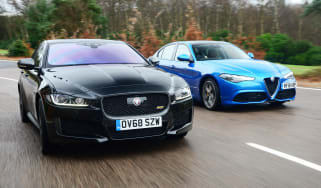
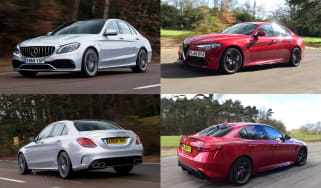
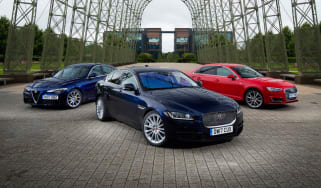
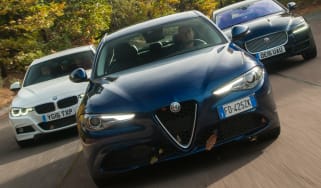
The Giulia has been put through plenty of testing during its long lifetime, including a group test against two executive car stalwarts; the Mercedes C-Class and Jaguar XE. The Giulia wound up in last place here, but the fact that it has since outlived the Jag could perhaps be taken as a sign of the Alfa magic being too charming for buyers to resist.
Alfa Romeo Giulia prices and latest deals
There are three trim levels to choose from with the standard Alfa Romeo Giulia. All three are powered by the same engine. Kicking off the line-up is the Sprint from just under £44,000, while the mid-range Veloce comes in at just under £49,000. The fanciest Intensa commands a little over £53,000.
Don’t forget, you can save serious pennies by building your dream Alfa Romeo Giulia with the Auto Express Buy a Car service. We also have used Giulia models in stock and wearing tempting price tags. You even sell your car with us, too.
Performance & driving experience
Pros |
|
Cons |
|
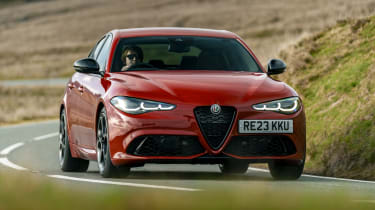
The Giulia nameplate has a rich history with roots stretching back to 1962. Today, this four-door executive saloon makes extensive use of lightweight materials, such as carbon fibre for the driveshaft and aluminium for some chassis parts and the bodywork, including the suspension subframes.
It means Alfa has given the Giulia 50:50 weight distribution, which contributes towards an enjoyable driving experience. Double-wishbone suspension takes care of damping at the front, while a multi-link rear set-up means no corners have been cut to deliver great handling.
The first thing you’ll notice after setting off in the Alfa is the quick steering, which feels great through a series of turns. It’s accurate, too, so you can have confidence placing the car where you want it.
The chassis is also sharp, although at first the Giulia can feel nervous and hyper-alert because its steering is that sensitive, particularly in the Dynamic setting. However, once you get used to the rate of response, you learn to use less lock and the Giulia’s reactions feel more natural.
Alfa Romeo’s DNA selector means you can choose from three driving modes in the standard cars: D for Dynamic, N for Natural and A for Advanced Efficiency. These allow you to alter the steering weight and throttle response, but the car feels at its best in the Natural and Dynamic modes, with the 'A' setting taking a bit too much away from the car's responses. It’s not as involving as a BMW 3 Series, but the Giulia serves up enough engagement to keep keen drivers interested.
An eight-speed automatic gearbox is standard on all UK cars, and it's a reasonable unit, providing fast shifts when required. The large paddles behind the wheel feel satisfying to use, which helps bring back some of the driver engagement lost with the lack of a manual model. However, the gearbox isn’t the smoothest-shifting unit – manual mode can feel quite jerky, and while in auto it slurs shifts better, it still doesn’t have the precision of an Audi’s DSG.
| Model | Power | 0-62mph | Top speed |
| Giulia Sprint | 276bhp | 5.7 seconds | 149mph |
| Giulia Veloce | 276bhp | 5.7 seconds | 149mph |
| Giulia Intensa | 276bhp | 5.7 seconds | 149mph |
Performance, 0-60mph acceleration and top speed
Following the Giulia’s last major facelift in 2023, the Italian saloon comes with a single engine: a 2.0-litre four-cylinder turbocharged petrol lump that produces 276bhp and 400Nm of torque; enough for 0-62mph in 5.7 seconds and a top speed of 149mph. The engine matches the chassis’s keenness to perform and revs freely with a nice rasp.
Town driving, visibility and parking
The Giulia’s desire to be a fine-handling saloon might have you think there are compromises to its low-speed manners, but there’s nothing further from the truth. The Giulia glides over rough surfaces, even on bigger wheels, and does so with a finely-tuned sense of control.
Its main issue concerns the brakes, which can feel a little grabby at low speeds, and hard to modulate at slightly faster ones. You’ll sometimes find yourself coming to an abrupt halt as the top of the pedal feels a little oversensitive, but it is at least consistent. This means that you’ll soon tune into its responses.
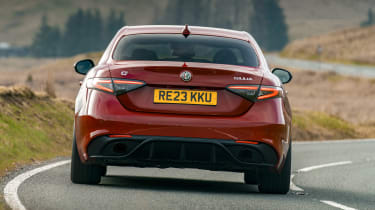
Visibility out is okay, but not brilliant. The long bonnet and relatively high dash mean it can be hard to place initially, and compounded by the extremely fast steering rack, it can take some time to get used to. Vision out the back is also only average, and the tiny parking camera view – and complete absence of any side or front cameras – also make it trickier to park than its rivals. Blame the Alfa’s relative age because a surround-view camera system just wasn’t as prevalent as it is today.
Country road driving and handling
The Giulia really comes into its own here, because there’s one obvious trait that permeates every part of the driving experience. The Giulia was always a light car, even at its launch, but this is especially true against its competition. At just 1,429kg, it’s around 340kg less than an entry-level Audi A5, and if you tick the diesel and quattro boxes in that rival, this bulk increases to 456kg – a huge difference for effectively the same size of car.
This makes the Alfa Romeo feel more agile than all key rivals on a twisty road. This could be accentuated by the relatively light steering, but push on and there’s genuine balance and poise to the Alfa’s driving experience that’s head and shoulders above any contemporary competition. The only downside is the relatively flat and uninspiring four-cylinder petrol engine. It produces the right power numbers, but lacks responsiveness compared to more modern compact executive rivals.
Motorway driving and long-distance comfort
With so little weight on board, shutting the door behind you or driving on coarse motorways makes you soon realise that, along with weight reduction, comes less sound deadening. The Giulia is not as calm, comforting or hushed as its key rivals, and thanks to the fast steering, it can also feel a little twitchy. It’s not a deal-breaker, but most rival compact executive saloons are impressively hushed in the current market; the Alfa’s aged underpinnings and dynamic focus mean it just can’t help to compete in this specific arena.
“The Giulia’s brake-by-wire system gives a firm, consistent pedal at everyday speeds, with Dynamic mode noticeably reducing travel.” - Sam Jenkins, Auto Express contributor.
MPG & running costs
Pros |
|
Cons |
|
Without any mild hybrid, full hybrid, or plug-in hybrid technology, the petrol only range Alfa Romeo Giulia range falls short of its rivals in terms of fuel efficiency an emissions. The sole engine returns 39.2mpg on the WLTP combined cycle, which is shy even of the six-cylinder, four-wheel drive BMW M340i which achieves 40.4mpg on the same cycle.
When we had an Alfa Romeo Giulia Veloce on our long-term test fleet for six months, this car returned a reasonably consistent average of 33mpg. Admittedly, our testing did involve some spirited driving from time to time, but this is more like the sort of figure you can expect in day-to-day driving.
| Model | MPG | CO2 | Insurance group |
| Giulia Sprint | 39.2mpg | 163g/km | 32 |
| Giulia Veloce | 38.2mpg | 167g/km | 34 |
| Giulia Intensa | 38.7mpg | 166g/km | 33 |
Insurance groups
The regular Giulia line-up sits between insurance groups 32 and 34 (out of 50), and this should make it a little cheaper to cover than the more powerful members of the BMW 3 Series family (the M340i sits in group 39).
Tax
A complete lack of electrification means there's no vehicle excise duty (VED) or company car tax relief to be had with any Giulia. What’s worse is that even the base model sits firmly north of the £40,000 combustion luxury car tax threshold, so you’ll need to pay another £440 on top of your annual bill between years two and six after the car is initially registered.
Company car buyers searching for a high-performance, low-tax executive car should look towards fully electric models like the BMW i4 and Tesla Model 3.
The only EV presently offered by the Italian brand is the Alfa Romeo Junior small SUV. An Alfa Romeo Giulia EV is likely to be offered alongside petrol and hybrid versions when the next generation Giulia goes on sale in 2027.
Check your tax status and renewal date in seconds. Check your VED car tax now...
Depreciation
Our market data shows that the standard Alfa Romeo Giulia should retain between 40 and 42 per cent of its original value after three years or 36,000 miles. The Mercedes C-Class is expected to maintain 41 to 47 per cent of its original value over the same period, while the Audi A5 is predicted to be worth 40 to 48 per cent over the same time frame. However, the BMW 3 Series does even better, retaining 44 to 51 per cent.
To get an accurate valuation on a specific model check out our Free Car Valuation tool...
Interior, design & technology
Pros |
|
Cons |
|
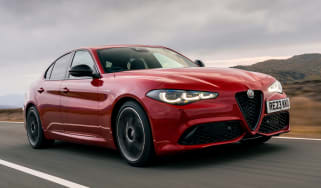
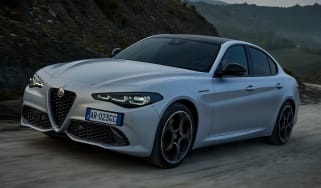
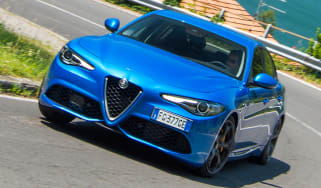
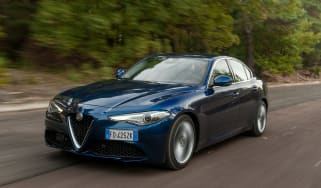
Alfa Romeo bestowed the Giulia with such a head-turning design that it still attracts attention on the road more than a decade later.
However, even though Alfa Romeo performed a series of updates in 2020 and 2023, this car’s on-board tech generally feels dated when compared to younger arrivals in the executive car market.
Interior and dashboard design
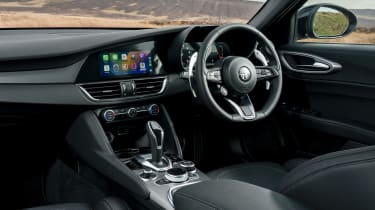
Little has changed to the design of the Giulia’s interior since it launched. The entire dashboard is angled towards the driver (a clear sign that this model is aimed at being a driver’s car), and another standout feature are the two whopping great aluminium paddles behind the steering wheel to shift gears with.
Heralding from a pre-touchscreen era does bring one or two benefits. The climate controls are accessible via three physical knobs, while other key functions like the drive modes and start-stop button are easy to use and reach.
Materials and build quality
The fundamental quality of Alfa Romeo interiors isn’t quite at the levels of a modern BMW, but with Audi and Mercedes having taken a few steps back on fit and finish in recent years, the Giulia doesn’t hold up badly. Low-grade models with cloth seats and the plastic dash can feel a little cheap, but when fitted with the optional leather packages (standard on Intensa trim) – which cover the seats, dash and doors – the feel is very different.
Infotainment, sat-nav and stereo
The Giulia’s dash layout confines the main infotainment screen to a relatively small opening, meaning aside from a few interface improvements made back in 2023, it’s still the same system accessible through touch or a clickwheel. The screen is also pretty low-resolution, and even if you’re not into big screens, it feels a little tricky to use in our era of bright touchscreen interfaces.
A modern amendment that was made as part of the facelift was the introduction of a 12.3 inch digital driver’s display. By comparison to the weedy main infotainment screen, this is a very high quality unit that’s customisable and really well designed. It fits perfectly into the traditional Alfa Romeo ‘porthole’ cowling, and you can choose between various designs, including one inspired by Alfa’s classic models from the 1960s.
“Even though the Giulia shines in the driving department, the interior trails a little. I should add that nothing has fallen off, but in places the quality is a bit disappointing and during the heatwave of the summer, the Alfa’s climate control either blew out icy cold or sauna hot air; there was no middle ground.” - James Batchelor, Auto Express contributor.
Boot space & practicality
Pros |
|
Cons |
|
The Giulia only comes as a four-door saloon, so those after a more versatile car with a hatchback tailgate might be better served by the Audi A5 or looking towards one of the Italia brand’s SUVs, such as the Alfa Romeo Stelvio.
Dimensions and size
The Giulia is shorter than the BMW 3 Series, but it is wider and lower, giving it a slightly sportier stance.
| Dimensions comparison | |||
| Model | Alfa Romeo Giulia | BMW 3 Series | Mercedes C-Class |
| Length | 4,650mm | 4,714mm | 4,793mm |
| Width | 1,960mm | 1,827mm | 1,820mm |
| Height | 1,436mm | 1,446mm | 1,446mm |
| Wheelbase | 2,820mm | 2,850mm | 2,865mm |
| Boot space | 480 litres | 480 litres | 455 litres |
Seats & passenger space
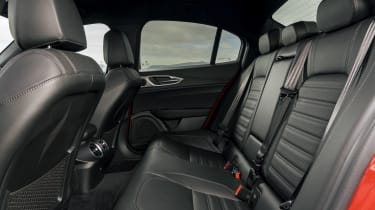
There’s plenty of space up front in the Giulia, and rear passengers won’t have too much to complain about, either, because this car actually has one of the longer wheelbases in its class, resulting in a good amount of legroom in the back.
However, the Giulia's large transmission tunnel means anyone in the middle seat will feel a bit cramped unless they’re particularly tiny, so it might be better to think of this as a four-seater rather than five.
Boot space
It’s clear that Alfa's designers benchmarked the 3 Series when developing the Giulia, because it has a similar 480-litre boot capacity. However, the opening is smaller with the Giulia, and there’s a high load lip to overcome in the Alfa. It’s good to see that you get a more flexible 40/20/40 split folding rear seat in the Giulia should you need to load longer items.
Hidden storage space in the cabin is good, with a decent-sized cubby between the front seats and a large glovebox. However, the Giulia has to give best to the 3 Series when it comes to storage elsewhere, as the Alfa's door bins are smaller and there’s nowhere to store a smartphone on the centre console.
Reliability & safety
Pros |
|
Cons |
|
All Giulia models include a lane departure warning, a blind spot monitoring system and autonomous emergency braking as standard, while the Driver Assistance Pack Plus adds active blind spot, Lane-keeping assist, traffic sign recognition (TSR), drowsy driver detection, intelligent speed control, traffic jam assist and a highway assist system (HAS).
The Giulia scored well for safety when Euro NCAP crash-tested the car, with a maximum five-star rating. However, the test has become much tougher since then, and so the Guilia’s 2016 result has since expired.
The Giulia and the Alfa Romeo brand haven’t appeared in our Driver Power customer satisfaction survey for a few years now, so we don’t have any current information about what it’s like to live with on a daily basis. It is encouraging to see that Alfa Romeo matches BMW’s more generous three year or unlimited mileage manufacturer’s warranty package, rather than the more stingy three year or 60,000 mile policies of Audi and Mercedes.
Buying and owning
- Best buy: Alfa Romeo Giulia Sprint
The Giulia isn’t a cheap car, but the £5,000 price gulf between the Sprint and Veloce models is a big one. You’ll still get all of the performance in the entry-level spec, along with a pretty good amount of standard kit. It doesn’t come with the limited slip rear differential of the Veloce trim, but you’re unlikely to really miss that while driving on the public roads.
Alfa Romeo Giulia alternatives
Numerous rivals to the Alfa Romeo Giulia have been axed during its lifetime, but its traditional BMW 3 Series and Mercedes C-Class rivals are as competitive as ever, with the former focusing on driving dynamics, just like the Alfa. There’s also the Audi A5 to consider, which features a more handy hatchback style boot opening, making it a little more versatile.
The growing electric car market has seen the arrival of some tempting alternatives, too, such as the BMW i4 and Tesla Model 3. These cars still provide plenty of performance, but with the added bonus of far more forgiving BiK running costs for company car drivers.
Frequently Asked Questions
The Alfa Romeo range comes with a three-year/unlimited mileage warranty, which equals BMW and beats the factory warranty Audi and Mercedes provide which have a 60,000-mile limit. Alfa also offers extended warranties that run in conjunction with any finance deal you might take out. The standard warranty also includes roadside assistance for the same period, while paintwork is covered for the same amount of time and any perforation of the bodywork is protected for eight years.
Deals on the Giulia and alternatives