Suzuki Swift review
The Suzuki Swift offers plenty of value and efficiency in a dwindling area of the market

Our opinion on the Suzuki Swift
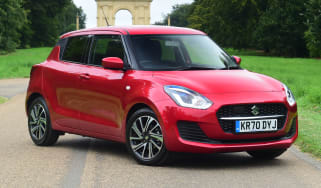
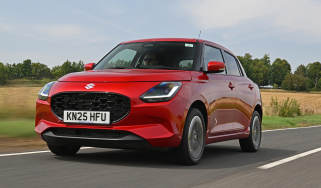
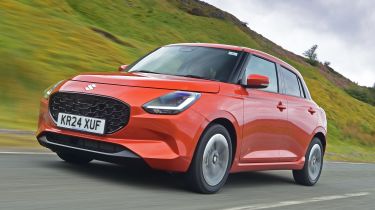
The Suzuki Swift continues to champion the case for traditional combustion-powered superminis, even though this sector has shrunk in recent years. It feels built to a price in a way the MG3 doesn’t, but the trade-off is a lightweight construction that provides agile handling and rock-bottom fuel costs. The Swift won’t suit everyone, but if you’re not yet ready to go electric, this car provides an affordable, familiar and honest entry into the small-car market.
About the Suzuki Swift
There’s an expectation from Suzuki that the Swift should appeal in a thinning market thanks to its long specification list, respectable efficiency from its mild-hybrid engine, a choice of manual or automatic gearboxes and even a four-wheel drive powertrain option.
It’s a car built with budget firmly in mind, but pricing for the Swift actually starts at around £2,500 more than the petrol-powered MG3.
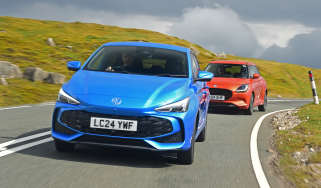
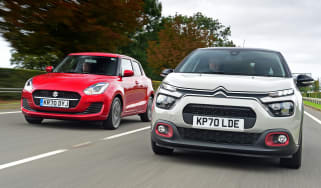
Due to the petrol supermini sector’s shrinking size, the Swift’s remaining competitors are fighting even harder for their place in the market. To see if the little Suzuki is a winner, we’ve tested it against the MG3 in a twin test. The latter car took the win, though, due to its outstanding performance, handling and refinement.
Performance & driving experience
Pros |
|
Cons |
|
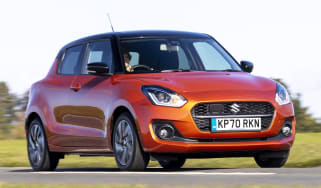
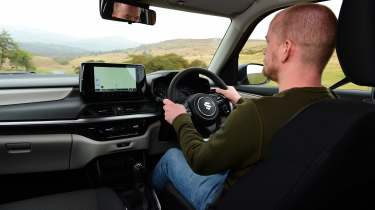
The Swift features some very trick construction that means it’s just about the lightest car in the supermini class, with even the 4x4 AllGrip model weighing less than 1,100kg. The front-wheel drive models are even lighter under 1,000kg. The relative lack of mass means the Swift feels pretty agile, and is happy to change direction quickly while staying admirably flat in corners.
Used - available now

2019 Suzuki
Swift
24,820 milesManualPetrol1.2L
Cash £9,999
2021 Suzuki
Swift
24,432 milesManualPetrol1.2L
Cash £10,699
2024 Suzuki
Swift
16,154 milesAutomaticPetrol1.2L
Cash £14,914
2024 Suzuki
Swift
13,290 milesManualPetrol1.2L
Cash £13,560However, despite the Swift’s light kerbweight, carefully timed gear changes are still required in order to get the most out of this engine. Those who stick with the standard five-speed manual gearbox will get an arm and leg workout in hilly areas and while driving around town. Mercifully, the gearbox and clutch are forgiving to use, if a bit vague.
The rest of the basics feel pleasant enough, too. The steering doesn’t provide hot-hatch level feedback on what the front wheels are doing, but it’s nicely weighted and consistent, making it relatively easy to place the Swift in corners.
Unique to the class is the AllGrip all-wheel drive system available on Ultra models, which offers extra traction and security. It’s just about rugged enough to take on some lighter off-roading duties, such as tackling snowy conditions or a muddy track. However, the demand for this in the UK is pretty limited, so we can’t really see the point of forking out extra for this over the front-wheel drive car.
It’s also worth noting that AllGrip models are only available with a manual gearbox. If you prefer an automatic, you’ll need to go for a front-wheel drive Swift. These cars come with the option of a CVT transmission, but this will cost you over £1,200 more than the manual.
| Model | Power | 0-62mph | Top speed |
| Suzuki Swift 1.2 Mild Hybrid Motion | 81bhp | 12.5 seconds | 103mph |
| Suzuki Swift 1.2 Mild Hybrid Motion CVT | 81bhp | 11.9 seconds | 106mph |
| Suzuki Swift 1.2 Mild Hybrid Ultra Allgrip | 81bhp | 13.6 seconds | 99mph |
Performance, 0-60mph acceleration and top speed
The 1.2 Dualjet petrol unit produces 81bhp and 112Nm of torque. So, to put it bluntly, it isn’t exactly a powerhouse. Opting for four-wheel drive results in the slowest 0-62mph time of the line-up at a very lethargic 13.6 seconds and a top speed of 99mph. The manual front-wheel-drive car trims this time ever so slightly to 12.5 seconds and increases the top speed to 103mph. Perhaps surprisingly, the quickest Swifts are those fitted with the CVT gearbox. These are capable of the same sprint in 11.9 seconds and 106mph flat out.
Mild-hybrid technology features on the 1.2-litre engine, utilising power from a lithium-ion battery that harnesses regenerative braking energy to power a small integrated generator. This, in turn, helps the petrol engine when you’re accelerating, but the goal is efficiency rather than performance, so it never feels like an extra surge of pace. It’s impressively well integrated, but the Swift still very much feels like a modestly-powered combustion car to drive.
The past three generations of Swift had a performance-oriented Swift Sport variant, but that has been axed for the current model. This means hot hatchback fans will now have to look elsewhere (or at least at older used Swift Sports) for thrills.
Town driving, visibility and parking
The Swift’s small stature, light controls and decent all-around visibility make it a breeze to zip around town in. A rear-view camera is included as standard, which helps with parking, but you shouldn’t find yourself too dependent on it (which may be a good job because it’s a bit low-resolution by today’s standards).
Country road driving and handling
It’s on the B-roads where the Suzuki’s light kerb weight comes into its own. While it takes a little while to get up to speed on straight sections, corners can be tackled at higher speeds than this docile supermini’s appearance suggests.
Suzuki’s engineers reportedly spent time developing the Swift on UK roads, but it hasn’t quite paid off. For the most part, it stays composed, but over broken surfaces – precisely the sort of bumps and potholes that are common on British B-roads, in fact – it gets a bit unsettled. In particular, passengers in the rear are likely to complain about being bounced around, a result of the car’s relatively simple torsion-beam rear suspension set-up and low weight.
Motorway driving and long-distance comfort
Due to its small size, the 1.2-litre engine requires a fair amount of stoking to reach and maintain motorway speeds. There’s an amusing growl when you put your foot down, but this is soon drowned out at higher speeds due to tyre roar. Unless you have a high level of tolerance for ambient noise, we doubt you’ll want to frequently tackle long trips in this particular car.
“The hybrid system doesn’t get too involved with accelerative duties, and its regenerative braking isn’t that intrusive, but a little more engine-off running would be nice.” - Jordan Katsianis, news editor.
MPG & running costs
Pros |
|
Cons |
|
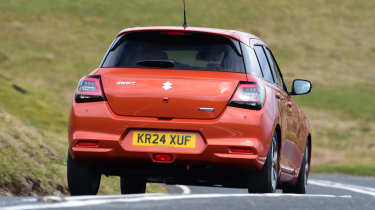
A combination of a low kerbweight and an effective mild-hybrid powertrain means the Suzuki Swift has a low thirst for fuel. Officially, the least economical model (the AllGrip Ultra) will return 57.6mpg on the WLTP combined cycle, which is still rather impressive. In fact, when we tested this model we saw a steady average of 60mpg, though our route consisted of A- and B-roads, so it’s reasonable to expect a slight drop at motorway speeds. Either way, fill-ups shouldn’t be a common occurrence.
The best performer on paper is the front-wheel drive Swift with the manual gearbox, because this returns a claimed 64.2mpg. Fitting the CVT automatic slightly reduces this figure to 60.1mpg.
The mild-hybrid technology also helps to keep CO2 figures under control, with the entire lineup ranging from 99 to 110g/km.
| Model | MPG | CO2 | Insurance group |
| Suzuki Swift 1.2 Mild Hybrid Motion | 64.2mpg | 99g/km | 21 |
| Suzuki Swift 1.2 Mild Hybrid Motion CVT | 60.1mpg | 106g/km | 22 |
| Suzuki Swift 1.2 Mild Hybrid Ultra Allgrip | 57.6mpg | 110g/km | 20 |
Insurance groups
Insurance group ratings for the Suzuki Swift are surprisingly high, with the line-up sitting in groups 20 to 22 out of 50. This isn’t quite as high as the hybrid-powered MG3, which resides in groups 23 to 24, but the petrol model dips as low as group 16. However, the pricier Skoda Fabia goes as low as group 4, so this could be a far more appealing option for new drivers.
An explanation for the Suzuki’s high ratings could be the relatively small number of the brand’s dealers and repairers in the UK, as well as the hassle of sourcing parts for the Swift from Japan if you have an accident.
Tax
The Suzuki Swift is liable for the standard rate of VED road tax, but luxury car tax won’t be an issue even if you go for the highest trim level. Company car buyers won’t receive any Benefit-in Kind (BiK) breaks here, because they’ll need a fully electric car in order to reap the savings of the lowest BiK rates.
Electric supermini options include the BYD Dolphin, Fiat Grande Panda, Nissan Micra and Renault 5, but those who want to keep the purchase price down may wish to consider a city car like the Dacia Spring, Honda Super-N or Leapmotor T03.
Depreciation
The Suzuki Swift manages to put up a decent fight against depreciation, according to our Market data. After a period of three years or 36,000 miles, this supermini retains 49 to 51 per cent of its original value. It’s here where the Swift manages to beat back the MG3, as that only manages 43 to 45 per cent.
To get an accurate valuation on a specific model check out our free car valuation tool...
Interior, design & technology
Pros |
|
Cons |
|
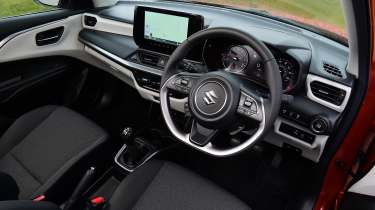
If there’s one area of the Swift that highlights Suzuki’s cost-cutting, it’s the interior. While it’s reasonably bright inside, the cabin is a plethora of low-rent materials. It’s not horrific to behold, but there are very few surfaces that aren’t hollow and scratchy to the touch.
Our long-term test car revealed some build-quality concerns, too, as some interior trim worked its way loose after only putting 1,000 miles on the odometer.
In an attempt to counteract this less-than-luxurious atmosphere, Suzuki has adorned the Swift with a pretty lavish helping of standard equipment. All trim levels get adaptive cruise control, a reversing camera, wireless Apple CarPlay and Android Auto, keyless entry and start and all-round electric windows.
Those who are willing to spend a bit more on the range-topping Ultra trim will also get 16-inch alloy wheels, automatic air-con, adjustable front seatbelts, electronically folding door mirrors and some interior design tweaks.
Interior and dashboard design
The interior design is pretty straightforward, and all of the controls are in sensible-enough positions. One upside of the Swift’s slightly dated design is physical climate control switches, which are far more ergonomic and easy to use than frustrating touchscreen sub-menus or haptics.
Another area that makes the Swift feel a bit long in the tooth is the dashboard. Analogue dials feature here rather than a digital driver’s display, although there is a small information screen in between the two. While it could never be called fancy, it all does the job and is clear enough to read.
Materials and build quality
As we’ve mentioned, our long-term test car managed to shake its centre console loose after only 1,000 miles of driving. Elsewhere, the interior plastics don’t instil too much confidence either, as many look and feel rather brittle.
While it’s certainly unfair to expect champagne luxury for this lemonade price, other cheap cars, such as the Dacia Sandero, do feel more solidly screwed together than the latest Swift.
Infotainment, sat-nav and stereo
All Swifts are fitted with a nine-inch touchscreen infotainment system, and this features wireless Apple CarPlay and Android Auto. You’ll probably want to use these smartphone mirroring systems, too, because the brand’s own software feels dated.
While the screen is big enough to display a decent amount of information without cramming it in, the system is slow to respond to input. The graphics are far from cutting-edge, either, and navigating the menus and functions isn’t a very easy task without some practice and patience.
“I’ve been making use of the standard-fit Apple CarPlay to avoid using Suzuki’s own infotainment software because it feels antiquated. The system can be lethargic in responding to inputs and lacks contrast.” - Tom Jervis, consumer reporter.
Boot space & practicality
Pros |
|
Cons |
|
Many superminis are used as two-seaters, in effect, with the rear cabin often being used as a dumping ground for shopping rather than as a space for passengers. If this is your pattern of use, the Swift shouldn’t disappoint.
Dimensions and size
The latest Swift sits on the same underpinnings as the previous model, and it has only gained a minimal 20mm in length.
As a result, the Swift still has truly compact dimensions compared to some of its rivals. To give you an idea, Suzuki’s supermini is over 200mm shorter in length than the Skoda Fabia.
| Dimensions comparison | |||
| Model | Suzuki Swift | MG3 | Renault Clio |
| Length | 3,860mm | 4,113mm | 4,053mm |
| Width | 1,735mm | 1,797mm | 1,798mm |
| Height | 1,520mm | 1,502mm | 1,440mm |
| Wheelbase | 2,450mm | 2,570mm | 2,583mm |
| Boot space | 265 litres | 293 litres |
391 litres (petrol) 301 litres (hybrid) |
Seats & passenger space
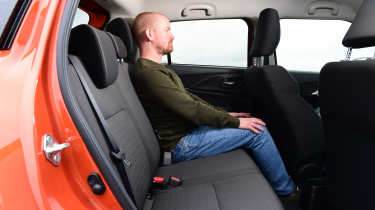
The Swift’s diminutive size naturally means there are some restrictions in terms of head and legroom, but two adult passengers should still be able to sit in reasonable comfort. The driving position is also pretty standard, provided you aren’t accustomed to a sportier, low-slung stance.
Four adults will be able to fit, but taller passengers will become a bit fidgety in the back, especially during a longer journey. Head and legroom are pretty good, but the seat bases provide minimal thigh support, and there isn’t much room under the seats in front to slot your feet under.
Boot space
The Swift’s boot is 265 litres in volume, but this lags well behind rivals like the MG3, which has 293 litres, while the Skoda Fabia offers a whopping 380 litres of space.
Folding the 60/40 rear seats opens up 589 litres for the occasional big tip run, but it’s still not about to double up as a small van.
“As soon as you lift the tailgate, you’ll notice that the boot floor is very low in relation to the bumper height, which isn't ideal if you're trying to get something heavy out of the luggage area.” - Shane Wilkinson, senior content editor.
Reliability & safety
Pros |
|
Cons |
|
While Suzuki does throw in the likes of blind-spot monitoring, traffic sign recognition, parking sensors and a driver-monitoring system as standard, the Swift only managed a rather poor three-star rating when it was tested by Euro NCAP in 2024. For comparison, similarly priced small electric car rivals like the Hyundai Inster and Renault 5 both got more respectable 4-star scores when tested under the same criteria.
The Suzuki Swift didn’t appear in the latest Driver Power owner satisfaction survey, but the Suzuki brand only managed 15th place out of 30 in the best manufacturer results. Drivers were pleased with their cars’ fuel economy and driving experience, but a lack of boot space and cheap-feeling cabins were two causes of dismay.
| Euro NCAP safety ratings | |
| Euro NCAP safety rating | Three stars (2024) |
| Adult occupant protection | 67% |
| Child occupant protection | 65% |
| Vulnerable road user protection | 76% |
| Safety assist | 62% |
Buying, prices and deals
Best buy: Suzuki Swift Hybrid Motion
In its entry-level Motion trim with a manual gearbox, the Suzuki Swift starts from a very reasonable £20,000. This version comes with enough equipment for most needs so it’s really not worth forking out another £1,100 for the Ultra. Opting for the automatic CVT gearbox also drives the price up, so we wouldn’t choose this unless you really need it.
We also see little point in paying out for the AllGrip four-wheel drive system unless you find yourself in a situation where you often need to drive in snowy or slippery conditions. For the vast majority of people, the front-wheel drive car will suffice.
You can save on the list price by building your new Suzuki Swift with the Auto Express Buy A Car service. We also have a range of Swift lease deals and used Swift models to choose from. You can also sell your car with us.
Suzuki Swift alternatives
Unfortunately, the Swift is too noisy inside to be a very good road trip car, so anyone looking for a premium-feeling small car will have to head towards a Skoda Fabia or Volkswagen Polo.
The Renault Clio remains one of our favourite superminis, and does everything you could ask of a small car, yet has lower insurance costs than the Swift, and, in some trims, actually costs less than a Swift.
Company car drivers looking for the lowest tax bill should gravitate towards electric alternatives like the Fiat Grande Panda, Honda Super-N, Hyundai Inster, Nissan Micra or Renault 5.
Suzuki Swift pictures
Suzuki Swift Hybrid Motion long-term test
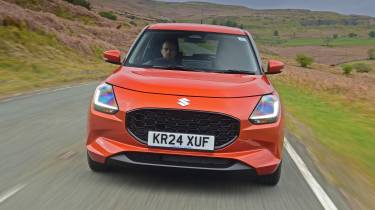
Our consumer reporter, Tom Jervis, ran an entry-level Suzuki Swift Motion as part of an Auto Express long-term test, and found the little supermini to be very frugal on fuel. He never saw less than 40mpg, and averaged nearer to 60mpg overall, which he worked out would save him a tidy sum over a year compared with the MG3 hybrid that was also being run at the time by our News reporter, Ellis Hyde.
However, not all was rosy with Tom's experience, because some interior trim came loose after only 1,000 miles, and he found out the car's high insurance group rating would translate into higher running costs compared with rivals. The latter would be problematic because a driver managed to damage our lovely Swift while parked in a car park and didn't leave Tom a note... You can read the full long-term test here…
Key updates of the Suzuki Swift review
21 September 2026: Latest pricing and depreciation data.
Frequently Asked Questions
The standard warranty is three years or 60,000 miles, but this can be extended up to ten years or 100,000 miles through routine servicing at a Suzuki dealership.
Deals on the Swift and alternatives